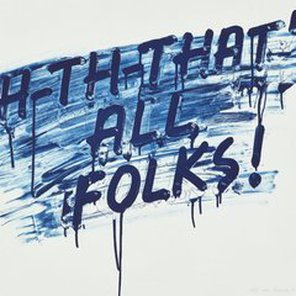
Mel Bochner spent 60 years treating language itself as a material. He painted single words in rainbow colour until viewers stopped reading and started looking.
A pioneer of American conceptual art in 1960s New York, Bochner organised what's often called the first conceptual art exhibition in 1966. He became best known for his Thesaurus paintings, which stack a loaded word alongside its cascading synonyms in thick, dripping paint.
Working across painting, prints, photography and drawing, Bochner treated humour as a serious tool. He used a word as ordinary as ‘blah’ to needle at how much meaning people project onto language that carries none.
He died in February 2025, having continued to paint and exhibit into his 80s.
A pioneer of American conceptual art in 1960s New York, Bochner organised what's often called the first conceptual art exhibition in 1966. He became best known for his Thesaurus paintings, which stack a loaded word alongside its cascading synonyms in thick, dripping paint.
Working across painting, prints, photography and drawing, Bochner treated humour as a serious tool. He used a word as ordinary as ‘blah’ to needle at how much meaning people project onto language that carries none.
He died in February 2025, having continued to paint and exhibit into his 80s.
Summary
Mel Bochner spent 60 years treating language itself as a material. He painted single words in rainbow colour until viewers stopped reading and started looking.
A pioneer of American conceptual art in 1960s New York, Bochner organised what's often called the first conceptual art exhibition in 1966. He became best known for his Thesaurus paintings, which stack a loaded word alongside its cascading synonyms in thick, dripping paint.
Working across painting, prints, photography and drawing, Bochner treated humour as a serious tool. He used a word as ordinary as ‘blah’ to needle at how much meaning people project onto language that carries none.
He died in February 2025, having continued to paint and exhibit into his 80s.
A pioneer of American conceptual art in 1960s New York, Bochner organised what's often called the first conceptual art exhibition in 1966. He became best known for his Thesaurus paintings, which stack a loaded word alongside its cascading synonyms in thick, dripping paint.
Working across painting, prints, photography and drawing, Bochner treated humour as a serious tool. He used a word as ordinary as ‘blah’ to needle at how much meaning people project onto language that carries none.
He died in February 2025, having continued to paint and exhibit into his 80s.
Artworks by Mel Bochner
About Mel Bochner
Biography
About Mel Bochner
Mel Bochner was born in 1940 in Pennsylvania, into an Orthodox Jewish family. His father was a sign painter and Bochner occasionally worked for him as a boy. He earned a degree from the Carnegie Institute of Technology in 1962. In 1964, he moved to New York, where he worked as a guard at the Jewish Museum while immersing himself in the city's shifting art scene.
Language before painting
In 1966, while teaching at the School of Visual Arts, Bochner organised an exhibition called Working Drawings and Other Visible Things on Paper Not Necessarily Meant to Be Viewed as Art. It's now widely considered one of the first conceptual art exhibitions. The show brought together drawings by artists including Eva Hesse, Donald Judd and Sol LeWitt, none of which were intended as finished artworks.
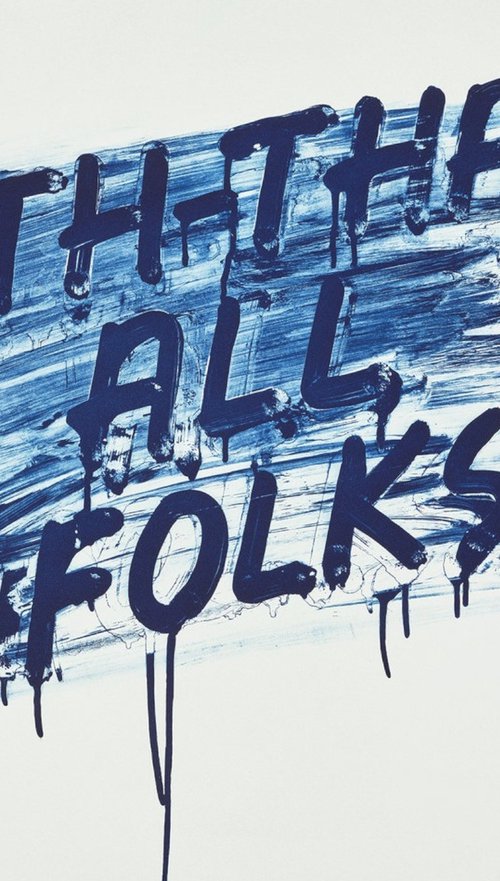
Bochner spent the next 10 years working with measurement, photography and installation. In the 1970s he turned to the painted text that would define the rest of his career. He built outward from an early series of word portraits of fellow artists into his best known Thesaurus paintings. These arrange a chosen word alongside a cascade of its synonyms in dripping, saturated colour.
Prints and Blah, Blah, Blah
Printmaking ran alongside Bochner's paintings for many years. He worked chiefly with the New York publisher Two Palms, producing richly worked monoprints that combined oil paint, collage, engraving and embossment on handmade paper.
His 2008 painting, Blah, Blah, Blah became one of his most recognised images, later reworked across numerous prints and screenprints. It was a single repeated phrase he described as both a form of agreement and an admission that language can be entirely empty.
Bochner taught at Yale University from 1979 onward, and was the subject of major exhibitions at the Jewish Museum, New York, the Whitechapel Gallery, London and the Art Institute of Chicago. He died in 2025 at the age of 84.
Biography
About Mel Bochner
Mel Bochner was born in 1940 in Pennsylvania, into an Orthodox Jewish family. His father was a sign painter and Bochner occasionally worked for him as a boy. He earned a degree from the Carnegie Institute of Technology in 1962. In 1964, he moved to New York, where he worked as a guard at the Jewish Museum while immersing himself in the city's shifting art scene.
Language before painting
In 1966, while teaching at the School of Visual Arts, Bochner organised an exhibition called Working Drawings and Other Visible Things on Paper Not Necessarily Meant to Be Viewed as Art. It's now widely considered one of the first conceptual art exhibitions. The show brought together drawings by artists including Eva Hesse, Donald Judd and Sol LeWitt, none of which were intended as finished artworks.
Bochner spent the next 10 years working with measurement, photography and installation. In the 1970s he turned to the painted text that would define the rest of his career. He built outward from an early series of word portraits of fellow artists into his best known Thesaurus paintings. These arrange a chosen word alongside a cascade of its synonyms in dripping, saturated colour.
Prints and Blah, Blah, Blah
Printmaking ran alongside Bochner's paintings for many years. He worked chiefly with the New York publisher Two Palms, producing richly worked monoprints that combined oil paint, collage, engraving and embossment on handmade paper.
His 2008 painting, Blah, Blah, Blah became one of his most recognised images, later reworked across numerous prints and screenprints. It was a single repeated phrase he described as both a form of agreement and an admission that language can be entirely empty.
Bochner taught at Yale University from 1979 onward, and was the subject of major exhibitions at the Jewish Museum, New York, the Whitechapel Gallery, London and the Art Institute of Chicago. He died in 2025 at the age of 84.