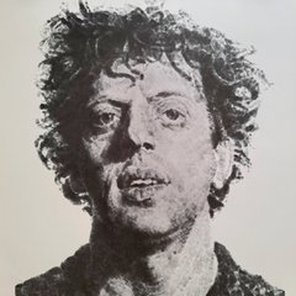
Chuck Close spent 50 years taking the human face apart and putting it back together again.
Working initially in stark black-and-white photorealism and later in vividly coloured, almost pixelated grids, he painted a wide cast of subjects, cell by cell, from a photographic source.
In 1988, a spinal artery collapse left Close almost completely paralysed from the neck down. With a brush strapped to his wrist, he adapted his method and kept working for the following 30 years. Printmaking, which he took up almost by accident in 1972, became just as central to his practice as painting, and he is remembered as one of the most technically ambitious printmakers of his generation.
Working initially in stark black-and-white photorealism and later in vividly coloured, almost pixelated grids, he painted a wide cast of subjects, cell by cell, from a photographic source.
In 1988, a spinal artery collapse left Close almost completely paralysed from the neck down. With a brush strapped to his wrist, he adapted his method and kept working for the following 30 years. Printmaking, which he took up almost by accident in 1972, became just as central to his practice as painting, and he is remembered as one of the most technically ambitious printmakers of his generation.
Summary
Chuck Close spent 50 years taking the human face apart and putting it back together again.
Working initially in stark black-and-white photorealism and later in vividly coloured, almost pixelated grids, he painted a wide cast of subjects, cell by cell, from a photographic source.
In 1988, a spinal artery collapse left Close almost completely paralysed from the neck down. With a brush strapped to his wrist, he adapted his method and kept working for the following 30 years. Printmaking, which he took up almost by accident in 1972, became just as central to his practice as painting, and he is remembered as one of the most technically ambitious printmakers of his generation.
Working initially in stark black-and-white photorealism and later in vividly coloured, almost pixelated grids, he painted a wide cast of subjects, cell by cell, from a photographic source.
In 1988, a spinal artery collapse left Close almost completely paralysed from the neck down. With a brush strapped to his wrist, he adapted his method and kept working for the following 30 years. Printmaking, which he took up almost by accident in 1972, became just as central to his practice as painting, and he is remembered as one of the most technically ambitious printmakers of his generation.
Artworks by Chuck Close
About Chuck Close
Biography
About Chuck Close
Chuck Close was born in 1940 and grew up drawing despite a diagnosis of dyslexia, later crediting art with helping him make sense of a world that was often difficult to navigate at school.
Close earned a BA from the University of Washington in 1962 and an MFA from Yale University in 1964. He worked as an art teacher before his breakthrough with Big Self-Portrait, a vast black-and-white close-up of his own face that the Walker Art Center bought for just $1,300.
The grid and the mezzotint
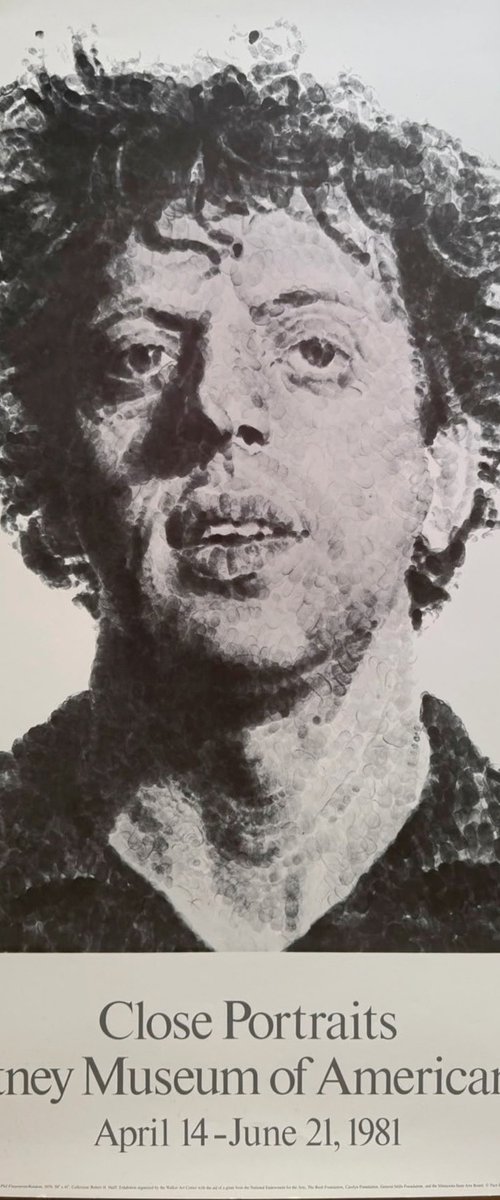
Close’s method involved overlaying a grid onto a source photograph, then transferring a proportional grid onto canvas and working through it cell by cell. In 1972, the print publisher Parasol Press invited him to make a series of prints in any technique he chose; Close picked the mezzotint, a printmaking technique developed in the 17th century. The print revealed the underlying grid far more starkly than his paintings did, leading him to keep exploring printmaking through pulp paper, fingerprinting and other unconventional processes. Some of his prints took up to two years to complete, in close collaboration with master printers.
Paralysis and later work
In 1988, an occlusion of a spinal artery left Close almost completely paralysed. He adapted, using a brush strapped to his wrist and forearm, and his work changed with it. The tight, photographic grids of his earlier portraits gave way to looser, more painterly cells of colour that only resolve into a face from a distance, echoing the Pointillism of Georges Seurat.
His subjects, drawn mostly from his own circle of family, friends and fellow artists including Alex Katz, Cindy Sherman and Kara Walker, later expanded into public commissions, including a series of mosaic portraits for the 86th Street subway station in New York.
Close died in 2021, having continued to paint, print and exhibit for more than 30 years after his paralysis.
Biography
About Chuck Close
Chuck Close was born in 1940 and grew up drawing despite a diagnosis of dyslexia, later crediting art with helping him make sense of a world that was often difficult to navigate at school.
Close earned a BA from the University of Washington in 1962 and an MFA from Yale University in 1964. He worked as an art teacher before his breakthrough with Big Self-Portrait, a vast black-and-white close-up of his own face that the Walker Art Center bought for just $1,300.
The grid and the mezzotint
Close’s method involved overlaying a grid onto a source photograph, then transferring a proportional grid onto canvas and working through it cell by cell. In 1972, the print publisher Parasol Press invited him to make a series of prints in any technique he chose; Close picked the mezzotint, a printmaking technique developed in the 17th century. The print revealed the underlying grid far more starkly than his paintings did, leading him to keep exploring printmaking through pulp paper, fingerprinting and other unconventional processes. Some of his prints took up to two years to complete, in close collaboration with master printers.
Paralysis and later work
In 1988, an occlusion of a spinal artery left Close almost completely paralysed. He adapted, using a brush strapped to his wrist and forearm, and his work changed with it. The tight, photographic grids of his earlier portraits gave way to looser, more painterly cells of colour that only resolve into a face from a distance, echoing the Pointillism of Georges Seurat.
His subjects, drawn mostly from his own circle of family, friends and fellow artists including Alex Katz, Cindy Sherman and Kara Walker, later expanded into public commissions, including a series of mosaic portraits for the 86th Street subway station in New York.
Close died in 2021, having continued to paint, print and exhibit for more than 30 years after his paralysis.