- Marco Savio
- All Artworks
- QVICQVID
Original artwork description
QUICQUID is a Latin term found in many medieval churches; it literally means "whatever" or "anything."
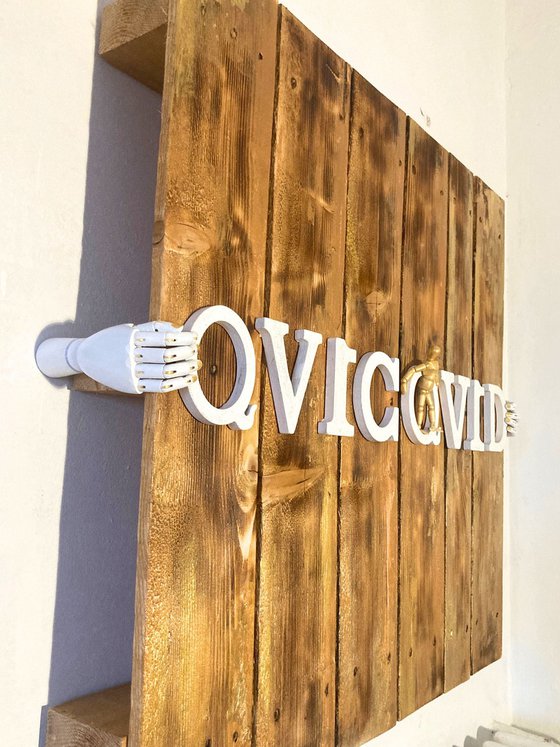
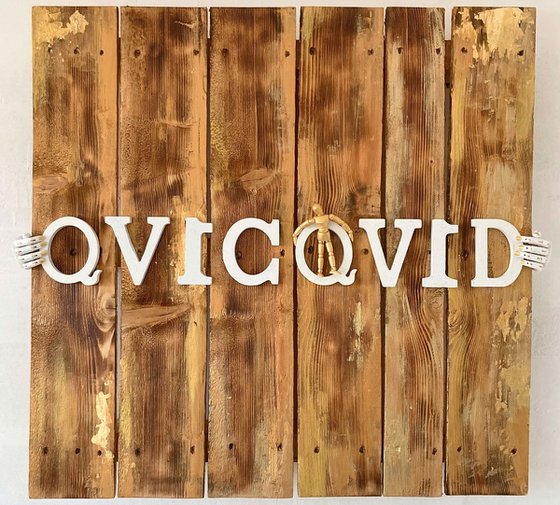
In a stark, pure white, it stands out against a wooden pallet charred using the Yakisugi technique—an ancient Japanese method of carbonizing the surface of wood to protect it and ensure its longevity. The connection is clear: a pallet is designed precisely to transport "anything" across the globe. Yet, the figure emerging from the letter "Q"—along with two small hands reaching out to hold onto the inscription—shifts the focus to a different plane.
The word quicquid appears in the famous maxim: “Alienum est omne, quicquid optando evenit”—meaning "everything that comes about merely through desire or chance belongs to others" (or, more accurately, is not truly our own). Seneca used this to explain that material goods, wealth, and fortune do not genuinely belong to us; they are merely an illusion of possession.
True wealth—the only thing that is truly ours—lies in virtue and in the mastery of one’s own spirit and time.
Materials used:
acrylic and gold on wood
Details:
- Mixed-media painting on Paper on board
- One of a kind artwork
- Size: 85 x 80 x 17cm
- Ready to hang
- Signed on the front
- Style: Unspecified
- Subject: Still life
 Free returns
14 day money back guaranteeLearn more
Original artwork description
QUICQUID is a Latin term found in many medieval churches; it literally means "whatever" or "anything."
In a stark, pure white, it stands out against a wooden pallet charred using the Yakisugi technique—an ancient Japanese method of carbonizing the surface of wood to protect it and ensure its longevity. The connection is clear: a pallet is designed precisely to transport "anything" across the globe. Yet, the figure emerging from the letter "Q"—along with two small hands reaching out to hold onto the inscription—shifts the focus to a different plane.
The word quicquid appears in the famous maxim: “Alienum est omne, quicquid optando evenit”—meaning "everything that comes about merely through desire or chance belongs to others" (or, more accurately, is not truly our own). Seneca used this to explain that material goods, wealth, and fortune do not genuinely belong to us; they are merely an illusion of possession.
True wealth—the only thing that is truly ours—lies in virtue and in the mastery of one’s own spirit and time.
Materials used:
acrylic and gold on wood
Details:
- Mixed-media painting on Paper on board
- One of a kind artwork
- Size: 85 x 80 x 17cm
- Ready to hang
- Signed on the front
- Style: Unspecified
- Subject: Still life