- Ryan Louder
- All Artworks
- Midsummer Nights Dream
Midsummer Nights DreamLimited edition print Paper Print
by Ryan Louder
£75.00
From an edition of 120
Size 22.86 x 30.48 cm (unframed)
Original artwork description
Signal Rating: 9/10 — Strong
Classification: Hypnagogic
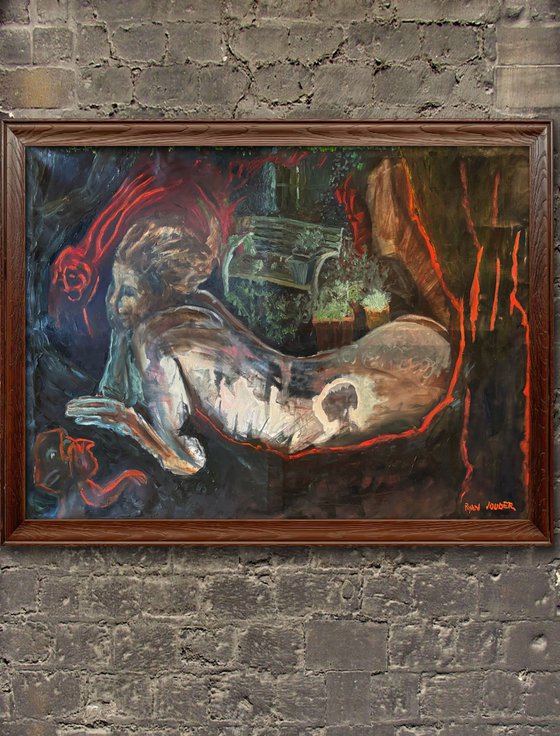
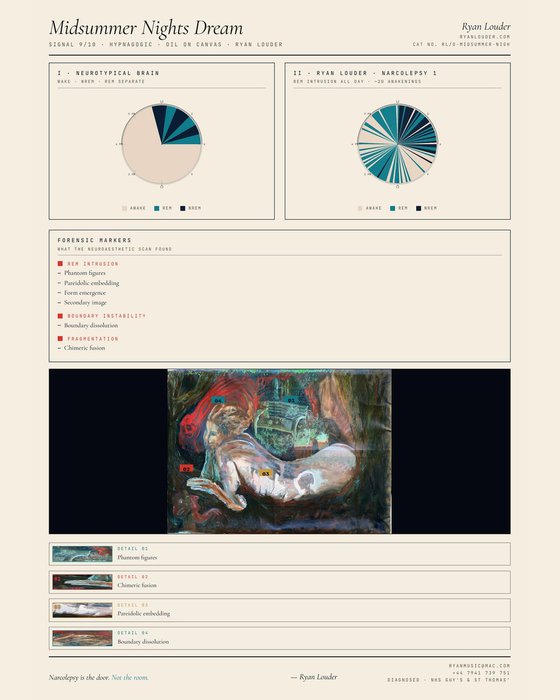
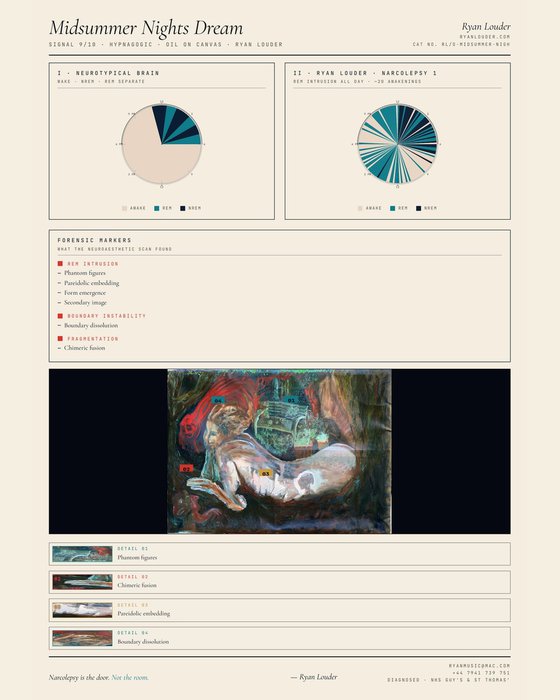
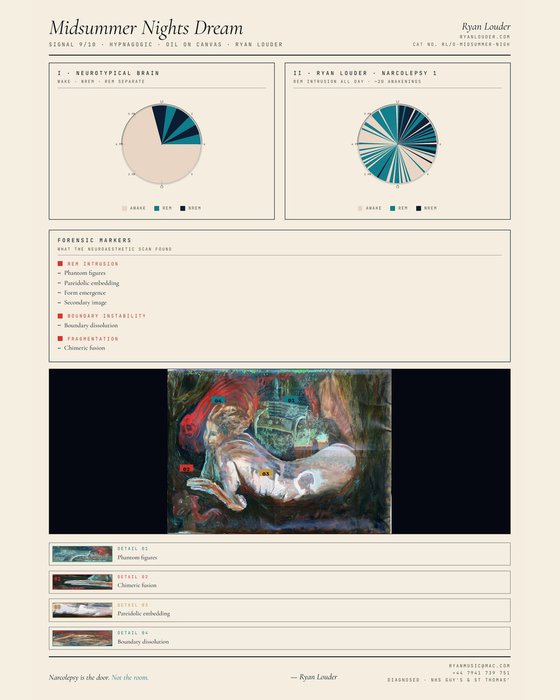
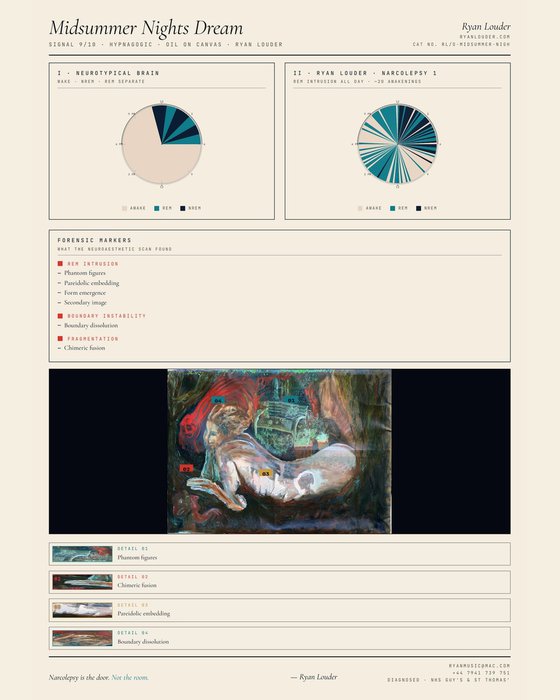
This painting by Ryan Louder is part of a body of work shaped by his neurological condition — Narcolepsy with REM Intrusion Hallucinations, clinically confirmed via MSLT at Guy's Hospital, London. The work contains hypnagogic imagery — embedded secondary images, phantom figures, and forms emerging from within the scene.
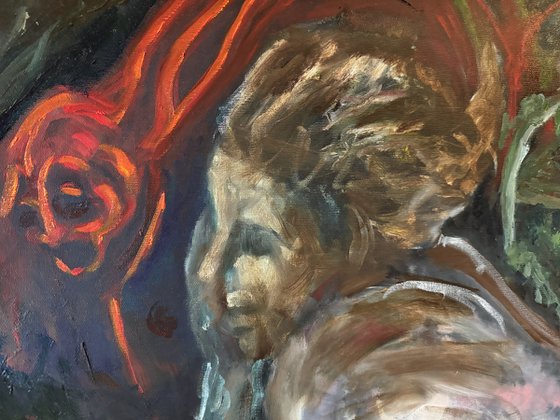
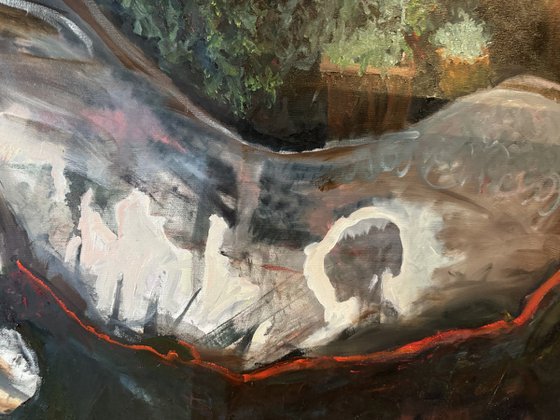
Neuroaesthetic markers identified: phantom figures; chimeric fusion; pareidolic embedding; boundary dissolution; secondary image; form emergence
These markers are not deliberate artistic techniques but direct visual recordings of what REM intrusion hallucinations look like. The imagery emerges from neurological experience, not metaphor. Ryan has painted over 2,000 works, with over 1,000 originals sold. Each painting in this collection has been subjected to neuroaesthetic forensic analysis to identify and catalogue the perceptual phenomena present.
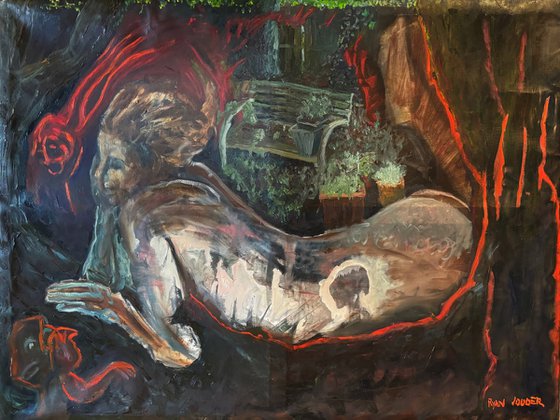
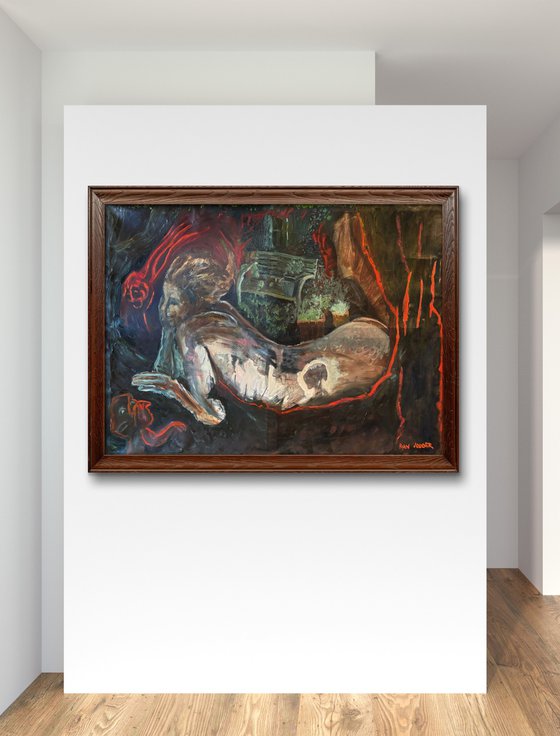
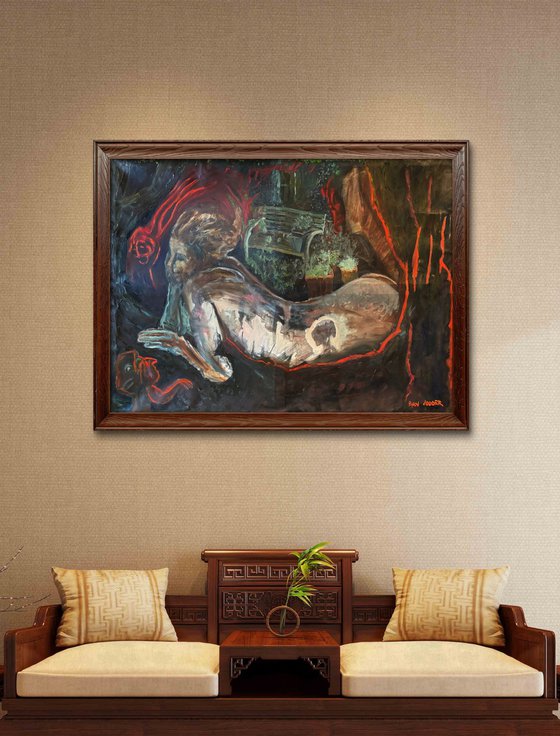
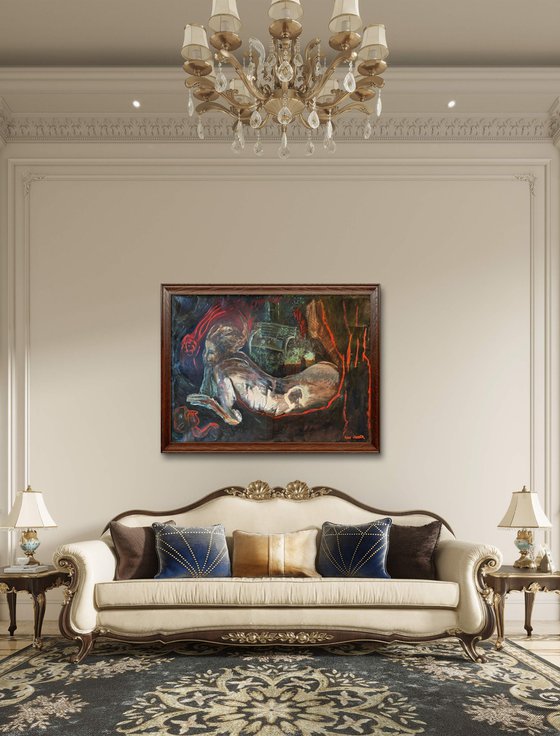
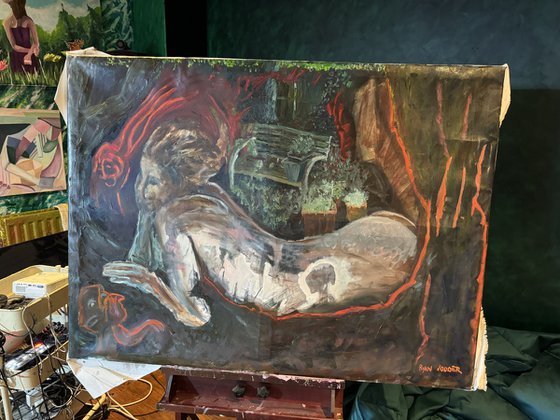
A reclining figure occupies the centre-left in grey-brown and pale flesh — the body blending into surrounding darkness before limbs resolve. The ground from which the figure emerges is near-black, punctuated by vertical drips of dark red tracing the right and lower edges like arterial marks. A garden bench and foliage are dimly legible in the upper right, rendered in dark greens as though seen through a tunnel. A small secondary figure, barely differentiated from the ground, crouches at the lower left. Any luminosity — the faint white of a torso, the smear of a face — reads as self-generated rather than lit from without.
Materials used:
Oil paint
Details:
- Mixed-media painting on Canvas
- One of a kind artwork
- Size: 121.92 x 91.44 x 0.51cm (unframed) / 106.68 x 170.18cm (actual image size)
- Ready to hang
- Signed on the front
- Style: Expressive and gestural
- Subject: People and portraits
 Free returns
14 day money back guaranteeLearn more
Original artwork description
Signal Rating: 9/10 — Strong
Classification: Hypnagogic
This painting by Ryan Louder is part of a body of work shaped by his neurological condition — Narcolepsy with REM Intrusion Hallucinations, clinically confirmed via MSLT at Guy's Hospital, London. The work contains hypnagogic imagery — embedded secondary images, phantom figures, and forms emerging from within the scene.
Neuroaesthetic markers identified: phantom figures; chimeric fusion; pareidolic embedding; boundary dissolution; secondary image; form emergence
These markers are not deliberate artistic techniques but direct visual recordings of what REM intrusion hallucinations look like. The imagery emerges from neurological experience, not metaphor. Ryan has painted over 2,000 works, with over 1,000 originals sold. Each painting in this collection has been subjected to neuroaesthetic forensic analysis to identify and catalogue the perceptual phenomena present.
A reclining figure occupies the centre-left in grey-brown and pale flesh — the body blending into surrounding darkness before limbs resolve. The ground from which the figure emerges is near-black, punctuated by vertical drips of dark red tracing the right and lower edges like arterial marks. A garden bench and foliage are dimly legible in the upper right, rendered in dark greens as though seen through a tunnel. A small secondary figure, barely differentiated from the ground, crouches at the lower left. Any luminosity — the faint white of a torso, the smear of a face — reads as self-generated rather than lit from without.
Materials used:
Oil paint
Details:
- Mixed-media painting on Canvas
- One of a kind artwork
- Size: 121.92 x 91.44 x 0.51cm (unframed) / 106.68 x 170.18cm (actual image size)
- Ready to hang
- Signed on the front
- Style: Expressive and gestural
- Subject: People and portraits
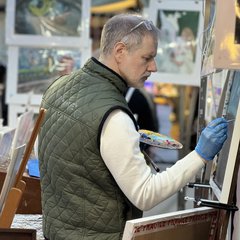
Ryan Louder
United Kingdom
About
Ryan Louder paints dreams in real time. Close to one thousand originals sold over a career spanning more than ten years. Independent forensic visual analysis of 873 of his paintings... Read more