- Ryan Louder
- All Artworks
- Pink Lillies
Pink LilliesLimited edition print Paper Print
by Ryan Louder
£75.00
From an edition of 120
Size 22.86 x 30.48 cm (unframed)
Original artwork description
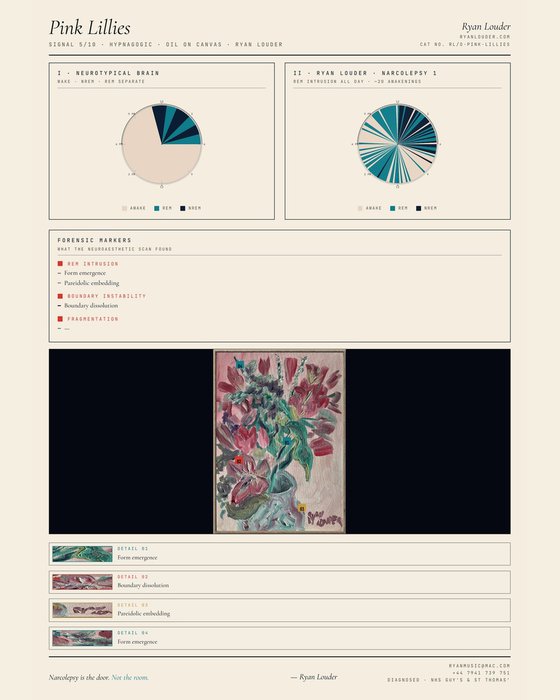
Signal Rating: 5/10 — Moderate
Classification: Hypnagogic
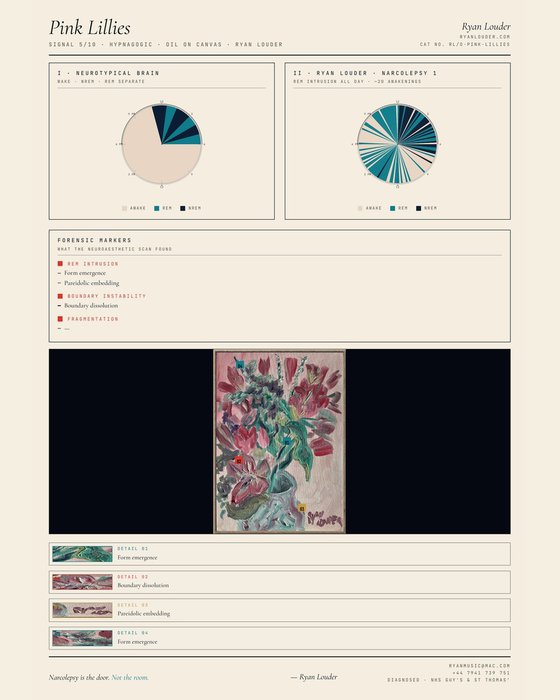
This painting by Ryan Louder is part of a body of work shaped by his neurological condition — Narcolepsy with REM Intrusion Hallucinations, clinically confirmed via MSLT at Guy's Hospital, London. The work contains hypnagogic imagery — embedded secondary images, phantom figures, and forms emerging from within the scene.
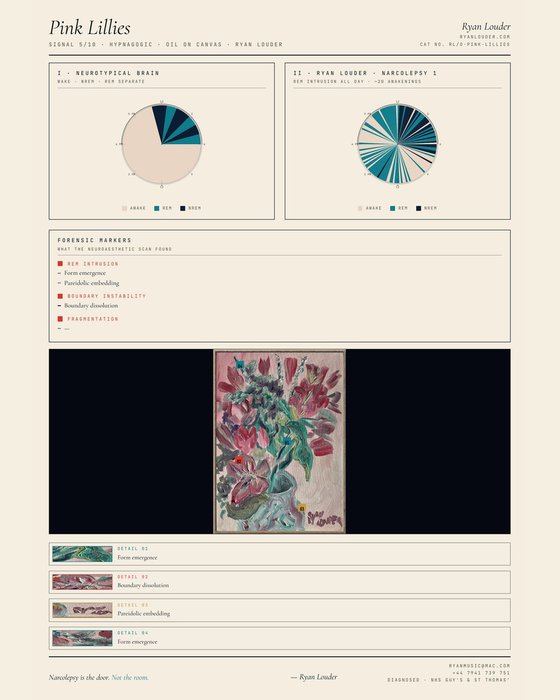
Neuroaesthetic markers identified: form emergence; boundary dissolution; pareidolic embedding
These markers are not deliberate artistic techniques but direct visual recordings of what REM intrusion hallucinations look like. The imagery emerges from neurological experience, not metaphor. Ryan has painted over 2,000 works, with over 1,000 originals sold. Each painting in this collection has been subjected to neuroaesthetic forensic analysis to identify and catalogue the perceptual phenomena present.
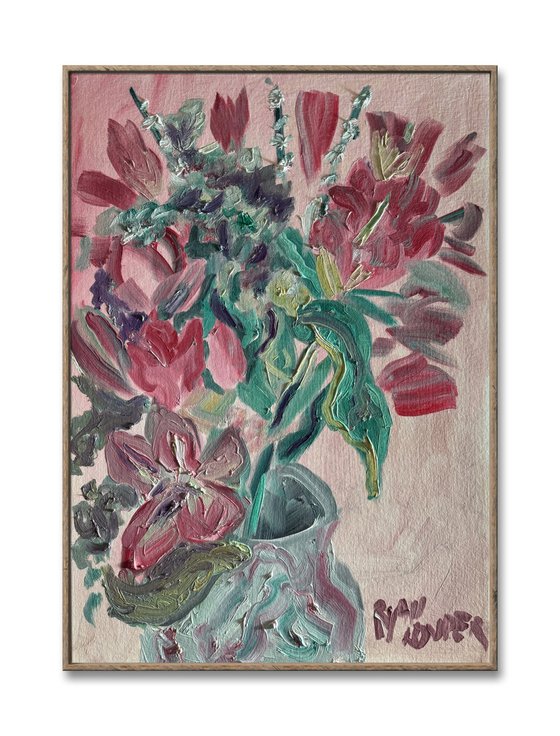
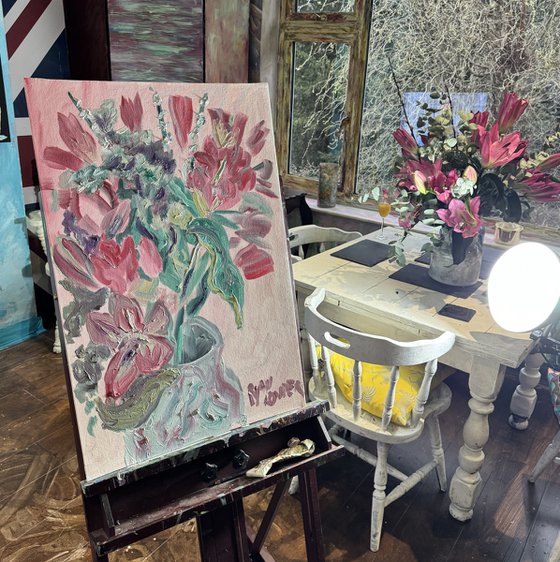
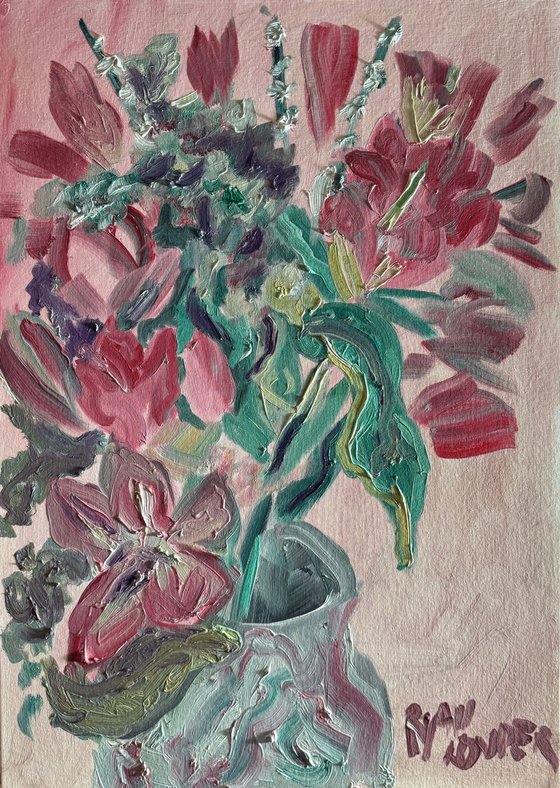
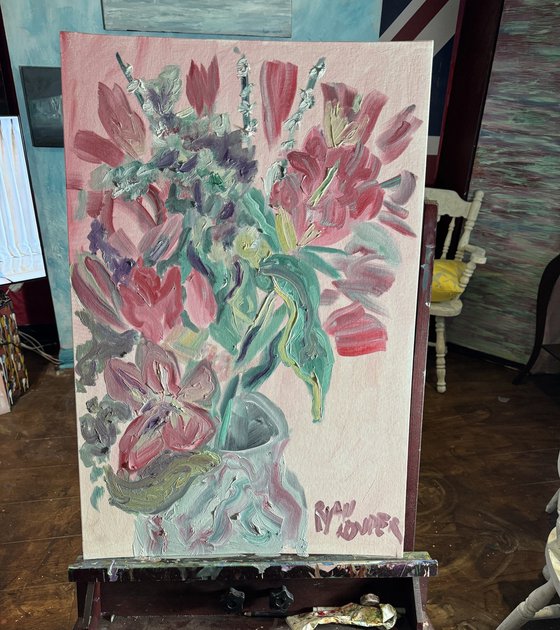
Pink and crimson lilies and tulip-like blooms crowd the upper two-thirds of the canvas in thick directional impasto, their petals built from strokes of dark rose, teal, and grey-green — more mark than description. The vase at the lower centre is white and loosely rendered, merging with a pale pink ground that offers no shadow or spatial recession. The palette is warm and high-key, pinks against a background of similar hue, so the flowers accumulate within a field of near-uniform tone rather than standing out against it. Individual blooms are identifiable at the edges of the arrangement but dissolve into each other toward the centre.
Materials used:
Oil on canvas
Details:
- Oil painting on Canvas
- One of a kind artwork
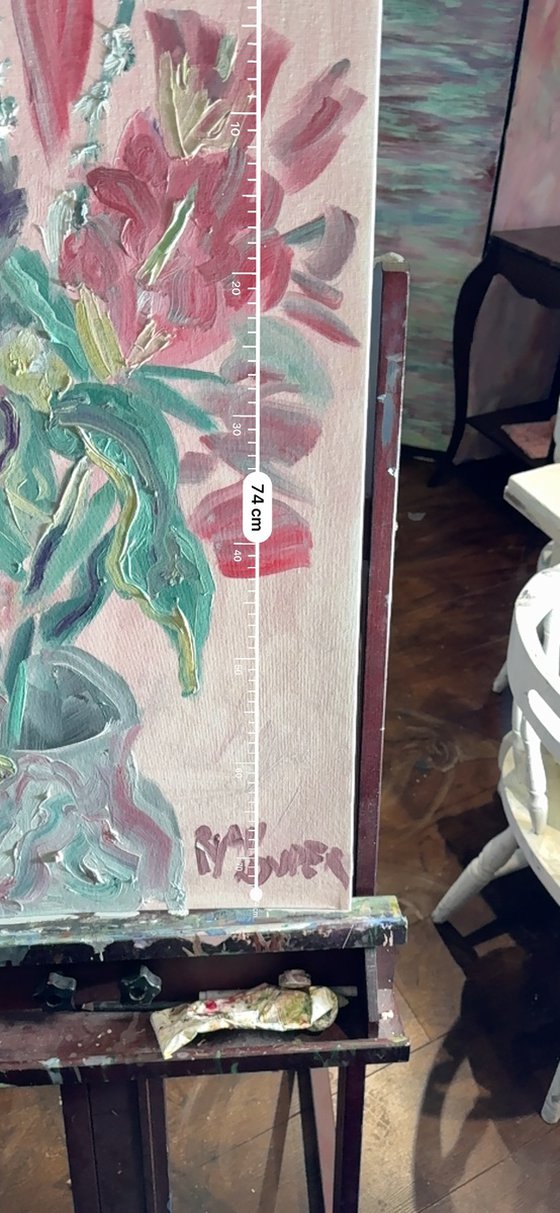
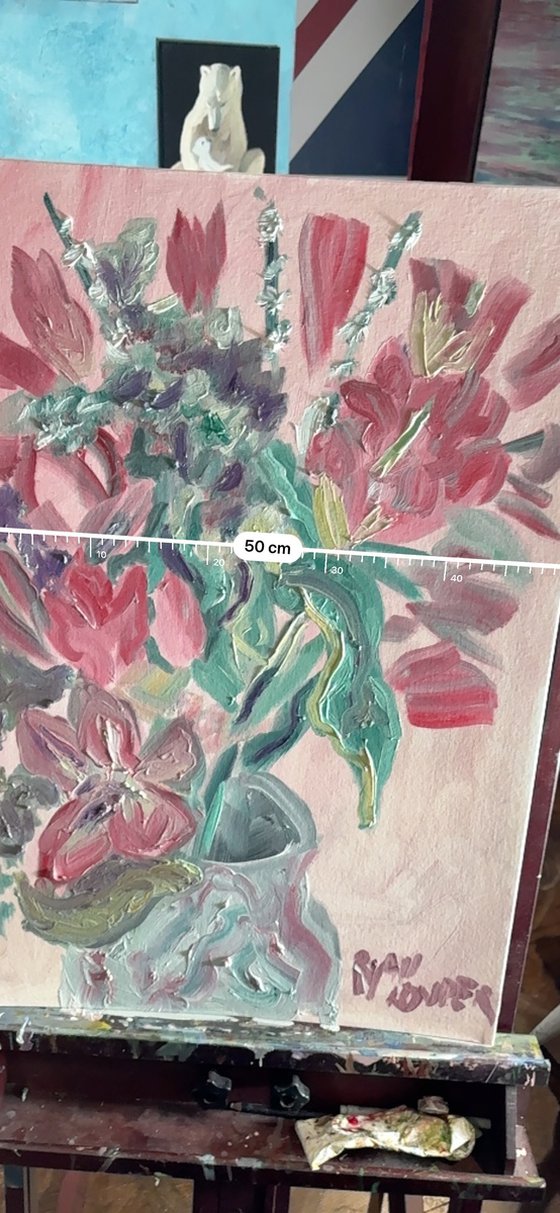
- Size: 50 x 75 x 0.4cm (unframed)
- Ready to hang
- Signed on the front
- Style: Expressive and gestural
- Subject: Flowers and plants
Featured by our Editors:
 Free returns
14 day money back guaranteeLearn more
Original artwork description
Signal Rating: 5/10 — Moderate
Classification: Hypnagogic
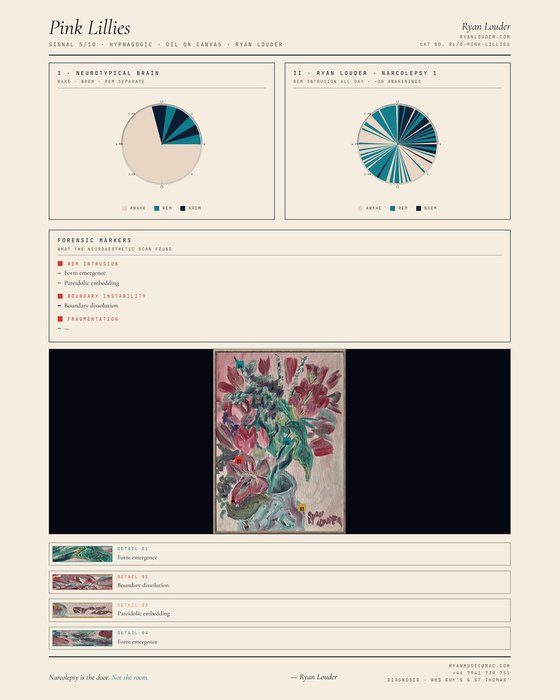
This painting by Ryan Louder is part of a body of work shaped by his neurological condition — Narcolepsy with REM Intrusion Hallucinations, clinically confirmed via MSLT at Guy's Hospital, London. The work contains hypnagogic imagery — embedded secondary images, phantom figures, and forms emerging from within the scene.
Neuroaesthetic markers identified: form emergence; boundary dissolution; pareidolic embedding
These markers are not deliberate artistic techniques but direct visual recordings of what REM intrusion hallucinations look like. The imagery emerges from neurological experience, not metaphor. Ryan has painted over 2,000 works, with over 1,000 originals sold. Each painting in this collection has been subjected to neuroaesthetic forensic analysis to identify and catalogue the perceptual phenomena present.
Pink and crimson lilies and tulip-like blooms crowd the upper two-thirds of the canvas in thick directional impasto, their petals built from strokes of dark rose, teal, and grey-green — more mark than description. The vase at the lower centre is white and loosely rendered, merging with a pale pink ground that offers no shadow or spatial recession. The palette is warm and high-key, pinks against a background of similar hue, so the flowers accumulate within a field of near-uniform tone rather than standing out against it. Individual blooms are identifiable at the edges of the arrangement but dissolve into each other toward the centre.
Materials used:
Oil on canvas
Details:
- Oil painting on Canvas
- One of a kind artwork
- Size: 50 x 75 x 0.4cm (unframed)
- Ready to hang
- Signed on the front
- Style: Expressive and gestural
- Subject: Flowers and plants
Featured by our Editors:

Ryan Louder
United Kingdom
About
Ryan Louder paints dreams in real time. Close to one thousand originals sold over a career spanning more than ten years. Independent forensic visual analysis of 873 of his paintings... Read more