- Kloska Ovidiu
- All Artworks
- I love to eat Bacon too 1
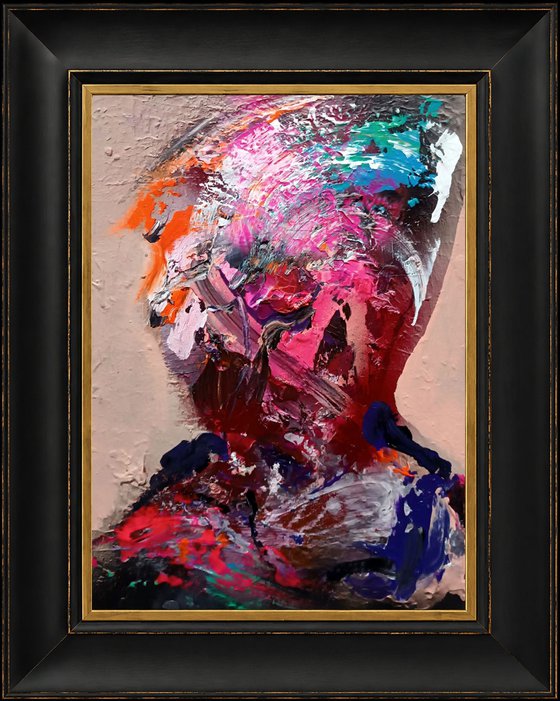
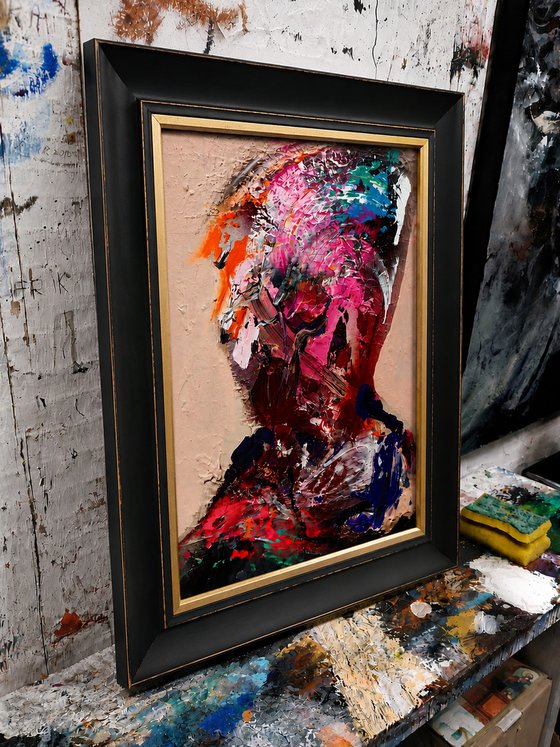
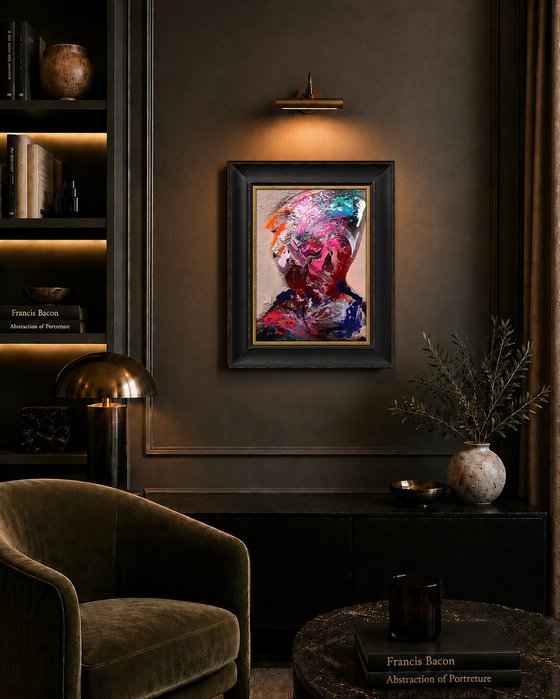
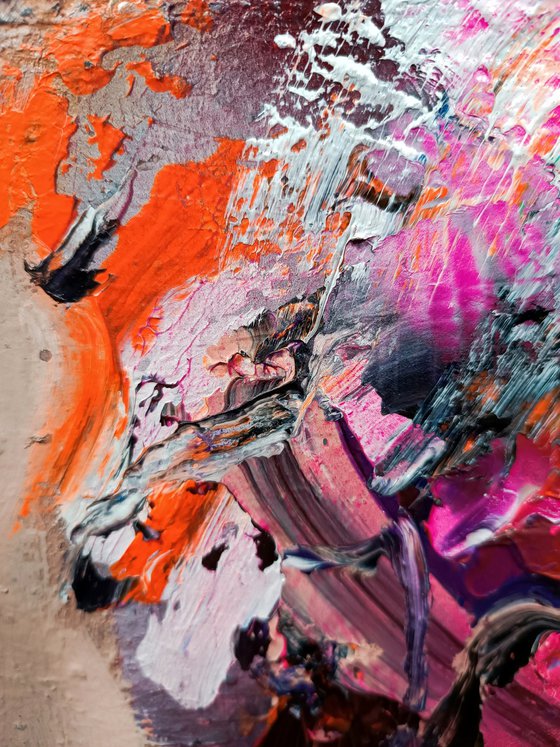
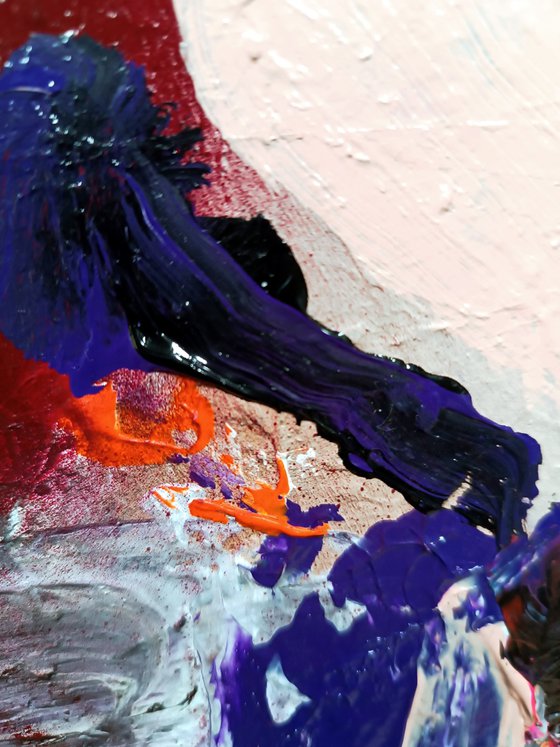
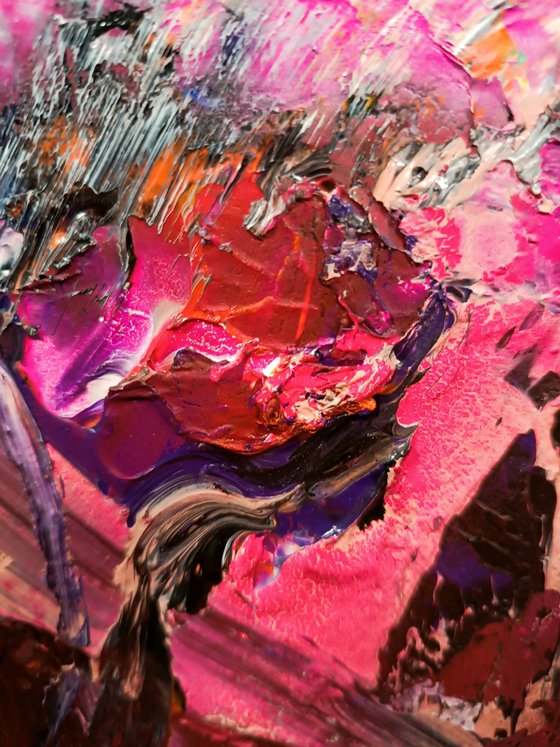
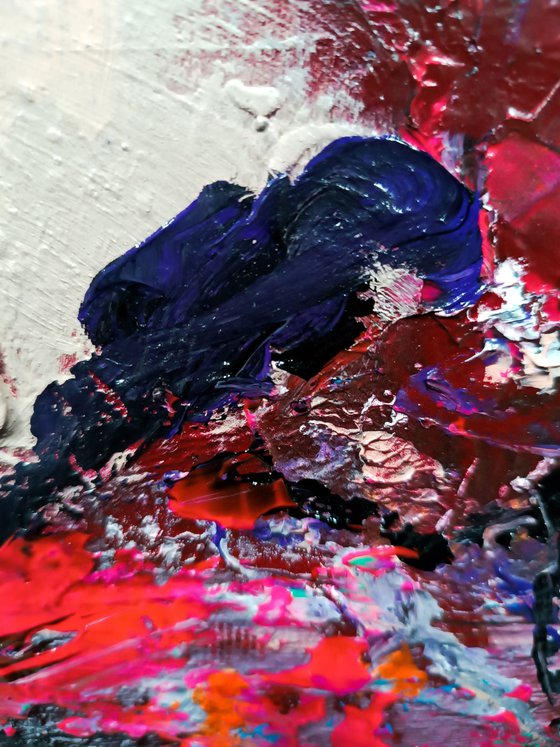
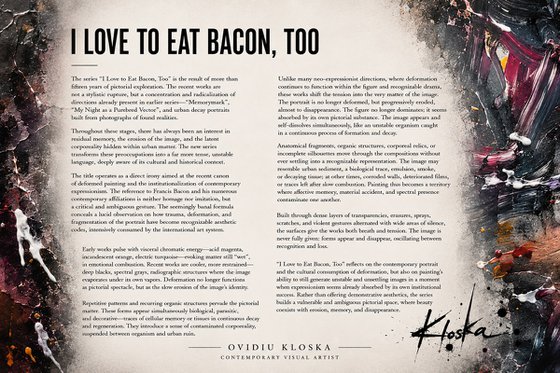
I love to eat Bacon too 1 (2026) Original Mixed-media Painting by Kloska Ovidiu
51 x 63 x 2cm (framed) / 33 x 45cm (actual image size)
£1,448.66
Original artwork description
I Love to Eat Bacon, Too — Critical Text
The first painting from the series I Love to Eat Bacon, Too operates like an implosion disguised as a portrait. At first glance, the work appears to inherit the psychological violence associated with Francis Bacon, yet it quickly escapes homage and enters a far more unstable territory: the collapse of representation under the pressure of contemporary image culture, appetite, memory, and self-consumption. The figure is neither fully present nor entirely erased. It flickers between apparition and residue.
The portrait becomes a site of impact.
Paint is not used here to describe form but to attack it, interrupt it, and ultimately destabilize the authority of the face itself. Thick gestures scrape against smoother passages, while eruptions of magenta, crimson, turquoise, black, and acidic orange create a chromatic nervous system that feels simultaneously seductive and wounded. The image appears as though it has survived several failed attempts at becoming legible. What remains is not identity, but evidence.
Within the context of the series title, the work acquires an additional layer of irony and brutality. I Love to Eat Bacon, Too is simultaneously humorous, irreverent, grotesque, and intellectually sharp. The title performs a double consumption: the literal consumption of flesh and the symbolic consumption of Bacon himself — Bacon as influence, Bacon as myth, Bacon as art historical commodity. Rather than denying influence, the painting devours it openly.
This strategy becomes central to the work.
The painting understands that contemporary art no longer operates under the illusion of originality as purity. Instead, it exists in a condition of cultural digestion. Images are sampled, absorbed, distorted, and expelled back into circulation. The work embraces this cannibalistic condition without apology. Bacon is not quoted here respectfully; he is metabolized.
Yet beneath the aggression lies vulnerability.
The fragmented head carries a strange emotional intimacy despite its deformation. The face seems trapped between emergence and disappearance, as though memory itself were dissolving in real time. Areas of thick impasto feel almost forensic, while translucent smears suggest fading perception, digital corruption, or psychic erosion. The portrait no longer functions as likeness; it becomes a psychological weather system.
Importantly, the work avoids becoming merely expressionistic spectacle. Its compositional intelligence restrains the chaos. The figure remains anchored within a fragile vertical structure, allowing the painting to oscillate between destruction and coherence. This tension is where the work gains its power. Every violent gesture is counterbalanced by an awareness of rhythm, spatial compression, and chromatic orchestration.
The result is a portrait that behaves less like an image and more like a confrontation. The viewer is denied stable access to the subject and is instead forced to experience painting as an unstable field of sensation. Flesh mutates into gesture; gesture mutates into noise; noise reorganizes itself into presence.
In this sense, I Love to Eat Bacon, Too is not about Francis Bacon alone. It is about what remains possible after influence, after oversaturation, after the exhaustion of the image. The painting asks whether portraiture can still carry psychological truth once identity itself has become fractured, consumed, and endlessly reproduced.
Its answer is brutal, unstable, and strangely alive.
Materials used:
framed mixed tehnique on wooden panel varnished
Details:
- Mixed-media painting on Panel / Board / MDF
- One of a kind artwork
- Size: 51 x 63 x 2cm (framed) / 33 x 45cm (actual image size)
- Framed and ready to hang
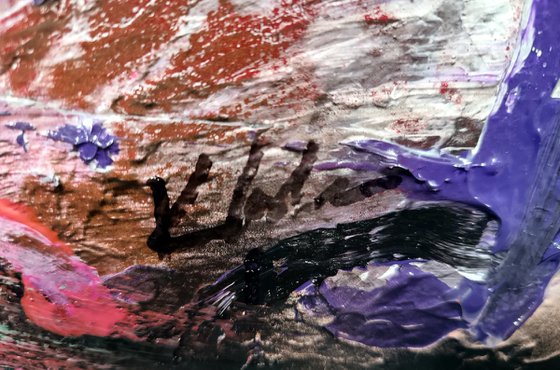
- Signed on the front
- Style: Expressive and gestural
- Subject: People and portraits
 Free returns
14 day money back guaranteeLearn more
Original artwork description
I Love to Eat Bacon, Too — Critical Text
The first painting from the series I Love to Eat Bacon, Too operates like an implosion disguised as a portrait. At first glance, the work appears to inherit the psychological violence associated with Francis Bacon, yet it quickly escapes homage and enters a far more unstable territory: the collapse of representation under the pressure of contemporary image culture, appetite, memory, and self-consumption. The figure is neither fully present nor entirely erased. It flickers between apparition and residue.
The portrait becomes a site of impact.
Paint is not used here to describe form but to attack it, interrupt it, and ultimately destabilize the authority of the face itself. Thick gestures scrape against smoother passages, while eruptions of magenta, crimson, turquoise, black, and acidic orange create a chromatic nervous system that feels simultaneously seductive and wounded. The image appears as though it has survived several failed attempts at becoming legible. What remains is not identity, but evidence.
Within the context of the series title, the work acquires an additional layer of irony and brutality. I Love to Eat Bacon, Too is simultaneously humorous, irreverent, grotesque, and intellectually sharp. The title performs a double consumption: the literal consumption of flesh and the symbolic consumption of Bacon himself — Bacon as influence, Bacon as myth, Bacon as art historical commodity. Rather than denying influence, the painting devours it openly.
This strategy becomes central to the work.
The painting understands that contemporary art no longer operates under the illusion of originality as purity. Instead, it exists in a condition of cultural digestion. Images are sampled, absorbed, distorted, and expelled back into circulation. The work embraces this cannibalistic condition without apology. Bacon is not quoted here respectfully; he is metabolized.
Yet beneath the aggression lies vulnerability.
The fragmented head carries a strange emotional intimacy despite its deformation. The face seems trapped between emergence and disappearance, as though memory itself were dissolving in real time. Areas of thick impasto feel almost forensic, while translucent smears suggest fading perception, digital corruption, or psychic erosion. The portrait no longer functions as likeness; it becomes a psychological weather system.
Importantly, the work avoids becoming merely expressionistic spectacle. Its compositional intelligence restrains the chaos. The figure remains anchored within a fragile vertical structure, allowing the painting to oscillate between destruction and coherence. This tension is where the work gains its power. Every violent gesture is counterbalanced by an awareness of rhythm, spatial compression, and chromatic orchestration.
The result is a portrait that behaves less like an image and more like a confrontation. The viewer is denied stable access to the subject and is instead forced to experience painting as an unstable field of sensation. Flesh mutates into gesture; gesture mutates into noise; noise reorganizes itself into presence.
In this sense, I Love to Eat Bacon, Too is not about Francis Bacon alone. It is about what remains possible after influence, after oversaturation, after the exhaustion of the image. The painting asks whether portraiture can still carry psychological truth once identity itself has become fractured, consumed, and endlessly reproduced.
Its answer is brutal, unstable, and strangely alive.
Materials used:
framed mixed tehnique on wooden panel varnished
Details:
- Mixed-media painting on Panel / Board / MDF
- One of a kind artwork
- Size: 51 x 63 x 2cm (framed) / 33 x 45cm (actual image size)
- Framed and ready to hang
- Signed on the front
- Style: Expressive and gestural
- Subject: People and portraits

Kloska Ovidiu
Romania
About
Ovidiu Kloska – Biography & Curriculum Vitae
BiographyOvidiu Kloska (b. 1977, Romania) is a contemporary visual artist whose multidisciplinary practice spans painting, welded-steel sculpture, mixed media, and oniric conceptual photography. His... Read more