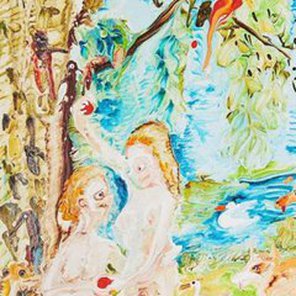
Genieve Figgis paints aristocratic life as a darkly comic ghost story. Grand drawing rooms, country estates and costume drama gatherings filled with melting skull figures in poured acrylic. Part 18th century portrait and part gothic horror.
The Irish painter started studying fine art in her 30s. In 2014, the American artist, Richard Prince, spotted the paintings she was sharing on Twitter and helped introduce her work to New York. She has been represented by Almine Rech since 2015 and her work is held in museum collections in the US, Europe and China.
The Irish painter started studying fine art in her 30s. In 2014, the American artist, Richard Prince, spotted the paintings she was sharing on Twitter and helped introduce her work to New York. She has been represented by Almine Rech since 2015 and her work is held in museum collections in the US, Europe and China.
Summary
Genieve Figgis paints aristocratic life as a darkly comic ghost story. Grand drawing rooms, country estates and costume drama gatherings filled with melting skull figures in poured acrylic. Part 18th century portrait and part gothic horror.
The Irish painter started studying fine art in her 30s. In 2014, the American artist, Richard Prince, spotted the paintings she was sharing on Twitter and helped introduce her work to New York. She has been represented by Almine Rech since 2015 and her work is held in museum collections in the US, Europe and China.
The Irish painter started studying fine art in her 30s. In 2014, the American artist, Richard Prince, spotted the paintings she was sharing on Twitter and helped introduce her work to New York. She has been represented by Almine Rech since 2015 and her work is held in museum collections in the US, Europe and China.
Artworks by Genieve Figgis
About Genieve Figgis
Biography
About Genieve Figgis
Genieve Figgis was born in Dublin in 1972 and lives and works in County Wicklow, Ireland. She came to painting later than many of her peers, beginning formal study at around 30, after starting a family. She completed a fine art degree at Gorey School of Art in County Wexford in 2006, then studied further at the National College of Art and Design (NCAD) in Dublin, where she finished her MFA in 2012.Discovered on Twitter
Figgis's breakthrough came online. In 2014, she began posting her paintings on Twitter, where Richard Prince spotted them. He championed her work and that summer she made her American debut at Harper's Books in East Hampton, New York, alongside her first book, Making Love with the Devil. Within a year, she had joined Almine Rech, the gallery that still represents her. She has since had solo exhibitions in London, Paris, Brussels, New York, Shanghai, Venice and Monaco.Old Masters made strange
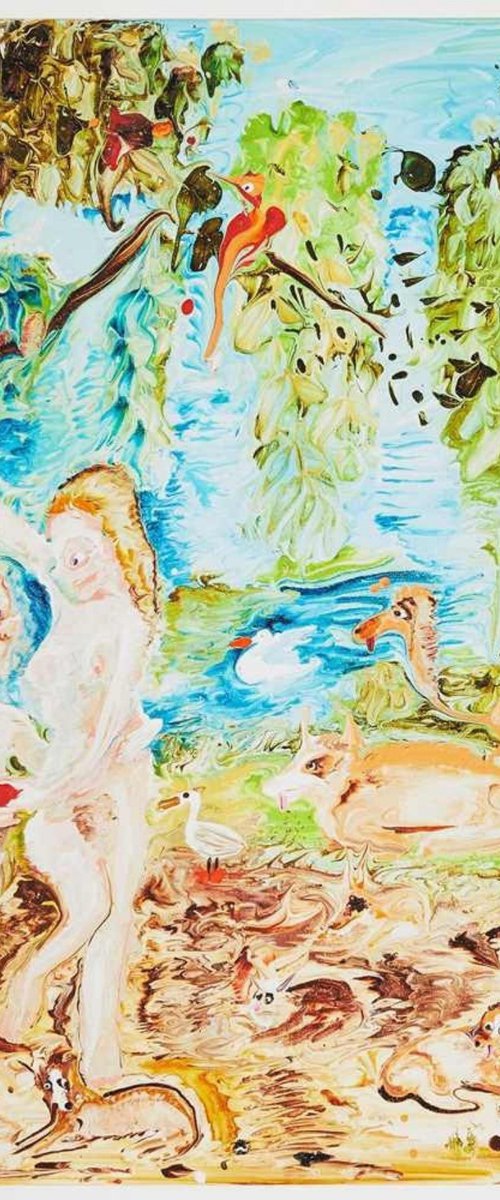
Figgis paints the world of wealth and leisure that fills centuries of European art: powdered aristocrats at the piano, families posed on country estates, picnics, balls and riders on horseback. But her figures rarely behave. Faces dissolve into skull-like masks, colours bleed into one another and elegant interiors start to feel more like haunted houses.Much of her work responds to the Old Masters and to Rococo painting, the ornate, pastel-toned 18th century style created by artists such as François Boucher and Jean-Honoré Fragonard. She has reworked Boucher's Leda and the Swan and Alexandre Cabanel's Birth of Venus, turning romantic scenes into something stranger and funnier. The tone owes as much to literature as to painting, with the gothic wit of Edgar Allan Poe and Oscar Wilde running through it. She has named Marlene Dumas, Cecily Brown and Jenny Saville among the contemporary painters she most admires.
Poured paint
Technique is central to the effect. Figgis works mainly in acrylic on small and medium canvases. She pours thinned paint so that it pools, marbles and runs, then works into it with fluid brushwork and fine surface marks. She has described the unpredictability of the pour as the most compelling part of the process, which leaves the paint to make many of the decisions. The finished paintings sit somewhere between figuration and abstraction, with figures emerging from the colour around them and sinking back into it.Figgis has shown at institutions including the Consortium Museum in Dijon and the M Woods Museum in Beijing, which staged her solo exhibition Drama Party in 2023. Her work is held by the Bass Museum of Art and the Pérez Art Museum in Miami, the Smart Museum of Art in Chicago, X Museum in Beijing and the Arts Council of Ireland. She has also made limited edition prints with Almine Rech Editions.