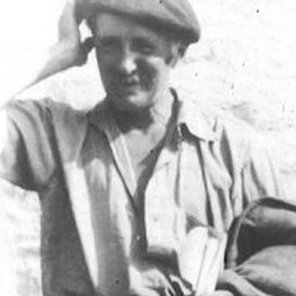
Claude Flight was a champion of the colour linocut in interwar Britain. He believed the humble, inexpensive linoleum print could be a truly modern art form, which should be open to everyone. His own prints of buses, crowds and racing cars pulse with the speed of the machine age.
As a teacher at the Grosvenor School of Modern Art from 1926 to 1930, he inspired a group of students whose work now defines the movement.
As a teacher at the Grosvenor School of Modern Art from 1926 to 1930, he inspired a group of students whose work now defines the movement.
Summary
Claude Flight was a champion of the colour linocut in interwar Britain. He believed the humble, inexpensive linoleum print could be a truly modern art form, which should be open to everyone. His own prints of buses, crowds and racing cars pulse with the speed of the machine age.
As a teacher at the Grosvenor School of Modern Art from 1926 to 1930, he inspired a group of students whose work now defines the movement.
As a teacher at the Grosvenor School of Modern Art from 1926 to 1930, he inspired a group of students whose work now defines the movement.
Artworks by Claude Flight
About Claude Flight
Biography
About Claude Flight
Walter Claude Flight was born in London in 1881. He came to art late, after trying work as an engineer, a librarian, a farmer and a beekeeper. In 1912 Flight began studying at Heatherley's School of Art, encountering the ideas of the Italian Futurists, with their fascination for speed and mechanised movement.
In 1922, he began a lifelong personal and working partnership with the artist Edith Lawrence, with whom he later ran an interior decoration business.
The modern linocut
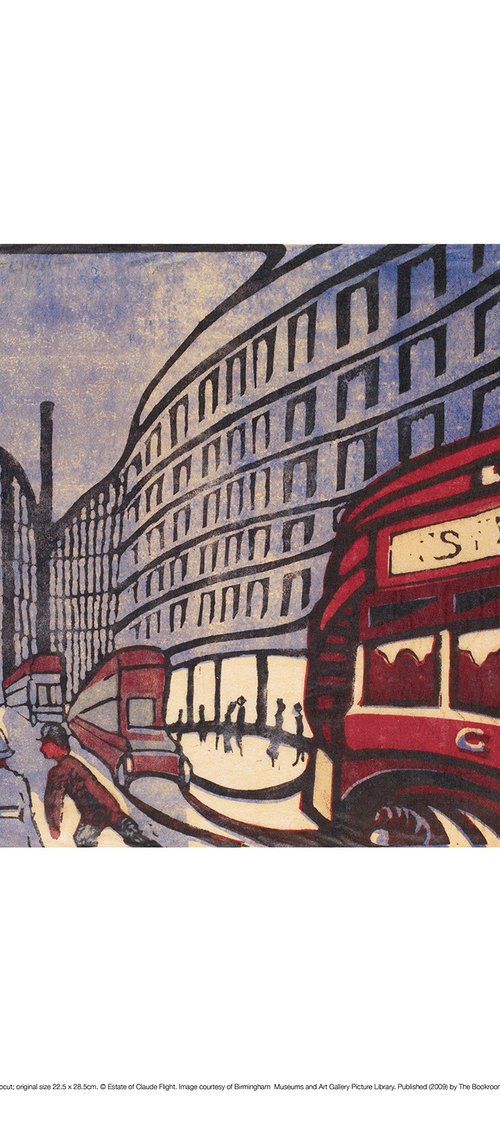
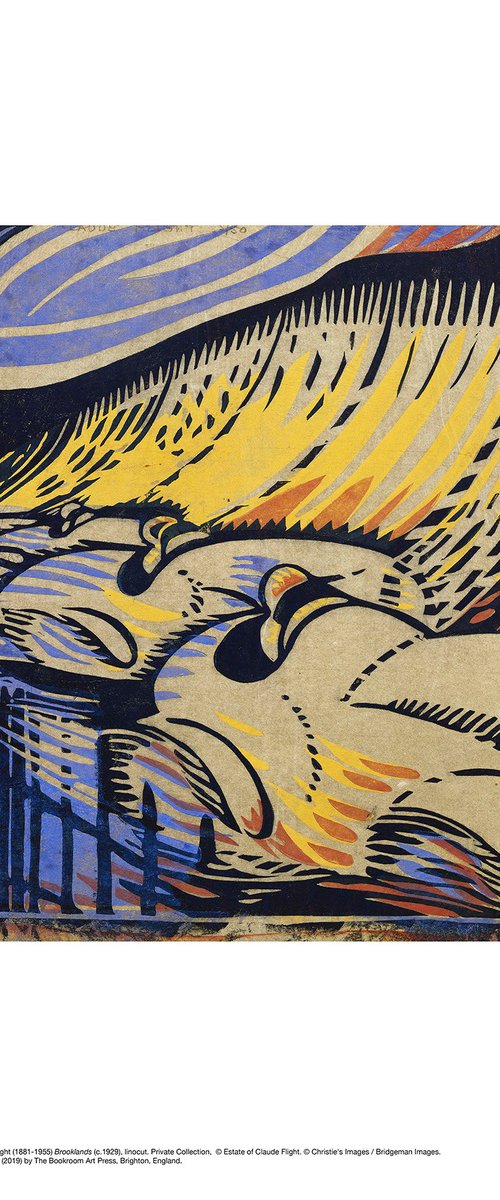
Flight first made linocuts around 1919 and soon became the medium's most passionate advocate. Linoleum was cheap and widely available; he argued that it could bring original art into everyday homes. Prints such as Speed and The Paris Omnibus use a few overlapping colours and sweeping lines to suggest motion, while Brooklands captures racing cars at the famous Surrey circuit.
He set out his methods in Lino-cuts: A Hand-Book of Linoleum-Cut Colour Printing and later in The Art and Craft of Lino Cutting and Printing. His approach was distinctive: rather than relying on a single key block to hold the design together, he built each image from several overlapping colour blocks.
Teaching at the Grosvenor School
From 1926, Flight taught linocutting one afternoon a week at the Grosvenor School of Modern Art in Pimlico. His students included Cyril Power, Sybil Andrews and Lill Tschudi, as well as the Australians Ethel Spowers, Eveline Syme and Dorrit Black. He also organised exhibitions of their work, beginning with the First Exhibition of British Lino-Cuts at London's Redfern Gallery in 1929.
Flight left the Grosvenor School in 1930. His London studio was bombed during WWII in 1941 and a serious stroke in 1947 ended his working life. Flight’s prints are held by the British Museum, the Victoria and Albert Museum and the National Gallery of Australia. He died in 1955.