- Kloska Ovidiu
- All Artworks
- Section in the Metaphysics of a Twilight
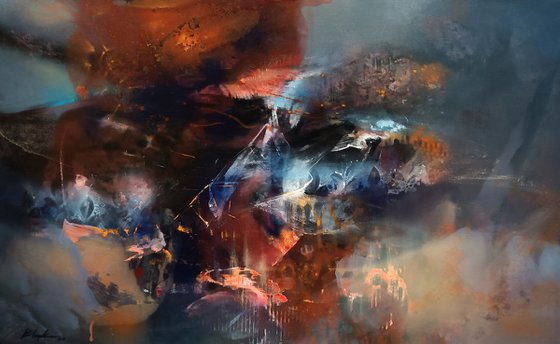
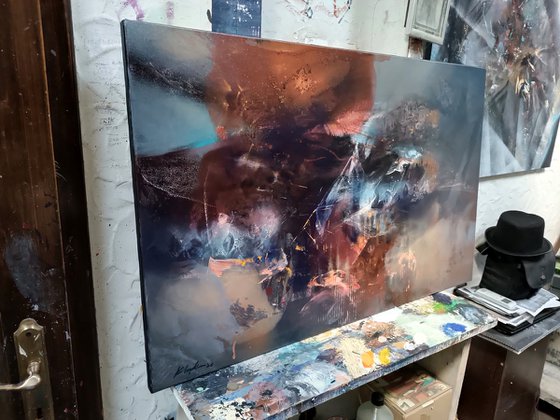
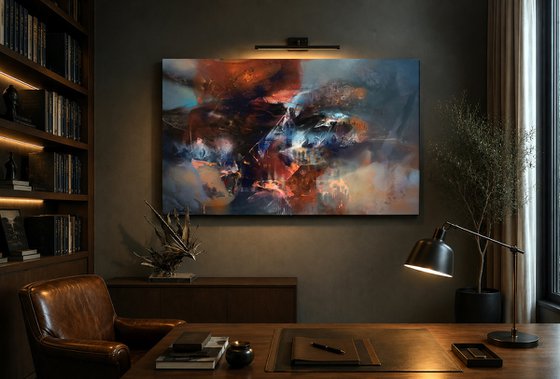
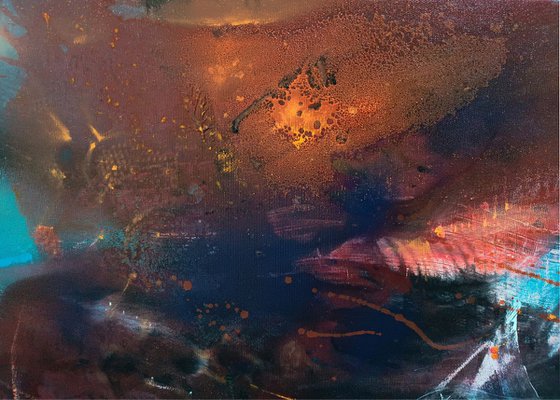
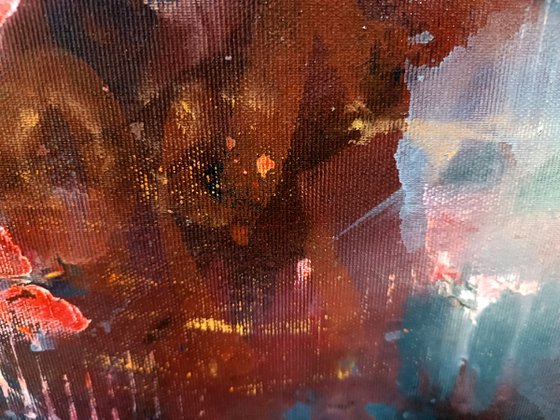
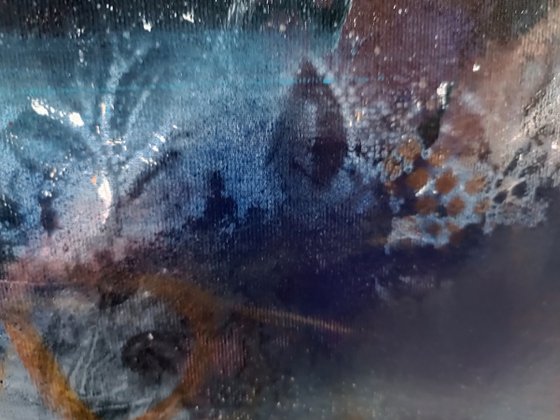
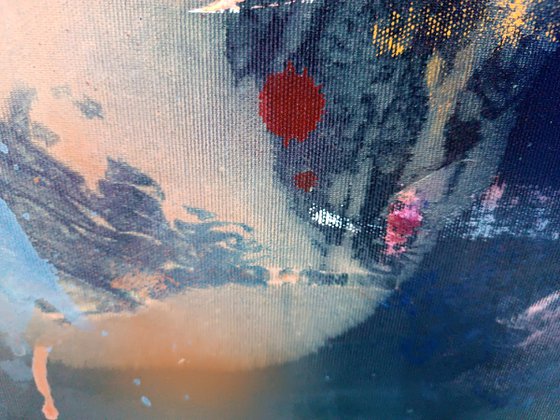
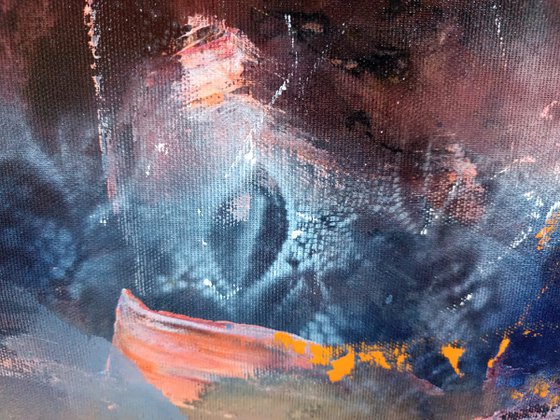
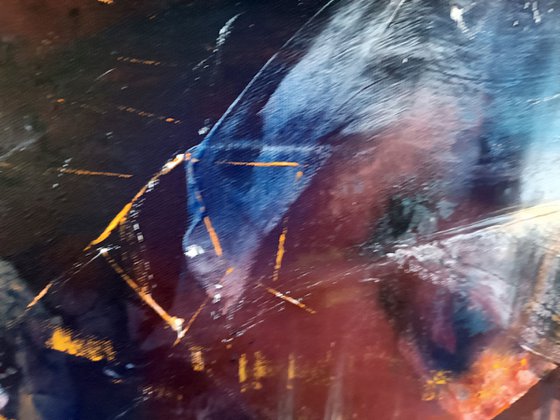
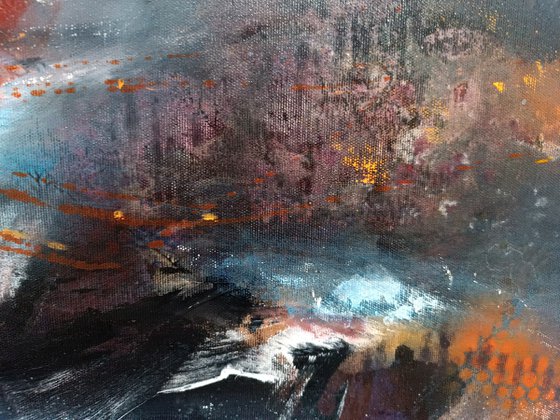
Section in the Metaphysics of a Twilight (2026) Original Mixed-media Painting by Kloska Ovidiu
110 x 70 x 2cm (unframed) / 110 x 70cm (actual image size)
£1,381.44
Original artwork description
Section in the Metaphysics of a Twilight
There are images that exhaust their entire existence in the instant they are seen, and there are images that only begin to unfold from that moment onward. This work seems to belong to the latter category. It does not present itself as a finished object, but rather as a process of gradual revelation, like a territory whose landscape changes as it is explored. What first appears as a tension between light and darkness slowly transforms into a deeper experience, one in which the eye ceases to search for forms and begins instead to follow states of becoming.
Within the painting, a silent force seems to be at work—difficult to name and impossible to locate precisely—a force that neither builds nor destroys, but keeps all things suspended in a condition of continuous metamorphosis. Matter gathers and disperses, light emerges from darkness only to return to it in another guise, and space itself oscillates between depth and surface, between proximity and distance, between what can be perceived and what can only be intuited.
The viewer encounters not an image, but the traces of a transformation. Something appears to be coming into being, while at the same time something else seems to be vanishing. Every accumulation of light carries within it the premonition of its own dissolution, while every region of obscurity conceals the possibility of a new emergence. Nothing is fixed. Nothing is final. And it is precisely this absence of certainty that becomes the source of a peculiar and enduring fascination.
Throughout the composition, unexpected ruptures appear—true cuts of contrast that traverse the pictorial field like thresholds between different worlds. They do not fragment the image; rather, they intensify its mystery. Near them, one has the sensation that reality itself becomes momentarily thinner, allowing a glimpse of something deeper beneath the visible surface of things. This is not revelation in the dramatic sense of the word, but a quieter and perhaps more unsettling form of knowledge: the realization that what we see can never fully exhaust what exists.
Perhaps this is why the work carries an initiatory dimension. Not because it leads toward a predetermined meaning, but because it invites the viewer to move through successive layers of perception. One enters the image like a traveler crossing an unfamiliar landscape, discovering that every answer opens onto a new question, and every light leads toward an even more fertile darkness.
The twilight evoked by the title is not an atmospheric phenomenon, but a state of consciousness. It is that rare moment when forms cease to appear definitive and reveal their transient nature, that suspended interval in which the world seems to remember that it was once pure possibility before becoming matter, name, and destiny.
At the center of this continuous movement remains something that resists translation into concepts and refuses reduction to symbols. A calm and profound mystery, seemingly still yet expansive in its effects, continuing to grow within the viewer long after the gaze has left the painting. As though the work preserves not the image of a world, but the memory of a threshold—a passage, a fleeting instant in which the invisible begins, however briefly, to assume form.
Materials used:
mixed media on strathed canvas varnished
Details:
- Mixed-media painting on Canvas
- One of a kind artwork
- Size: 110 x 70 x 2cm (unframed) / 110 x 70cm (actual image size)
- Ready to hang
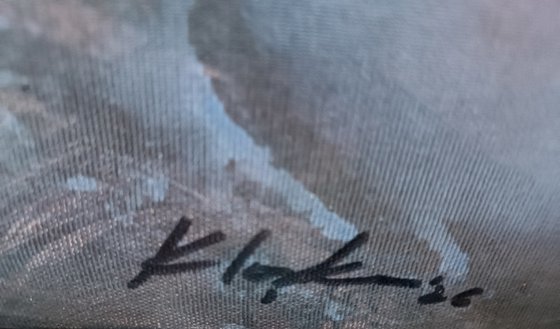
- Signed on the front
- Style: Expressive and gestural
- Subject: Landscapes, sea and sky
 Free returns
14 day money back guaranteeLearn more
Original artwork description
Section in the Metaphysics of a Twilight
There are images that exhaust their entire existence in the instant they are seen, and there are images that only begin to unfold from that moment onward. This work seems to belong to the latter category. It does not present itself as a finished object, but rather as a process of gradual revelation, like a territory whose landscape changes as it is explored. What first appears as a tension between light and darkness slowly transforms into a deeper experience, one in which the eye ceases to search for forms and begins instead to follow states of becoming.
Within the painting, a silent force seems to be at work—difficult to name and impossible to locate precisely—a force that neither builds nor destroys, but keeps all things suspended in a condition of continuous metamorphosis. Matter gathers and disperses, light emerges from darkness only to return to it in another guise, and space itself oscillates between depth and surface, between proximity and distance, between what can be perceived and what can only be intuited.
The viewer encounters not an image, but the traces of a transformation. Something appears to be coming into being, while at the same time something else seems to be vanishing. Every accumulation of light carries within it the premonition of its own dissolution, while every region of obscurity conceals the possibility of a new emergence. Nothing is fixed. Nothing is final. And it is precisely this absence of certainty that becomes the source of a peculiar and enduring fascination.
Throughout the composition, unexpected ruptures appear—true cuts of contrast that traverse the pictorial field like thresholds between different worlds. They do not fragment the image; rather, they intensify its mystery. Near them, one has the sensation that reality itself becomes momentarily thinner, allowing a glimpse of something deeper beneath the visible surface of things. This is not revelation in the dramatic sense of the word, but a quieter and perhaps more unsettling form of knowledge: the realization that what we see can never fully exhaust what exists.
Perhaps this is why the work carries an initiatory dimension. Not because it leads toward a predetermined meaning, but because it invites the viewer to move through successive layers of perception. One enters the image like a traveler crossing an unfamiliar landscape, discovering that every answer opens onto a new question, and every light leads toward an even more fertile darkness.
The twilight evoked by the title is not an atmospheric phenomenon, but a state of consciousness. It is that rare moment when forms cease to appear definitive and reveal their transient nature, that suspended interval in which the world seems to remember that it was once pure possibility before becoming matter, name, and destiny.
At the center of this continuous movement remains something that resists translation into concepts and refuses reduction to symbols. A calm and profound mystery, seemingly still yet expansive in its effects, continuing to grow within the viewer long after the gaze has left the painting. As though the work preserves not the image of a world, but the memory of a threshold—a passage, a fleeting instant in which the invisible begins, however briefly, to assume form.
Materials used:
mixed media on strathed canvas varnished
Details:
- Mixed-media painting on Canvas
- One of a kind artwork
- Size: 110 x 70 x 2cm (unframed) / 110 x 70cm (actual image size)
- Ready to hang
- Signed on the front
- Style: Expressive and gestural
- Subject: Landscapes, sea and sky

Kloska Ovidiu
Romania
About
Ovidiu Kloska – Biography & Curriculum Vitae
BiographyOvidiu Kloska (b. 1977, Romania) is a contemporary visual artist whose multidisciplinary practice spans painting, welded-steel sculpture, mixed media, and oniric conceptual photography. His... Read more