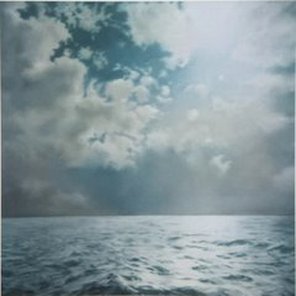
Gerhard Richter treats the mechanics of painting itself as an open question, moving between meticulously blurred photo-based paintings and abstract works created by a giant squeegee. Born in Germany in 1932, he trained on both sides of a divided Germany, and is now widely regarded as one of the most significant contemporary painters today. His subjects range from family snapshots to the deaths of German terrorists, always filtered through the uncertainty of a photograph. By contrast, his abstract paintings leave much of the outcome to chance.
Summary
Gerhard Richter treats the mechanics of painting itself as an open question, moving between meticulously blurred photo-based paintings and abstract works created by a giant squeegee. Born in Germany in 1932, he trained on both sides of a divided Germany, and is now widely regarded as one of the most significant contemporary painters today. His subjects range from family snapshots to the deaths of German terrorists, always filtered through the uncertainty of a photograph. By contrast, his abstract paintings leave much of the outcome to chance.
Artworks by Gerhard Richter
About Gerhard Richter
Biography
About Gerhard Richter
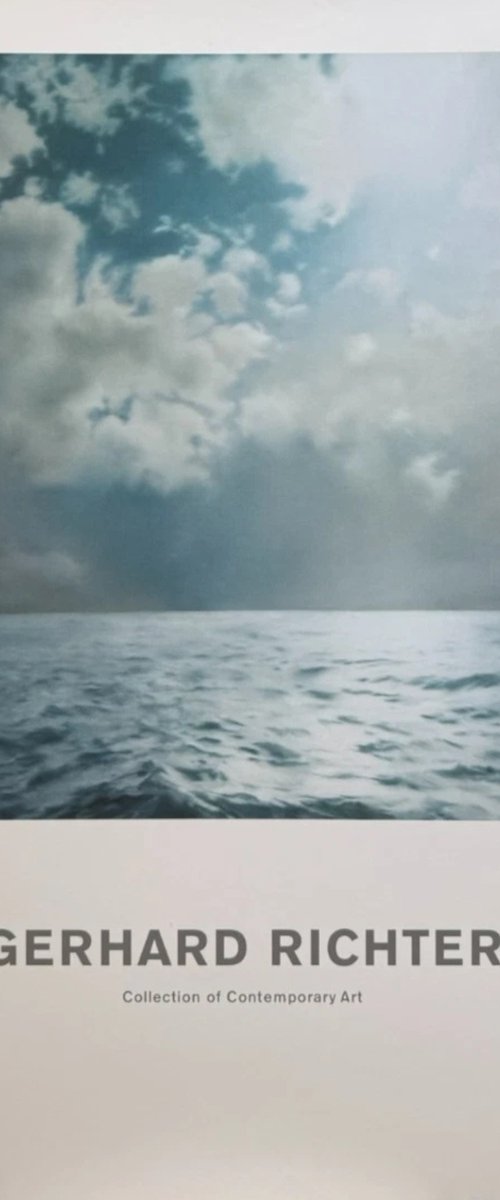
Gerhard Richter was born in 1932 in Dresden, which at that point was a part of Germany’s Free State of Saxony. He trained first at the Dresden Art Academy in East Germany, working in a realist style shaped by state expectations, before moving to West Germany to study in 1961, shortly before the Berlin Wall was built. There, exposed to Western abstraction and Pop art, he began developing the photo-based technique that would define much of his career: painting directly from family snapshots, newspaper cuttings and other found photographs, then dragging a brush or cloth across the wet paint to blur the image while it was still forming.
Photo paintings and blur
That blurred, photographic realism became one of Richter’s defining approaches, applied to subjects ranging from portraits of friends and family to some of the most difficult material in postwar German history. His series, 18. Oktober 1977, depicts moments of the lives and death of members of the Baader-Meinhof group (West German militants). While the subject matter is highly sensitive, the series avoids clear political statements and instead relies on the uncertainty of the blurred image to evoke meaning.
Abstraction and the squeegee
Alongside his photo paintings, Richter developed a parallel body of abstract work, using rollers and increasingly large squeegees to pull and scrape layers of colour across the canvas, producing effects he could guide but not fully control.
Print editions have run alongside Richter's paintings: offset prints, photographic editions and artist's books let him extend the same interests in colour and abstraction into a more widely accessible body of work. His piece, 1260 Colours (2007), reworks the same colour chart logic that also informs his large-scale paintings and stained-glass window for Cologne Cathedral.
A major retrospective opened at the Museum of Modern Art in New York in 2002 before touring to Chicago, San Francisco and Washington. Richter continues to live and work in Cologne.
Biography
About Gerhard Richter
Gerhard Richter was born in 1932 in Dresden, which at that point was a part of Germany’s Free State of Saxony. He trained first at the Dresden Art Academy in East Germany, working in a realist style shaped by state expectations, before moving to West Germany to study in 1961, shortly before the Berlin Wall was built. There, exposed to Western abstraction and Pop art, he began developing the photo-based technique that would define much of his career: painting directly from family snapshots, newspaper cuttings and other found photographs, then dragging a brush or cloth across the wet paint to blur the image while it was still forming.
Photo paintings and blur
That blurred, photographic realism became one of Richter’s defining approaches, applied to subjects ranging from portraits of friends and family to some of the most difficult material in postwar German history. His series, 18. Oktober 1977, depicts moments of the lives and death of members of the Baader-Meinhof group (West German militants). While the subject matter is highly sensitive, the series avoids clear political statements and instead relies on the uncertainty of the blurred image to evoke meaning.
Abstraction and the squeegee
Alongside his photo paintings, Richter developed a parallel body of abstract work, using rollers and increasingly large squeegees to pull and scrape layers of colour across the canvas, producing effects he could guide but not fully control.
Print editions have run alongside Richter's paintings: offset prints, photographic editions and artist's books let him extend the same interests in colour and abstraction into a more widely accessible body of work. His piece, 1260 Colours (2007), reworks the same colour chart logic that also informs his large-scale paintings and stained-glass window for Cologne Cathedral.
A major retrospective opened at the Museum of Modern Art in New York in 2002 before touring to Chicago, San Francisco and Washington. Richter continues to live and work in Cologne.