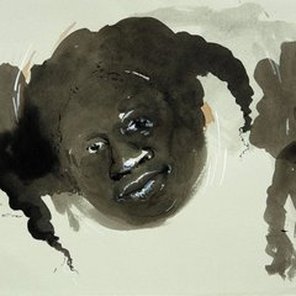
Kara Walker turns the genteel 18th century art of the cut-paper silhouette into some of the most confrontational works of the past 30 years, using it to highlight the brutality of American slavery.
Working in silhouette, drawing, printmaking, film and large-scale installation, she stages scenes set in the antebellum South that are deliberately shocking — violence, racism, casual cruelty — because softening them, she has argued, would let viewers look away from what actually happened.
By 1997, Walker had become one of the youngest ever recipients of the MacArthur Fellowship, sometimes called the ‘genius grant’. She continues to be one of the most widely discussed and collected artists of her generation.
Working in silhouette, drawing, printmaking, film and large-scale installation, she stages scenes set in the antebellum South that are deliberately shocking — violence, racism, casual cruelty — because softening them, she has argued, would let viewers look away from what actually happened.
By 1997, Walker had become one of the youngest ever recipients of the MacArthur Fellowship, sometimes called the ‘genius grant’. She continues to be one of the most widely discussed and collected artists of her generation.
Summary
Kara Walker turns the genteel 18th century art of the cut-paper silhouette into some of the most confrontational works of the past 30 years, using it to highlight the brutality of American slavery.
Working in silhouette, drawing, printmaking, film and large-scale installation, she stages scenes set in the antebellum South that are deliberately shocking — violence, racism, casual cruelty — because softening them, she has argued, would let viewers look away from what actually happened.
By 1997, Walker had become one of the youngest ever recipients of the MacArthur Fellowship, sometimes called the ‘genius grant’. She continues to be one of the most widely discussed and collected artists of her generation.
Working in silhouette, drawing, printmaking, film and large-scale installation, she stages scenes set in the antebellum South that are deliberately shocking — violence, racism, casual cruelty — because softening them, she has argued, would let viewers look away from what actually happened.
By 1997, Walker had become one of the youngest ever recipients of the MacArthur Fellowship, sometimes called the ‘genius grant’. She continues to be one of the most widely discussed and collected artists of her generation.
Artworks by Kara Walker
About Kara Walker
Biography
About Kara Walker
Kara Walker was born in 1969 in California, moving with her family to Stone Mountain, Georgia, at the age of 13. This was a town closely tied to the history of the Confederacy and the Ku Klux Klan, and one that sharpened her interest in race and Southern history. She received a degree from the Atlanta College of Art in 1991 and a master’s degree from the Rhode Island School of Design in 1994.
Silhouettes and an early breakthrough
Walker’s breakthrough came in 1994, with Gone: An Historical Romance of a Civil War as It Occurred b’tween the Dusky Thighs of One Young Negress and Her Heart, a room-sized frieze of cut-black-paper silhouettes that reimagined the romanticised antebellum South of ‘Gone with the Wind’ as a place of violence and exploitation.
The silhouette’s small scale history made it an unsettling vehicle for Walker’s subject matter. Figures rendered only in flat black profile, stripped of individual features, become both victim and aggressor, forcing viewers to fill in the details of what they are seeing for themselves. Her 1997 MacArthur Fellowship, awarded when she was 28, made her one of the youngest people ever to receive the award.
Prints, film and later work
Printmaking has run throughout Walker’s career alongside her silhouettes. Her 2005 portfolio Harper’s Pictorial History of the Civil War (Annotated), made in offset lithography and screenprint, overlays her own imagery onto plates from an 1866 illustrated history of the war. Her etchings, including the Resurrection Story series and An Unpeopled Land in Uncharted Waters, extend the same material into the language of old master printmaking.
From the early 2000s she began making 16mm films and video installations that set her silhouettes in motion. Her large scale public sculpture, A Subtlety, a monumental sugar-coated sphinx installed in a former Domino Sugar refinery in Brooklyn, brought her work to new audiences beyond the gallery.
Walker’s work is held in the collections of the Museum of Modern Art, the Guggenheim, Tate and the Whitney Museum of American Art, among many others.
Biography
About Kara Walker
Kara Walker was born in 1969 in California, moving with her family to Stone Mountain, Georgia, at the age of 13. This was a town closely tied to the history of the Confederacy and the Ku Klux Klan, and one that sharpened her interest in race and Southern history. She received a degree from the Atlanta College of Art in 1991 and a master’s degree from the Rhode Island School of Design in 1994.
Silhouettes and an early breakthrough
Walker’s breakthrough came in 1994, with Gone: An Historical Romance of a Civil War as It Occurred b’tween the Dusky Thighs of One Young Negress and Her Heart, a room-sized frieze of cut-black-paper silhouettes that reimagined the romanticised antebellum South of ‘Gone with the Wind’ as a place of violence and exploitation.
The silhouette’s small scale history made it an unsettling vehicle for Walker’s subject matter. Figures rendered only in flat black profile, stripped of individual features, become both victim and aggressor, forcing viewers to fill in the details of what they are seeing for themselves. Her 1997 MacArthur Fellowship, awarded when she was 28, made her one of the youngest people ever to receive the award.
Prints, film and later work
Printmaking has run throughout Walker’s career alongside her silhouettes. Her 2005 portfolio Harper’s Pictorial History of the Civil War (Annotated), made in offset lithography and screenprint, overlays her own imagery onto plates from an 1866 illustrated history of the war. Her etchings, including the Resurrection Story series and An Unpeopled Land in Uncharted Waters, extend the same material into the language of old master printmaking.
From the early 2000s she began making 16mm films and video installations that set her silhouettes in motion. Her large scale public sculpture, A Subtlety, a monumental sugar-coated sphinx installed in a former Domino Sugar refinery in Brooklyn, brought her work to new audiences beyond the gallery.
Walker’s work is held in the collections of the Museum of Modern Art, the Guggenheim, Tate and the Whitney Museum of American Art, among many others.