Julian Opie
Artworks for sale:
Loading...
United Kingdom
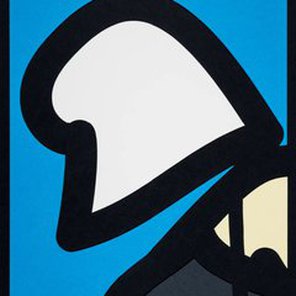
Julian Opie works with the simplest possible lines and in doing so, has made some of the most instantly recognisable portraiture and public art of the past three decades.
Working across painting, sculpture, prints and LED animation, he refines photographs of people into flat, economical outlines. His walking figures, rendered as looping LED or lenticular animations, have become permanent fixtures on city streets from London’s Carnaby Street to Boston and Dublin.
Opie first reached a wider audience through his cover artwork for Blur’s Best Of album in 2000 and has continued working between contemporary art and design ever since.
Working across painting, sculpture, prints and LED animation, he refines photographs of people into flat, economical outlines. His walking figures, rendered as looping LED or lenticular animations, have become permanent fixtures on city streets from London’s Carnaby Street to Boston and Dublin.
Opie first reached a wider audience through his cover artwork for Blur’s Best Of album in 2000 and has continued working between contemporary art and design ever since.
Summary
Julian Opie works with the simplest possible lines and in doing so, has made some of the most instantly recognisable portraiture and public art of the past three decades.
Working across painting, sculpture, prints and LED animation, he refines photographs of people into flat, economical outlines. His walking figures, rendered as looping LED or lenticular animations, have become permanent fixtures on city streets from London’s Carnaby Street to Boston and Dublin.
Opie first reached a wider audience through his cover artwork for Blur’s Best Of album in 2000 and has continued working between contemporary art and design ever since.
Working across painting, sculpture, prints and LED animation, he refines photographs of people into flat, economical outlines. His walking figures, rendered as looping LED or lenticular animations, have become permanent fixtures on city streets from London’s Carnaby Street to Boston and Dublin.
Opie first reached a wider audience through his cover artwork for Blur’s Best Of album in 2000 and has continued working between contemporary art and design ever since.
Artworks by Julian Opie
About Julian Opie
Biography
About Julian Opie
Julian Opie was born in London in 1958 and grew up in Oxford. He graduated from Goldsmiths in 1983, where he studied under the conceptual artist, Michael Craig-Martin. Throughout the 1980s, he produced a body of painted metal sculptures that combined loosely rendered imagery with cut steel shapes, establishing him as part of the New British Sculpture movement.
From billboards to LED figures
Opie’s mature style draws on an unusually wide range of sources: classical portrait busts, Japanese ukiyo-e woodblock prints, road signs and passport photographs.
He works across an equally wide range of media, including painting, screenprint, vinyl, lenticular print, LCD and LED, often revisiting a single sitter across several formats.
His best-known motif, the walking figure, first appeared as a looping computer animation and has since been installed as LED sculpture in public spaces including Regent’s Place in London and Seoul Square, South Korea.
Prints, portraits and public recognition
Screenprinting has been part of Opie’s practice since the 1990s, turning his portraits into editions that keep the same integrity as his paintings and sculptures.
His 2000 cover artwork for Blur’s Best Of, introduced his style to a mass audience. Opie has exhibited at institutions including the Museum of Applied Arts in Vienna, the National Gallery of Victoria in Melbourne and Tokyo Opera City Art Gallery, and continues to work from a four-storey studio in Shoreditch, East London.
Biography
About Julian Opie
Julian Opie was born in London in 1958 and grew up in Oxford. He graduated from Goldsmiths in 1983, where he studied under the conceptual artist, Michael Craig-Martin. Throughout the 1980s, he produced a body of painted metal sculptures that combined loosely rendered imagery with cut steel shapes, establishing him as part of the New British Sculpture movement.
From billboards to LED figures
Opie’s mature style draws on an unusually wide range of sources: classical portrait busts, Japanese ukiyo-e woodblock prints, road signs and passport photographs.
He works across an equally wide range of media, including painting, screenprint, vinyl, lenticular print, LCD and LED, often revisiting a single sitter across several formats.
His best-known motif, the walking figure, first appeared as a looping computer animation and has since been installed as LED sculpture in public spaces including Regent’s Place in London and Seoul Square, South Korea.
Prints, portraits and public recognition
Screenprinting has been part of Opie’s practice since the 1990s, turning his portraits into editions that keep the same integrity as his paintings and sculptures.
His 2000 cover artwork for Blur’s Best Of, introduced his style to a mass audience. Opie has exhibited at institutions including the Museum of Applied Arts in Vienna, the National Gallery of Victoria in Melbourne and Tokyo Opera City Art Gallery, and continues to work from a four-storey studio in Shoreditch, East London.