Charming Baker paints tender, classically rendered animals and figures, then damages the finished paintings by drilling, cutting or occasionally shooting them. The aim is to question how precious a painting is really allowed to be.
He works chiefly in oil, in a technique he traces back to traditionalist painters including George Stubbs and John Constable. He builds images of quiet melancholy, then undercuts them with a wound that can't be painted over.
Baker left school at 16 and worked manual jobs for years before training at Central Saint Martins. He has since built a career spanning sell-out exhibitions in London, New York and Los Angeles. Admirers include fellow painter, Damien Hirst.
He works chiefly in oil, in a technique he traces back to traditionalist painters including George Stubbs and John Constable. He builds images of quiet melancholy, then undercuts them with a wound that can't be painted over.
Baker left school at 16 and worked manual jobs for years before training at Central Saint Martins. He has since built a career spanning sell-out exhibitions in London, New York and Los Angeles. Admirers include fellow painter, Damien Hirst.
Summary
Charming Baker paints tender, classically rendered animals and figures, then damages the finished paintings by drilling, cutting or occasionally shooting them. The aim is to question how precious a painting is really allowed to be.
He works chiefly in oil, in a technique he traces back to traditionalist painters including George Stubbs and John Constable. He builds images of quiet melancholy, then undercuts them with a wound that can't be painted over.
Baker left school at 16 and worked manual jobs for years before training at Central Saint Martins. He has since built a career spanning sell-out exhibitions in London, New York and Los Angeles. Admirers include fellow painter, Damien Hirst.
He works chiefly in oil, in a technique he traces back to traditionalist painters including George Stubbs and John Constable. He builds images of quiet melancholy, then undercuts them with a wound that can't be painted over.
Baker left school at 16 and worked manual jobs for years before training at Central Saint Martins. He has since built a career spanning sell-out exhibitions in London, New York and Los Angeles. Admirers include fellow painter, Damien Hirst.
Artworks by Charming Baker
About Charming Baker
Biography
About Charming Baker
Charming Baker was born in Hampshire, England, in 1964. He spent much of his childhood travelling with his family, who eventually settled in North Yorkshire, when he was 12. He left school at 16 and spent several years doing manual work. It’s rumoured that this included time on a farm where he is said to have acquired the nickname 'Charming'. He later returned to education and won a place at Central Saint Martins, where he also later returned to teach.
Beauty, then a wound
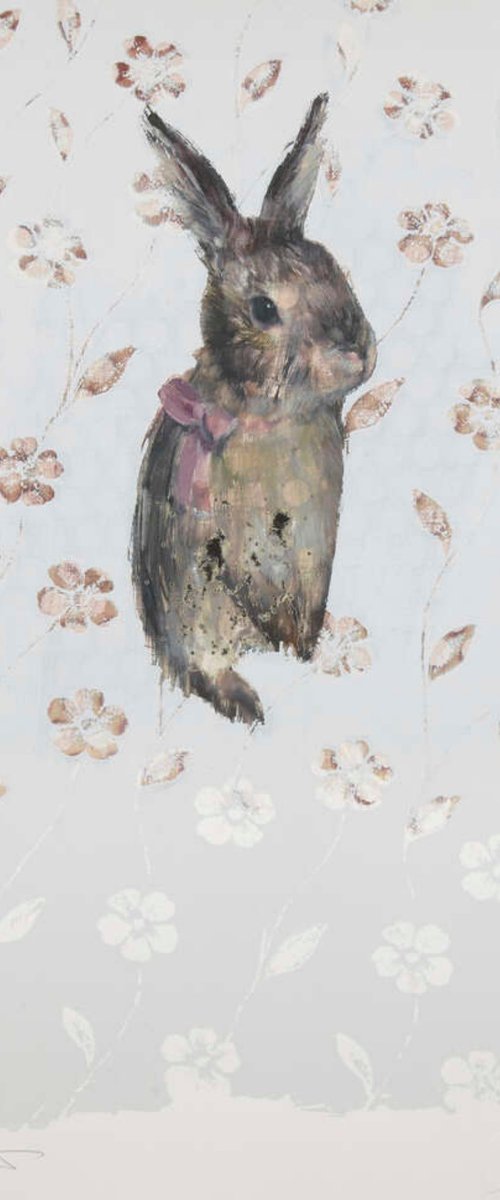
Baker's paintings favour a small cast of recurring subjects, including horses, birds and people. They're often rendered with tenderness and technical control, which he then intervenes with physically, drilling holes through a canvas or, on occasion, firing a shotgun into it.
He has described the impulse as a refusal to let any image mean only one thing. Damien Hirst, a longtime admirer, has praised the resulting tension between preciousness and throwaway risk that runs through Baker's work.
Prints for a wider audience
Alongside his paintings, Baker produces an extensive range of screenprints, archival pigment prints and handfinished editions. He often releases these through the London print studio, Jealous. His pricing is also deliberate: it lets him reach collectors who could never afford an original.
Some editions extend his damaged canvas technique onto paper and wood panel, combining screenprint with handpainting, airbrushed ink, gold leaf or copper leaf overlays. Baker's sculpture Triumph in the Face of Absurdity was made with designer Sir Paul Smith for the 2012 Olympics and was displayed at the Victoria and Albert Museum in 2012. He has exhibited widely across London, New York and Los Angeles.
Biography
About Charming Baker
Charming Baker was born in Hampshire, England, in 1964. He spent much of his childhood travelling with his family, who eventually settled in North Yorkshire, when he was 12. He left school at 16 and spent several years doing manual work. It’s rumoured that this included time on a farm where he is said to have acquired the nickname 'Charming'. He later returned to education and won a place at Central Saint Martins, where he also later returned to teach.
Beauty, then a wound
Baker's paintings favour a small cast of recurring subjects, including horses, birds and people. They're often rendered with tenderness and technical control, which he then intervenes with physically, drilling holes through a canvas or, on occasion, firing a shotgun into it.
He has described the impulse as a refusal to let any image mean only one thing. Damien Hirst, a longtime admirer, has praised the resulting tension between preciousness and throwaway risk that runs through Baker's work.
Prints for a wider audience
Alongside his paintings, Baker produces an extensive range of screenprints, archival pigment prints and handfinished editions. He often releases these through the London print studio, Jealous. His pricing is also deliberate: it lets him reach collectors who could never afford an original.
Some editions extend his damaged canvas technique onto paper and wood panel, combining screenprint with handpainting, airbrushed ink, gold leaf or copper leaf overlays. Baker's sculpture Triumph in the Face of Absurdity was made with designer Sir Paul Smith for the 2012 Olympics and was displayed at the Victoria and Albert Museum in 2012. He has exhibited widely across London, New York and Los Angeles.