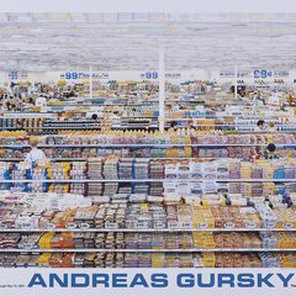
Andreas Gursky photographs the scale of modern life: stock exchange floors, supermarket aisles, apartment blocks and crowded dance floors, printed so large and sharp that every tiny detail stays in focus. From a distance, his images read as patterns, but up close, they're full of detail.
A leading figure of the Düsseldorf School of Photography, he trained under Bernd and Hilla Becher and began digitally reworking his photographs around 1990, combining and editing shots to build views no single camera could capture.
In 2011, his photograph Rhein II became the most expensive photograph ever sold at auction at the time.
Summary
Andreas Gursky photographs the scale of modern life: stock exchange floors, supermarket aisles, apartment blocks and crowded dance floors, printed so large and sharp that every tiny detail stays in focus. From a distance, his images read as patterns, but up close, they're full of detail.
A leading figure of the Düsseldorf School of Photography, he trained under Bernd and Hilla Becher and began digitally reworking his photographs around 1990, combining and editing shots to build views no single camera could capture.
In 2011, his photograph Rhein II became the most expensive photograph ever sold at auction at the time.
A leading figure of the Düsseldorf School of Photography, he trained under Bernd and Hilla Becher and began digitally reworking his photographs around 1990, combining and editing shots to build views no single camera could capture.
In 2011, his photograph Rhein II became the most expensive photograph ever sold at auction at the time.
Artworks by Andreas Gursky
About Andreas Gursky
Biography
About Andreas Gursky
Andreas Gursky was born in 1955 in Leipzig, then part of East Germany. Growing up in Düsseldorf, photography ran in the family: his grandfather was a photographer and his father worked as a successful commercial photographer.
In the late 1970s, Gursky studied visual communication at the Folkwang School in Essen, before joining the Kunstakademie Düsseldorf in the early 1980s, where he became a master student of Bernd Becher.
From the Becher class to the big picture
The Bechers taught a cool, systematic way of looking, where the practice was to photograph industrial structures with the same neutral approach again and again. Gursky's earliest black-and-white work followed that method closely. Alongside fellow students including Thomas Ruff, Thomas Struth and Candida Höfer, he became one of the defining names of what's now known as the Düsseldorf School.
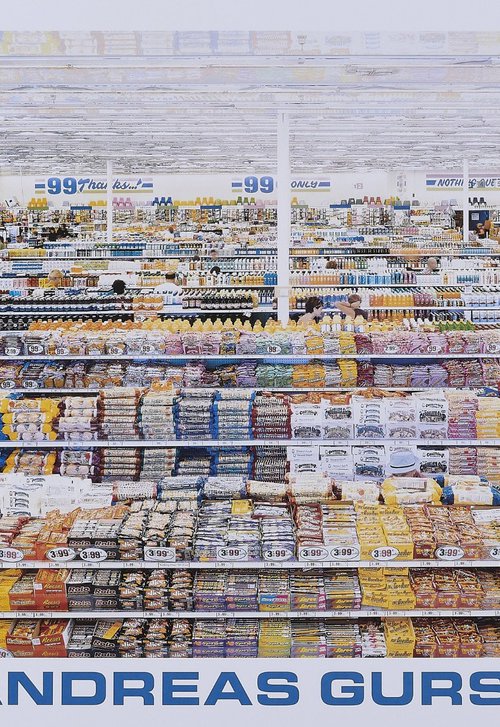
Gursky soon moved to colour and a much larger scale, often shooting from a raised viewpoint that flattened space and turned people into patterns. From around 1990, he began editing his photographs digitally, merging several frames and removing details to sharpen an idea rather than simply record a scene. For Paris, Montparnasse he combined views of a vast apartment block into a single, seemingly endless façade, while 99 Cent turned the aisles of a Los Angeles discount store into rows of colour stretching into the distance.
Rhein II takes this concept the furthest. Gursky digitally removed buildings, including a power station, from a view of the Rhine outside Düsseldorf, leaving bands of sky, grass and water that echo abstract painting.
Printing on a monumental scale
Gursky's prints are central to how they're experienced. Many are several metres wide and face-mounted behind acrylic, a process known as ‘Diasec’, so the image can be seen at full scale and in full detail. They're typically produced in small editions, which keeps each print rare and makes size a defining part of the work.
His later series have carried that scale into new subjects, from the mass performances of Pyongyang to the warehouse shelves of Amazon. The Museum of Modern Art in New York held a major retrospective of his work in 2001. In 2018, the Hayward Gallery in London reopened with his first major UK retrospective.
He received the Goslar Kaiserring in 2008, taught at the Kunstakademie Düsseldorf from 2010 to 2018, and continues to live and work in Düsseldorf.