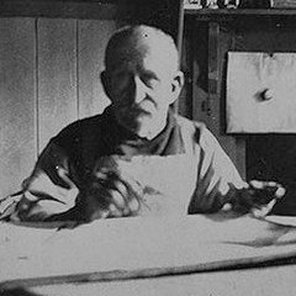
Alfred Wallis was a retired mariner who started painting in his 70s and became an unlikely influence on modern British art without ever setting out to be an artist. Working from memory, he painted ships, harbours and the cottages of St Ives on scraps of cardboard, using ship's paint and a handful of colours.
In 1928, two visiting painters, Ben Nicholson and Christopher Wood, spotted his pictures through an open door. Their admiration helped shape the modern art that grew up in St Ives in the decades that followed.
In 1928, two visiting painters, Ben Nicholson and Christopher Wood, spotted his pictures through an open door. Their admiration helped shape the modern art that grew up in St Ives in the decades that followed.
Summary
Alfred Wallis was a retired mariner who started painting in his 70s and became an unlikely influence on modern British art without ever setting out to be an artist. Working from memory, he painted ships, harbours and the cottages of St Ives on scraps of cardboard, using ship's paint and a handful of colours.
In 1928, two visiting painters, Ben Nicholson and Christopher Wood, spotted his pictures through an open door. Their admiration helped shape the modern art that grew up in St Ives in the decades that followed.
In 1928, two visiting painters, Ben Nicholson and Christopher Wood, spotted his pictures through an open door. Their admiration helped shape the modern art that grew up in St Ives in the decades that followed.
Artworks by Alfred Wallis
About Alfred Wallis
Biography
About Alfred Wallis
Alfred Wallis was born in 1855 in Devon to Cornish parents. He went to sea as a boy, working as a cabin boy and cook, later spending years as a fisherman in Cornwall. In 1876, he married Susan Ward, a widow more than 20 years his senior.
The couple moved to St Ives in 1887, where Wallis ran a business as a marine stores dealer, buying and selling ships' gear and scrap. After it closed, he took on odd jobs, reportedly including selling ice cream.
Painting from memory
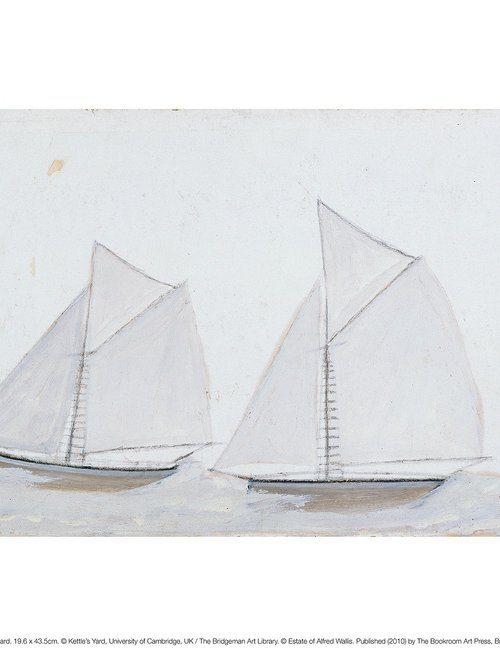
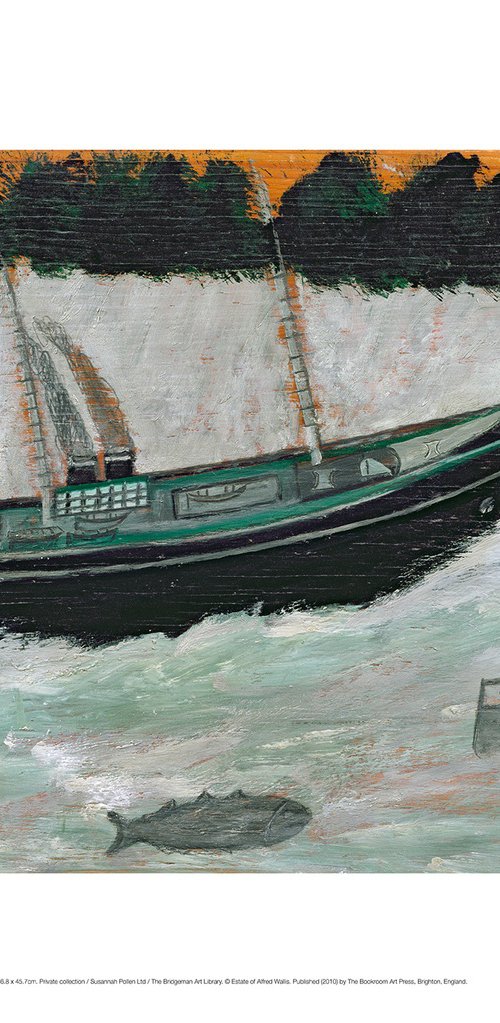
Susan died in 1922 and three years later (at around 70 years old), Wallis began to paint, as he said, “for company”. He had no training, instead painting the world he'd known: sailing ships and steamers, harbours, lighthouses and the streets of St Ives, often with boats shown larger than the houses around them, their size set by importance rather than perspective.
His materials were whatever he had to hand. He used cardboard torn from packing boxes, odd scraps of wood and a narrow range of paint bought from local suppliers. He often let the shape of the cardboard guide the composition. Close study of his work suggests his choices were more deliberate than they first appear.
Discovery and legacy
In 1928, Ben Nicholson and Christopher Wood were walking through St Ives when they saw Wallis's paintings pinned up inside his cottage. Both were struck by the directness of his work; Wood going on to describe him as “not a bad master”. Through them, Wallis was introduced to the collector Jim Ede, who promoted his work in London. Today, Ede's former home, Kettle's Yard in Cambridge, holds one of the largest collections of his paintings.
Despite the attention, Wallis had little money and he died in 1942 in the workhouse at Madron, near Penzance. He's buried in Barnoon Cemetery, overlooking Porthmeor Beach and today's Tate St Ives.