- Kloska Ovidiu
- All Artworks
- The Eroded Journal of a Philosopher
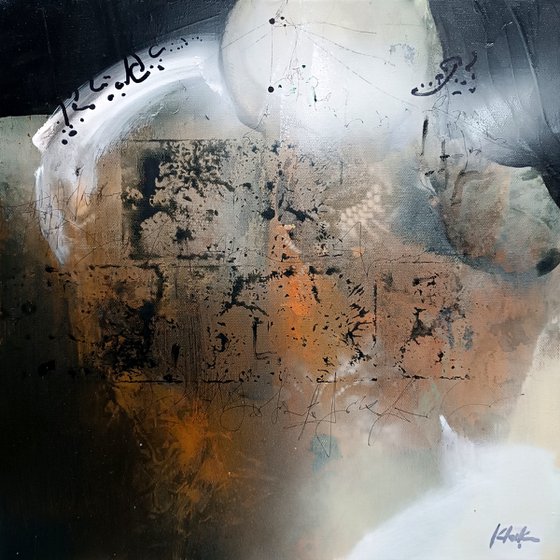
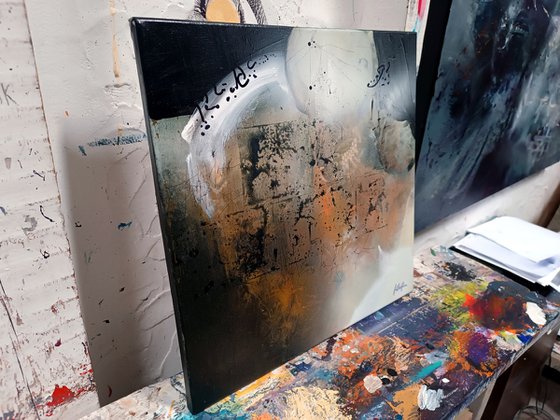

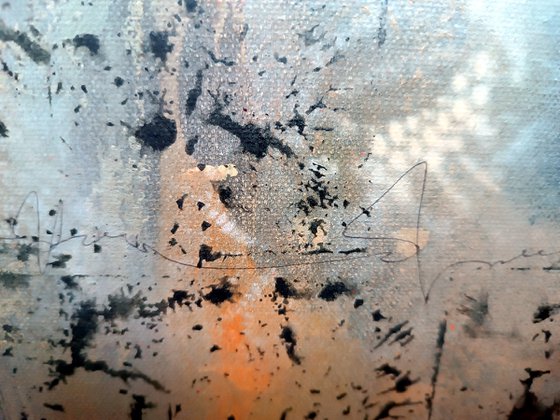
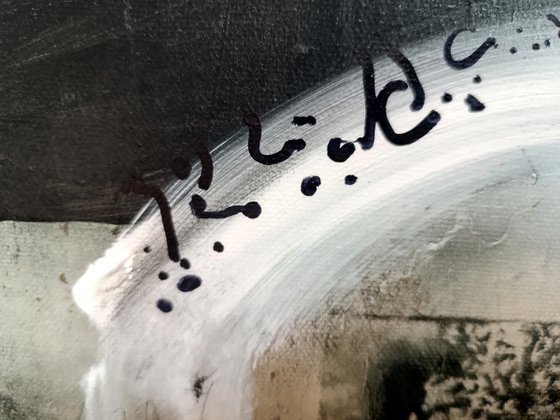
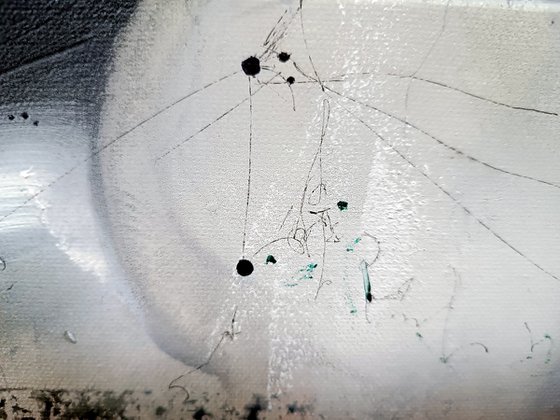
The Eroded Journal of a Philosopher (2026) Original Acrylic Painting by Kloska Ovidiu
40 x 40 x 2cm (unframed) / 40 x 40cm (actual image size)
£259.62
Original artwork description
“The Eroded Journal of a Philosopher”
from the series " The intimate caligraphies of the forgotten "
acrylic painting on canvas / 40 x 40 cm / signed and dated February 2026
This work may be understood as an archaeological section of collective memory — not as the representation of an identity, but as the excavation of the history of the human mind. The surface does not describe an individual body; it retains the sediment of a consciousness that traverses epochs. The painting functions as a fragment of a historical site in which matter preserves the traces of thought.
The pale curve in the upper register evokes a human presence on the threshold of disappearance — not the portrait of an individual, but the relic of a universal interiority. It recalls ancient torsos unearthed beneath layers of soil: incomplete, yet still bearing meaning. The body is not asserted, but inferred through erosion. Its presence is a consequence of time, not a point of departure.
The central horizontal band introduces a logic of historical sedimentation. Oxidized pigments, tones of burnt earth and carbonized black evoke corroded metal, worn parchment, fractured ancient walls. The surface appears to have endured successive inscriptions, erasures, rewritings. What we encounter is not composition in a formal sense, but a palimpsest of thought.
The calligraphic signs do not emerge as autobiographical expression, but as echoes of archaic writing. They evoke pre-Socratic fragments, the marginal notes of a withdrawn thinker, the traces of striking minds that intuited the great truths of humanity before those truths hardened into systems. Here, language does not deliver a coherent message; it testifies to the existence of a search. The mark is the residue of an intellectual combustion.
The history of the human mind is not linear. It is a colossal repository of intuitions, revelations, and failures. Each epoch reinterprets the ruins of the previous one. The painting captures precisely this transitional moment: not the idea in its plenitude, but its erosion. Not the monument, but the fragment. In this sense, forgetting is not disappearance, but a historical mechanism of transformation.
The square format intensifies the impression of a sealed archive, a chamber of accumulation. There is no narrative horizon, only the pressure of layers. The diffused luminosity in the lower area does not offer revelation, but exposure — like the museum light that protects fragile objects not because they are intact, but because they are essential.
Beneath the surface resonates an existential dimension: being is thrown into time, and time alters its form. Meaning is not guaranteed; it must be assumed under conditions of degradation and uncertainty. Memory is not a stable archive, but a vulnerable territory — and it is precisely this vulnerability that makes it indispensable.
“The Eroded Journal of a Philosopher” does not depict loss, but the continuity of consciousness through fragment. In abrasion, oxidation, and suspended mark emerges the idea that human thought survives not through clarity, but through residue.
Materials used:
acrylic painting on canvas varnished
Details:
- Acrylic painting on Canvas
- One of a kind artwork
- Size: 40 x 40 x 2cm (unframed) / 40 x 40cm (actual image size)
- Ready to hang
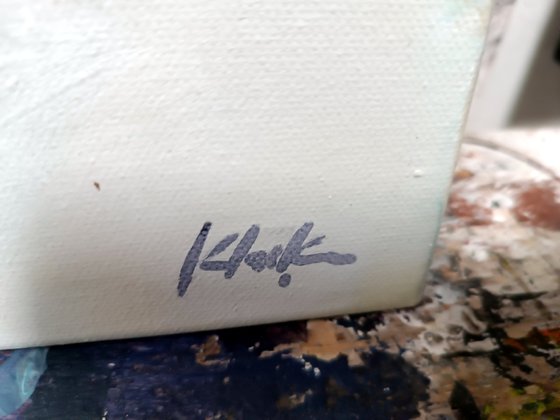
- Signed on the front
- Style: Expressive and gestural
- Subject: Abstract and non-figurative
Tags:
#time#history#memory#metaphysical#human mind#perenity#ovidiu kloska#caligraphic#phylosophycal#erossion Free returns
14 day money back guaranteeLearn more
Original artwork description
“The Eroded Journal of a Philosopher”
from the series " The intimate caligraphies of the forgotten "
acrylic painting on canvas / 40 x 40 cm / signed and dated February 2026
This work may be understood as an archaeological section of collective memory — not as the representation of an identity, but as the excavation of the history of the human mind. The surface does not describe an individual body; it retains the sediment of a consciousness that traverses epochs. The painting functions as a fragment of a historical site in which matter preserves the traces of thought.
The pale curve in the upper register evokes a human presence on the threshold of disappearance — not the portrait of an individual, but the relic of a universal interiority. It recalls ancient torsos unearthed beneath layers of soil: incomplete, yet still bearing meaning. The body is not asserted, but inferred through erosion. Its presence is a consequence of time, not a point of departure.
The central horizontal band introduces a logic of historical sedimentation. Oxidized pigments, tones of burnt earth and carbonized black evoke corroded metal, worn parchment, fractured ancient walls. The surface appears to have endured successive inscriptions, erasures, rewritings. What we encounter is not composition in a formal sense, but a palimpsest of thought.
The calligraphic signs do not emerge as autobiographical expression, but as echoes of archaic writing. They evoke pre-Socratic fragments, the marginal notes of a withdrawn thinker, the traces of striking minds that intuited the great truths of humanity before those truths hardened into systems. Here, language does not deliver a coherent message; it testifies to the existence of a search. The mark is the residue of an intellectual combustion.
The history of the human mind is not linear. It is a colossal repository of intuitions, revelations, and failures. Each epoch reinterprets the ruins of the previous one. The painting captures precisely this transitional moment: not the idea in its plenitude, but its erosion. Not the monument, but the fragment. In this sense, forgetting is not disappearance, but a historical mechanism of transformation.
The square format intensifies the impression of a sealed archive, a chamber of accumulation. There is no narrative horizon, only the pressure of layers. The diffused luminosity in the lower area does not offer revelation, but exposure — like the museum light that protects fragile objects not because they are intact, but because they are essential.
Beneath the surface resonates an existential dimension: being is thrown into time, and time alters its form. Meaning is not guaranteed; it must be assumed under conditions of degradation and uncertainty. Memory is not a stable archive, but a vulnerable territory — and it is precisely this vulnerability that makes it indispensable.
“The Eroded Journal of a Philosopher” does not depict loss, but the continuity of consciousness through fragment. In abrasion, oxidation, and suspended mark emerges the idea that human thought survives not through clarity, but through residue.
Materials used:
acrylic painting on canvas varnished
Details:
- Acrylic painting on Canvas
- One of a kind artwork
- Size: 40 x 40 x 2cm (unframed) / 40 x 40cm (actual image size)
- Ready to hang
- Signed on the front
- Style: Expressive and gestural
- Subject: Abstract and non-figurative
Tags:
#time#history#memory#metaphysical#human mind#perenity#ovidiu kloska#caligraphic#phylosophycal#erossion
Kloska Ovidiu
Romania
About
Ovidiu Kloska – Biography & Curriculum Vitae
BiographyOvidiu Kloska (b. 1977, Romania) is a contemporary visual artist whose multidisciplinary practice spans painting, welded-steel sculpture, mixed media, and oniric conceptual photography. His... Read more