- Enrico Brunati
- All Artworks
- Alcol 3
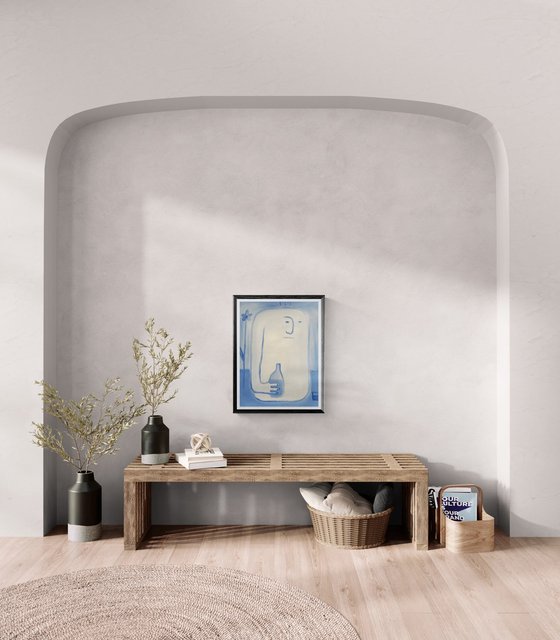
Original artwork description
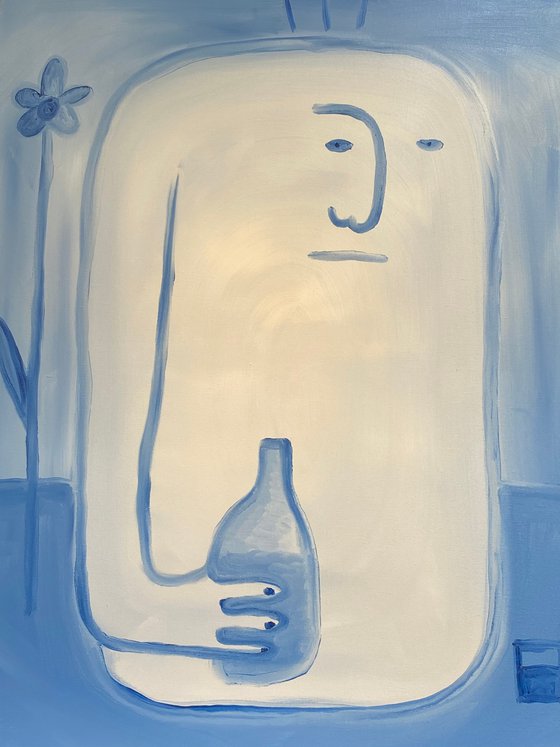
In "alcol 3", the visual narrative initiated in the first chapter expands, moving toward an even more pronounced formal synthesis loaded with symbolism. The anthropomorphic figure sheds the details of the chair and table to blend almost entirely with the space, transforming into a large, ivory-colored monolithic silhouette outlined in signature cobalt blue. The body becomes a tabula rasa, a vessel for silences.
The composition is enriched by new key elements that engage in a silent dialogue:
The bottle and the hand: at the center of the figure, a minimalist hand tightly grips a bottle. The arm forms a geometric, protective curve, as if to imply that the object has now become an extension of the body itself, a central axis around which the subject's existence revolves.
The displaced face: the facial features are minimal, almost naïve, yet deeply expressive. The eyes look away, past the viewer, suggesting a state of alienation, a fixated thought, or a detachment from the surrounding reality.
The flower in the background: On the left, a blue flower emerges, a new organic element that introduces a note of poetic melancholy. It may represent the fragility of life passing by outside, a memory of beauty, or a faint hope enduring despite the isolation.
The tiny glass: in the bottom right corner, scaled down against the majesty of the figure, the glass reappears—a geometric anchor connecting the scene back to the theme of the counter and solitude.
The overall effect is one of lyrical melancholy. While "alcol 1" captured a moment of reflection, "alcol 3" feels like a moment of assimilation: solitude becomes a landscape, the vice or refuge integrates into the self, while life (the flower) quietly observes from the corner.
Details:
- Oil painting on Canvas
- One of a kind artwork
- Size: 60 x 78 x 4cm (unframed)
- Signed on the back
- Style: Abstract
- Subject: People and portraits
 Free returns
14 day money back guaranteeLearn more
Original artwork description
In "alcol 3", the visual narrative initiated in the first chapter expands, moving toward an even more pronounced formal synthesis loaded with symbolism. The anthropomorphic figure sheds the details of the chair and table to blend almost entirely with the space, transforming into a large, ivory-colored monolithic silhouette outlined in signature cobalt blue. The body becomes a tabula rasa, a vessel for silences.
The composition is enriched by new key elements that engage in a silent dialogue:
The bottle and the hand: at the center of the figure, a minimalist hand tightly grips a bottle. The arm forms a geometric, protective curve, as if to imply that the object has now become an extension of the body itself, a central axis around which the subject's existence revolves.
The displaced face: the facial features are minimal, almost naïve, yet deeply expressive. The eyes look away, past the viewer, suggesting a state of alienation, a fixated thought, or a detachment from the surrounding reality.
The flower in the background: On the left, a blue flower emerges, a new organic element that introduces a note of poetic melancholy. It may represent the fragility of life passing by outside, a memory of beauty, or a faint hope enduring despite the isolation.
The tiny glass: in the bottom right corner, scaled down against the majesty of the figure, the glass reappears—a geometric anchor connecting the scene back to the theme of the counter and solitude.
The overall effect is one of lyrical melancholy. While "alcol 1" captured a moment of reflection, "alcol 3" feels like a moment of assimilation: solitude becomes a landscape, the vice or refuge integrates into the self, while life (the flower) quietly observes from the corner.
Details:
- Oil painting on Canvas
- One of a kind artwork
- Size: 60 x 78 x 4cm (unframed)
- Signed on the back
- Style: Abstract
- Subject: People and portraits