- Kloska Ovidiu
- All Artworks
- Where Memory Thins
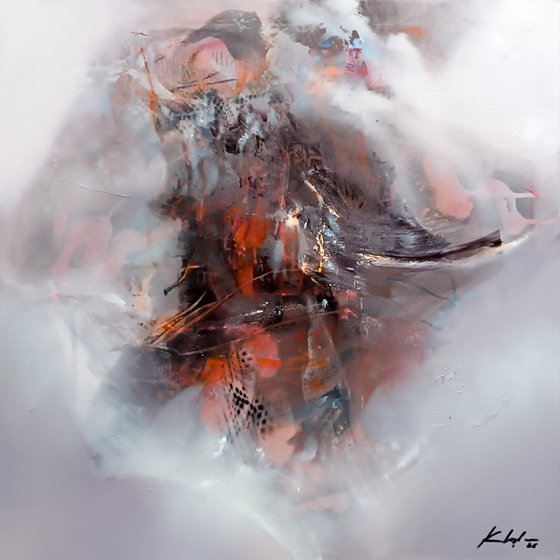
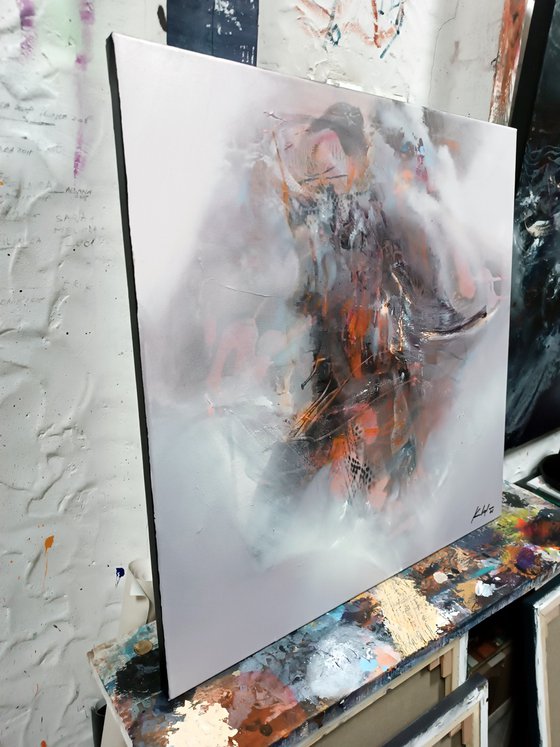
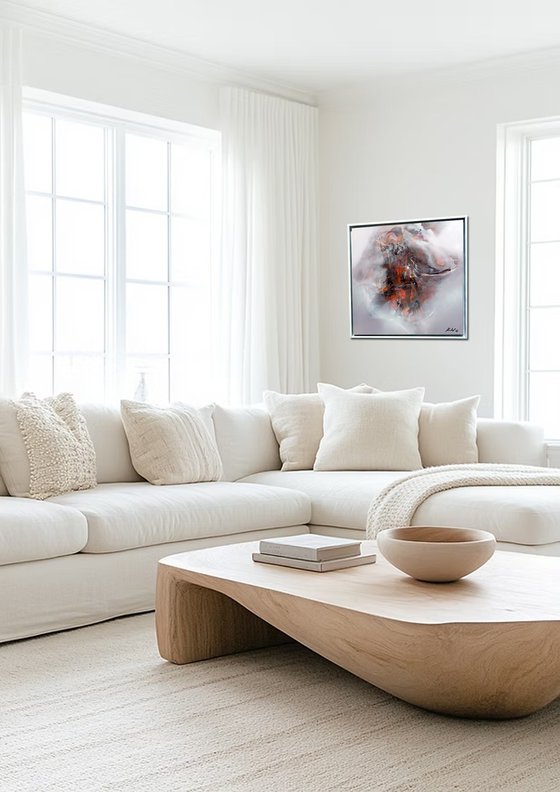

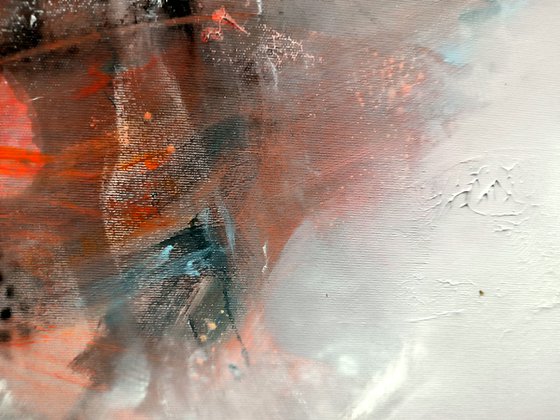
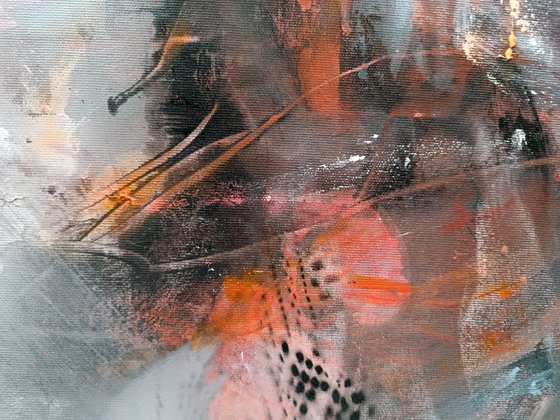
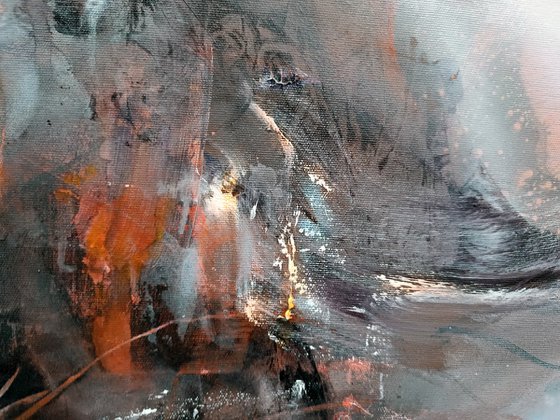
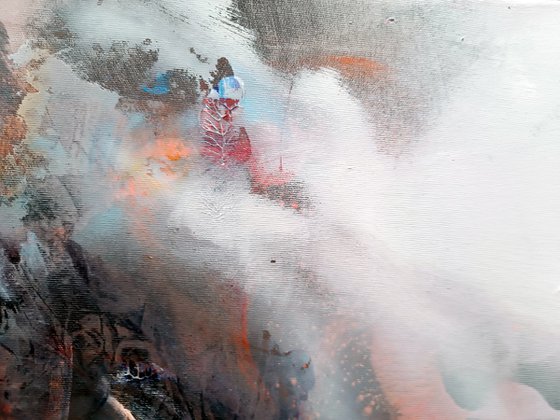
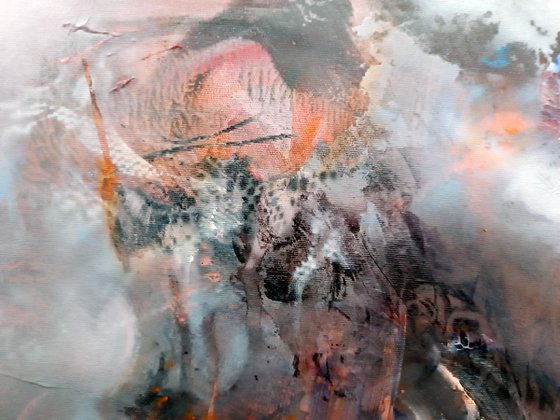
Where Memory Thins (2026) Original Acrylic Painting by Kloska Ovidiu
70 x 70 x 2cm (unframed) / 70 x 70cm (actual image size)
£865.41Sold
Do you like this artwork?
This artwork has sold, but the artist is accepting commission requests. Commissioning an artwork is easy and you get a perfectly personalised piece.
Original artwork description
Where Memory Thins continues the Cycle of Remembering by shifting its focus from condensation to release, from the weight of sedimented memory to its gradual diffusion. If earlier works within the cycle explored how memory accumulates, hardens, and presses upon form, this painting inhabits a more permeable state—one in which memory begins to loosen its grip without fully dissolving.
The composition is structured around a vertical, loosely centralized axis that evokes an internal architecture: a spine, a breath column, or a core of sensation. Unlike the dense central mass seen in The Shape Memory Leaves, this structure remains unstable, partially veiled by layers of translucent paint and atmospheric haze. Form here is not asserted but negotiated. It flickers between emergence and disappearance, suggesting memory not as a fixed imprint but as a fluctuating condition.
The surrounding field plays a crucial role in this negotiation. Soft, cloud-like passages expand outward from the center, blurring the boundary between figure and ground. This diffusion introduces a sense of suspension, as if the painting were inhaling and exhaling. Memory no longer confronts the viewer with its weight; instead, it drifts, thins, and disperses across the surface. The edges refuse closure, reinforcing the idea that remembering is not confined to a single locus but seeps into peripheral awareness.
Color operates as a carrier of residual intensity. Muted greys and pale tonalities establish an atmospheric calm, yet this calm is punctuated by pulses of ember-like orange, deep browns, and traces of blue. These chromatic interruptions feel less like ruptures than afterimages—remnants of heat retained after contact. They suggest that even as memory thins, it does not empty itself of affect. What remains is not absence, but a softened persistence.
Gesturally, the painting balances control and surrender. Sweeping lateral marks intersect with vertical tensions, disrupting any stable orientation. This interplay introduces movement and temporality, aligning the work with the cyclical logic of the series. Memory here does not progress forward; it circulates, loosens, reforms, and releases again. The viewer is invited not to decipher the image, but to inhabit its rhythm.
In relation to the Cycle of Remembering, Where Memory Thins functions as a necessary counterpoint. If The Shape Memory Leaves articulated memory’s capacity to weigh upon matter, this work asks what becomes possible once that weight begins to lift. It proposes remembering as a dynamic equilibrium between holding and letting go, between residue and air.
Ultimately, this painting does not resolve memory; it suspends it. It suggests that thinning is not loss, but transformation—a state in which memory remains present precisely because it is no longer fixed. In this openness, the work finds its quiet strength, allowing memory to breathe, drift, and persist in altered form.
Materials used:
acrylics on canvas varnished
Details:
- Acrylic painting on Canvas
- One of a kind artwork
- Size: 70 x 70 x 2cm (unframed) / 70 x 70cm (actual image size)
- Ready to hang
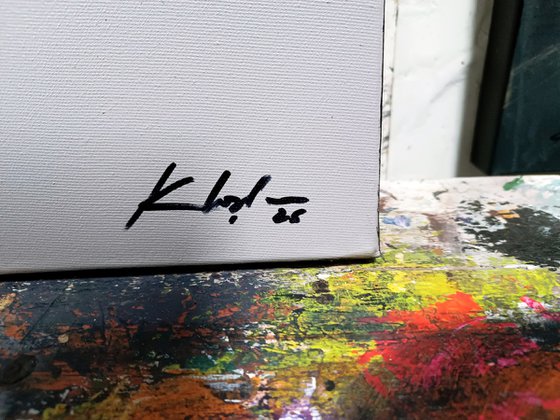
- Signed on the front
- Style: Organic
- Subject: Landscapes, sea and sky
Tags:
#time#light#memory#dreamscape#silence#erosion#mindscape#metaphysical#perenity#ovidiu kloska Free returns
14 day money back guaranteeLearn more
Original artwork description
Where Memory Thins continues the Cycle of Remembering by shifting its focus from condensation to release, from the weight of sedimented memory to its gradual diffusion. If earlier works within the cycle explored how memory accumulates, hardens, and presses upon form, this painting inhabits a more permeable state—one in which memory begins to loosen its grip without fully dissolving.
The composition is structured around a vertical, loosely centralized axis that evokes an internal architecture: a spine, a breath column, or a core of sensation. Unlike the dense central mass seen in The Shape Memory Leaves, this structure remains unstable, partially veiled by layers of translucent paint and atmospheric haze. Form here is not asserted but negotiated. It flickers between emergence and disappearance, suggesting memory not as a fixed imprint but as a fluctuating condition.
The surrounding field plays a crucial role in this negotiation. Soft, cloud-like passages expand outward from the center, blurring the boundary between figure and ground. This diffusion introduces a sense of suspension, as if the painting were inhaling and exhaling. Memory no longer confronts the viewer with its weight; instead, it drifts, thins, and disperses across the surface. The edges refuse closure, reinforcing the idea that remembering is not confined to a single locus but seeps into peripheral awareness.
Color operates as a carrier of residual intensity. Muted greys and pale tonalities establish an atmospheric calm, yet this calm is punctuated by pulses of ember-like orange, deep browns, and traces of blue. These chromatic interruptions feel less like ruptures than afterimages—remnants of heat retained after contact. They suggest that even as memory thins, it does not empty itself of affect. What remains is not absence, but a softened persistence.
Gesturally, the painting balances control and surrender. Sweeping lateral marks intersect with vertical tensions, disrupting any stable orientation. This interplay introduces movement and temporality, aligning the work with the cyclical logic of the series. Memory here does not progress forward; it circulates, loosens, reforms, and releases again. The viewer is invited not to decipher the image, but to inhabit its rhythm.
In relation to the Cycle of Remembering, Where Memory Thins functions as a necessary counterpoint. If The Shape Memory Leaves articulated memory’s capacity to weigh upon matter, this work asks what becomes possible once that weight begins to lift. It proposes remembering as a dynamic equilibrium between holding and letting go, between residue and air.
Ultimately, this painting does not resolve memory; it suspends it. It suggests that thinning is not loss, but transformation—a state in which memory remains present precisely because it is no longer fixed. In this openness, the work finds its quiet strength, allowing memory to breathe, drift, and persist in altered form.
Materials used:
acrylics on canvas varnished
Details:
- Acrylic painting on Canvas
- One of a kind artwork
- Size: 70 x 70 x 2cm (unframed) / 70 x 70cm (actual image size)
- Ready to hang
- Signed on the front
- Style: Organic
- Subject: Landscapes, sea and sky
Tags:
#time#light#memory#dreamscape#silence#erosion#mindscape#metaphysical#perenity#ovidiu kloska
Kloska Ovidiu
Romania
About
Ovidiu Kloska – Biography & Curriculum Vitae
BiographyOvidiu Kloska (b. 1977, Romania) is a contemporary visual artist whose multidisciplinary practice spans painting, welded-steel sculpture, mixed media, and oniric conceptual photography. His... Read more