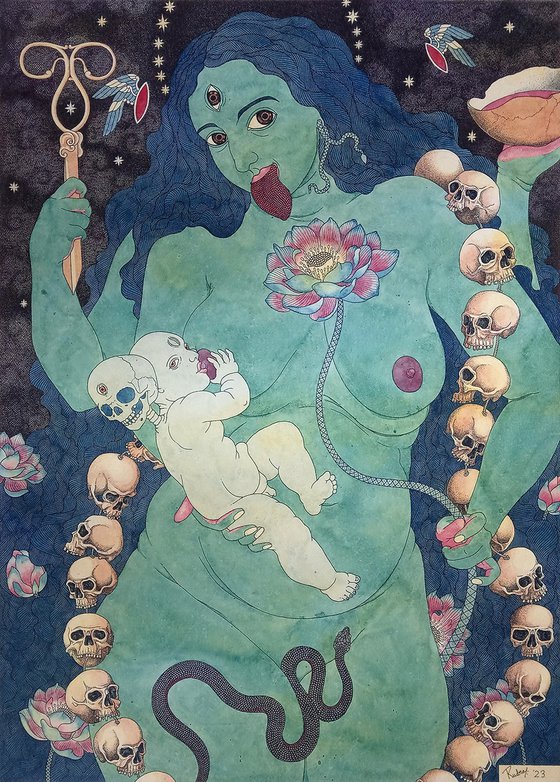
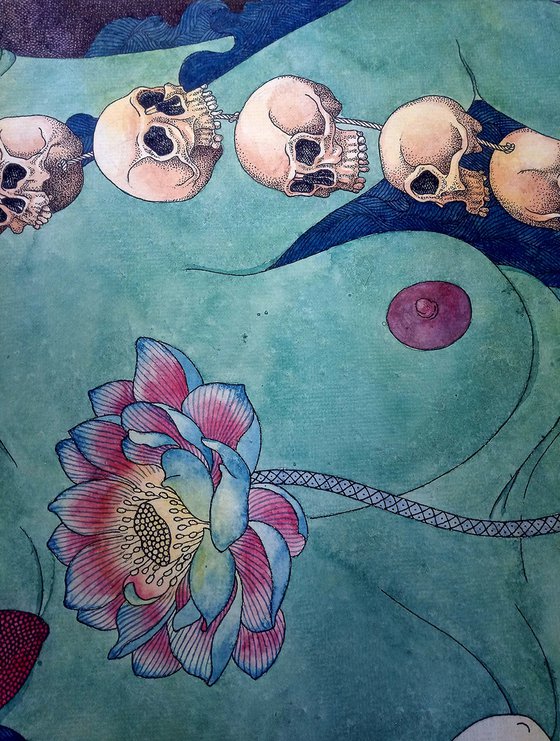
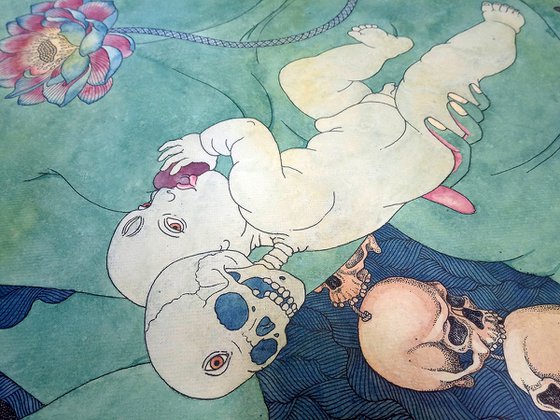
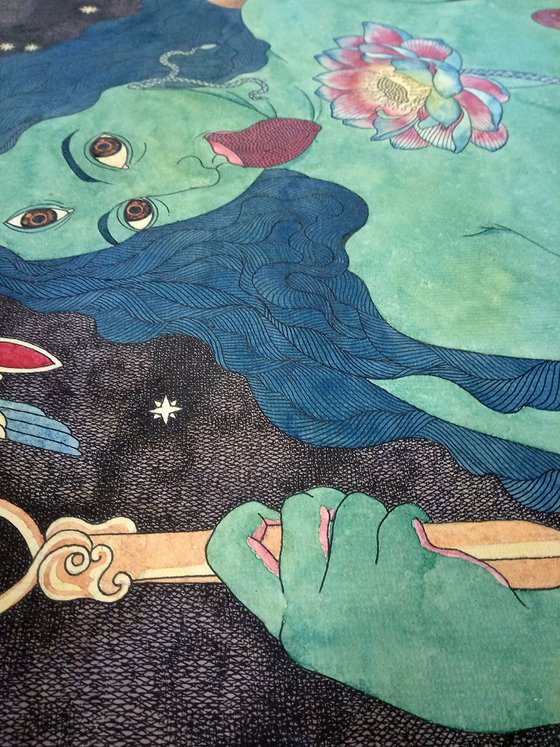
Tara (2023) Original Mixed-media Painting by Rudra Kishore Mandal
52.07 x 72.39 x 0.25cm (unframed)
£2,869.09
Original artwork description
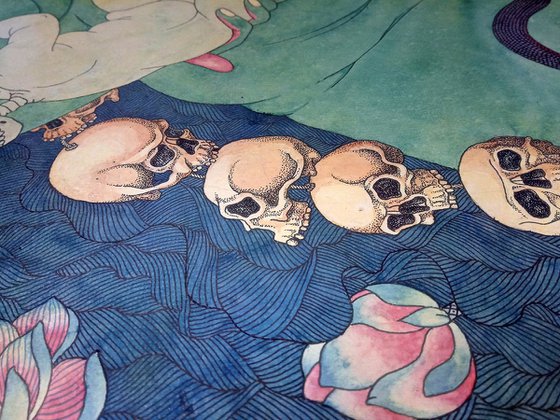
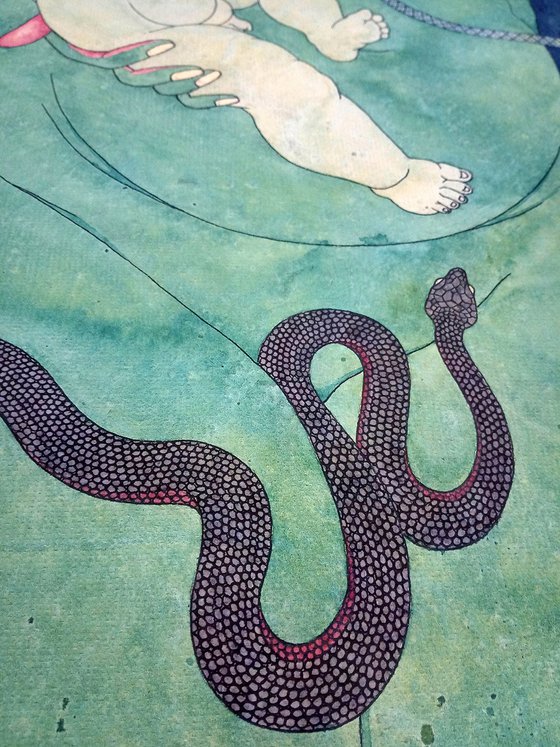
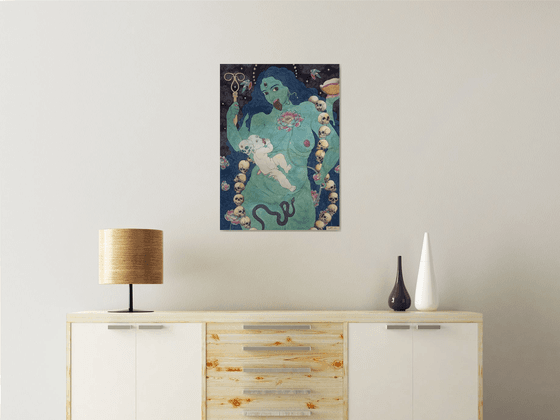
Tara is glorified as the 2nd fierce manifestation of Sati, just after Kali, as a Dasa Mahavidya (Ten cosmic wisdoms) in Hindu mythology but Tara’s origins can be traced to ancient Goddesses like Ishtar, Astarte, Isis and Aphrodite, due to the derived similarities in attributed powers, symbolism and ritual practices. All these goddesses were linked with water bodies in some ways and the symbolism of stars or planets. The same connections are easily traceable to the Christian attributes of Mother Mary also known as ‘Stella Maris’ (Star of the Sea). Tara was the void at the beginning of time and once awakened she created the entire universe out of her nonbeing. Created life and death, and everything in between. The ‘Samsara’ she manifested out of ‘Maya’ is like a vast sea of the unknown and she was the only guide who could help us to traverse that sea without getting lost and drowning. She is the peril and she is the saviour. She is the void and she is the ‘Tara’ (Star) of light in that void; the duality which is intrinsic to nature. Hence Tara’s role as a Devi imbues her with powers of compassion, protection from danger and providing enlightenment. In Tibet, Tara is referred to as ‘Dolma’ meaning saviour. Both the Hindu and Buddhist narratives about Tara have one thing in common: Shakti, the strength of the feminine energy and how it defies patriarchal misogyny. Tara as the mother suckles an incapacitated Shiva and nourishes him back to full power while Princess Jnanacandra rejecting the need for a male body to become a bodhisattva also challenges the almighty masculinity driven religious practices and successfully creates a place of reverence for female bodied bodhisattvas. The sad truth though: the fight for femininity to prove its power, again and again, in comparison and in competition with masculinity is still as much a reality as it was in those ancient times! The need for these narratives to resurface has never lost its importance.
NOTE: Custom duty fee if any is payable by the buyer. Different Countries have different rules and regulations for packages being shipped in and the Custom duty fee varies as well. Such fees are not included in the shipping cost.
Materials used:
Watercolor wash and pen drawing with waterproof ink on handmade paper
Details:
- Mixed-media painting on Paper
- One of a kind artwork
- Size: 52.07 x 72.39 x 0.25cm (unframed)
- Signed on the front
- Style: Surrealistic
- Subject: Nudes and erotic
Tags:
#figurative#nude#mother#spiritual#symbolism#mythology#goddess#female body#femininity#women power Free returns
14 day money back guaranteeLearn more
Original artwork description
Tara is glorified as the 2nd fierce manifestation of Sati, just after Kali, as a Dasa Mahavidya (Ten cosmic wisdoms) in Hindu mythology but Tara’s origins can be traced to ancient Goddesses like Ishtar, Astarte, Isis and Aphrodite, due to the derived similarities in attributed powers, symbolism and ritual practices. All these goddesses were linked with water bodies in some ways and the symbolism of stars or planets. The same connections are easily traceable to the Christian attributes of Mother Mary also known as ‘Stella Maris’ (Star of the Sea). Tara was the void at the beginning of time and once awakened she created the entire universe out of her nonbeing. Created life and death, and everything in between. The ‘Samsara’ she manifested out of ‘Maya’ is like a vast sea of the unknown and she was the only guide who could help us to traverse that sea without getting lost and drowning. She is the peril and she is the saviour. She is the void and she is the ‘Tara’ (Star) of light in that void; the duality which is intrinsic to nature. Hence Tara’s role as a Devi imbues her with powers of compassion, protection from danger and providing enlightenment. In Tibet, Tara is referred to as ‘Dolma’ meaning saviour. Both the Hindu and Buddhist narratives about Tara have one thing in common: Shakti, the strength of the feminine energy and how it defies patriarchal misogyny. Tara as the mother suckles an incapacitated Shiva and nourishes him back to full power while Princess Jnanacandra rejecting the need for a male body to become a bodhisattva also challenges the almighty masculinity driven religious practices and successfully creates a place of reverence for female bodied bodhisattvas. The sad truth though: the fight for femininity to prove its power, again and again, in comparison and in competition with masculinity is still as much a reality as it was in those ancient times! The need for these narratives to resurface has never lost its importance.
NOTE: Custom duty fee if any is payable by the buyer. Different Countries have different rules and regulations for packages being shipped in and the Custom duty fee varies as well. Such fees are not included in the shipping cost.
Materials used:
Watercolor wash and pen drawing with waterproof ink on handmade paper
Details:
- Mixed-media painting on Paper
- One of a kind artwork
- Size: 52.07 x 72.39 x 0.25cm (unframed)
- Signed on the front
- Style: Surrealistic
- Subject: Nudes and erotic
Tags:
#figurative#nude#mother#spiritual#symbolism#mythology#goddess#female body#femininity#women power