- Megan Ashman
- All Artworks
- Synchrodestiny & Pseudo Fate
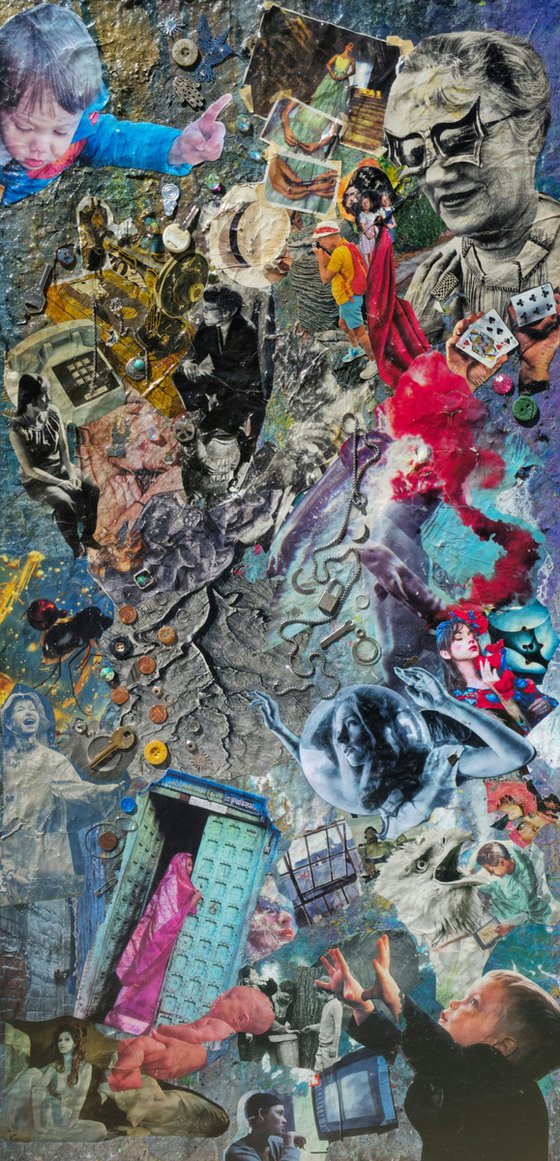
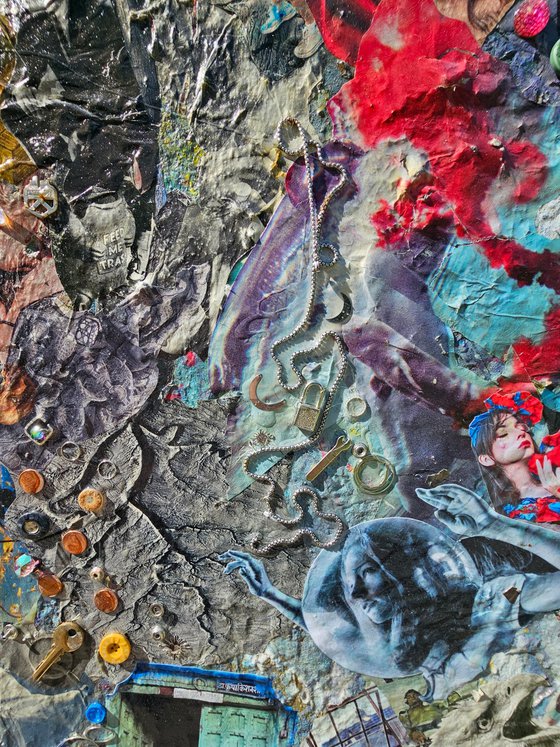
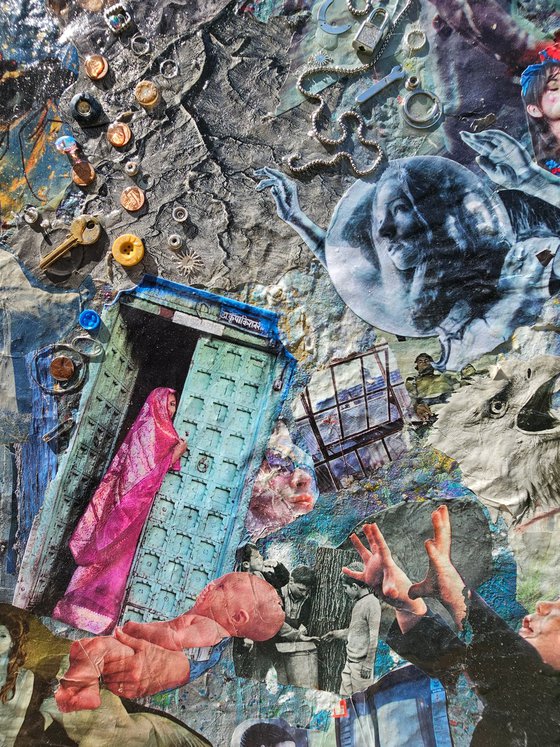
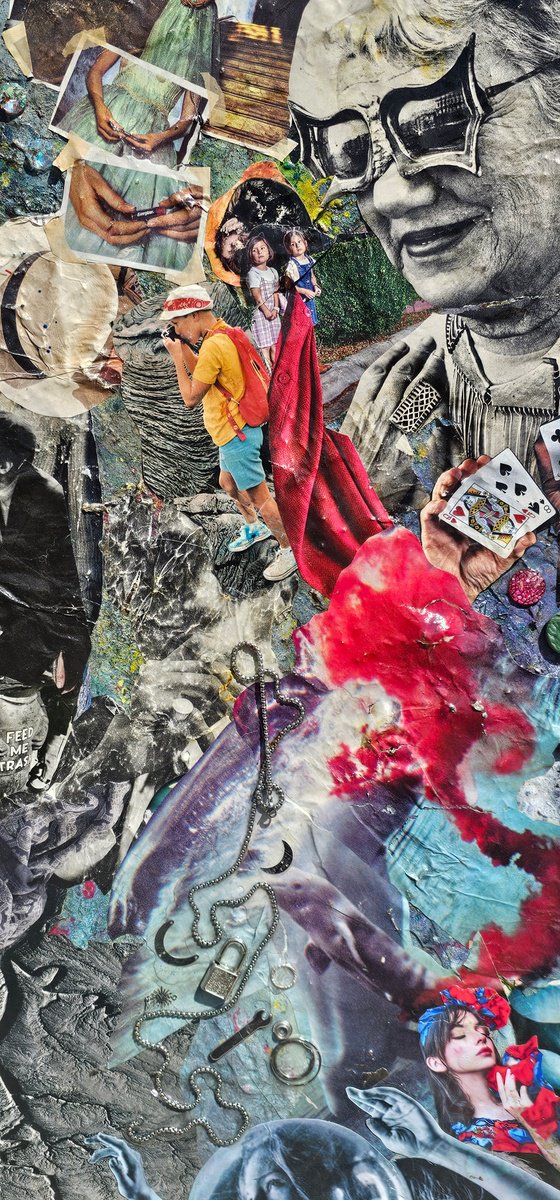
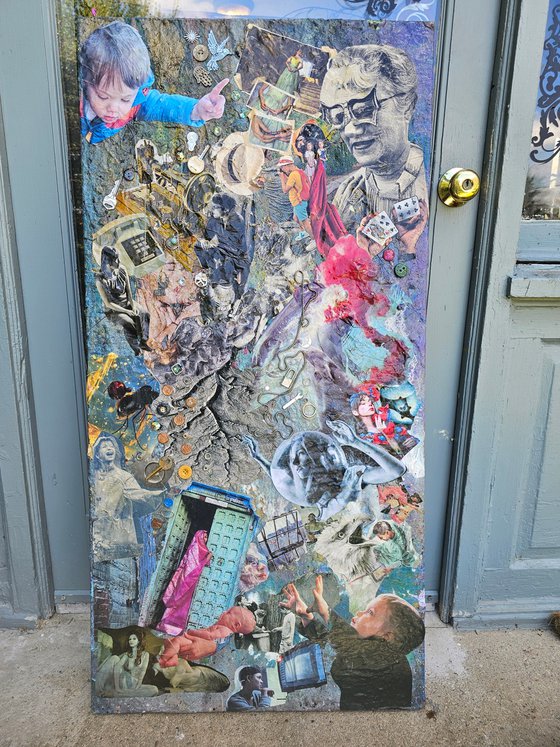
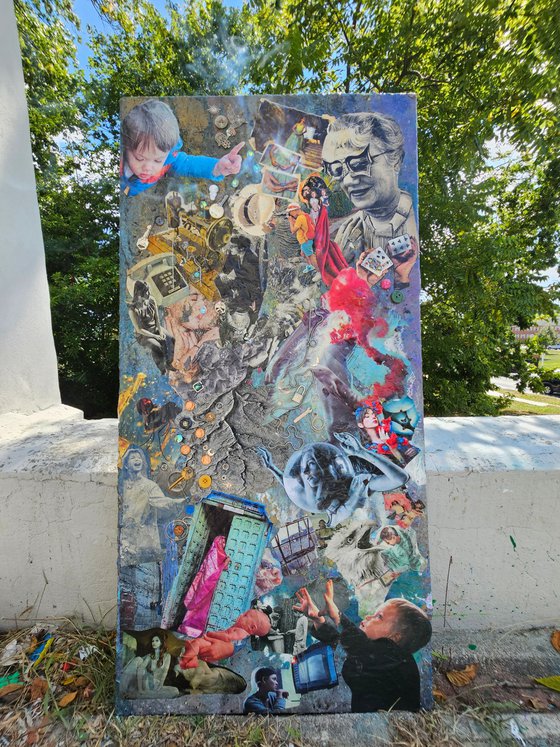
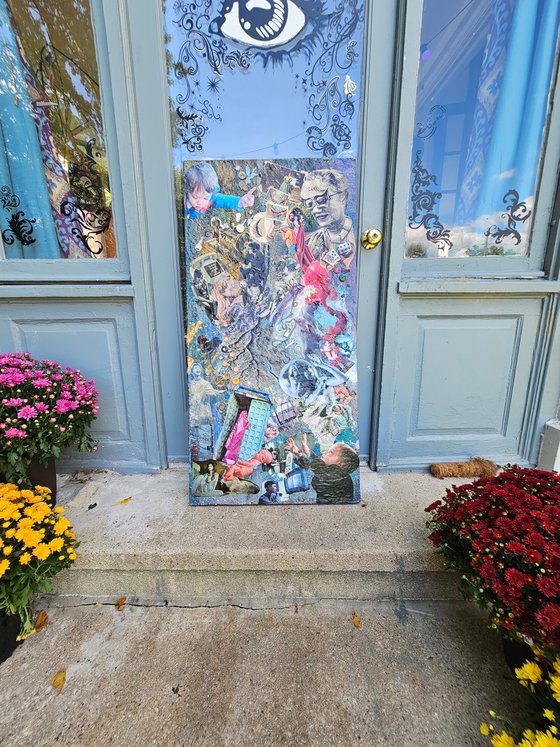
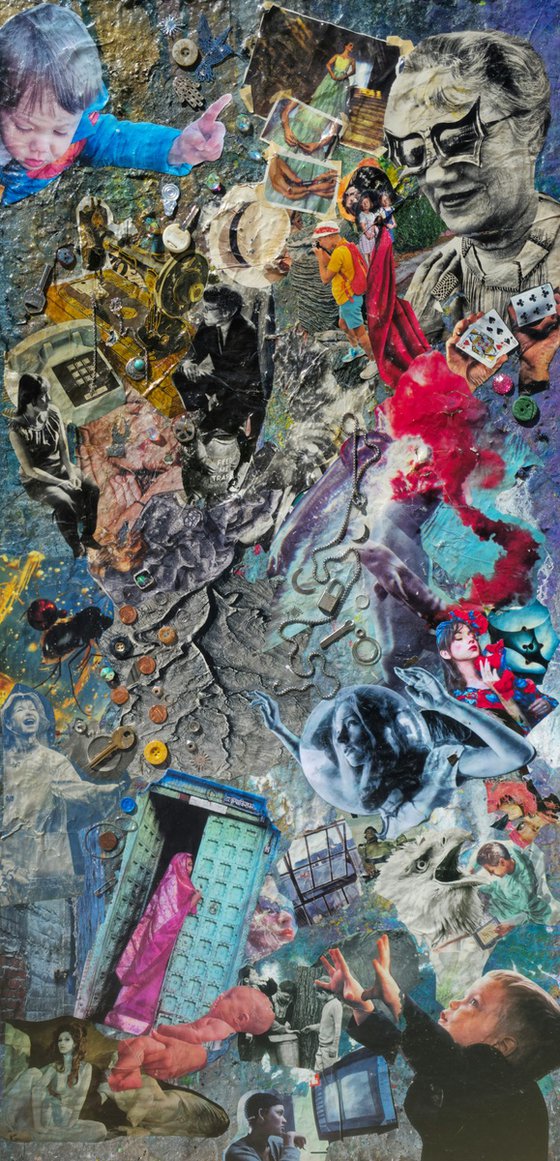
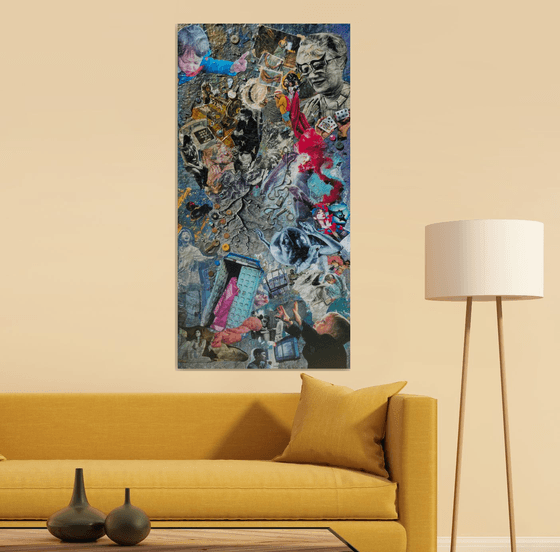
Synchrodestiny & Pseudo Fate (2025) Original Collage by Megan Ashman
60.96 x 121.92 x 5.08cm (unframed) / 60.96 x 121.92cm (actual image size)
£2,484.15
Original artwork description
Synchrodestiny & Pseudo Fate is a map of connection—an exploration of the tension between the paths we are given and the paths we choose. It follows the beautiful, bloody, and bizarre threads that weave together a life: birth, memory, inheritance, chance, communication, identity, technology, and the stories we create to explain how we arrived where we are.
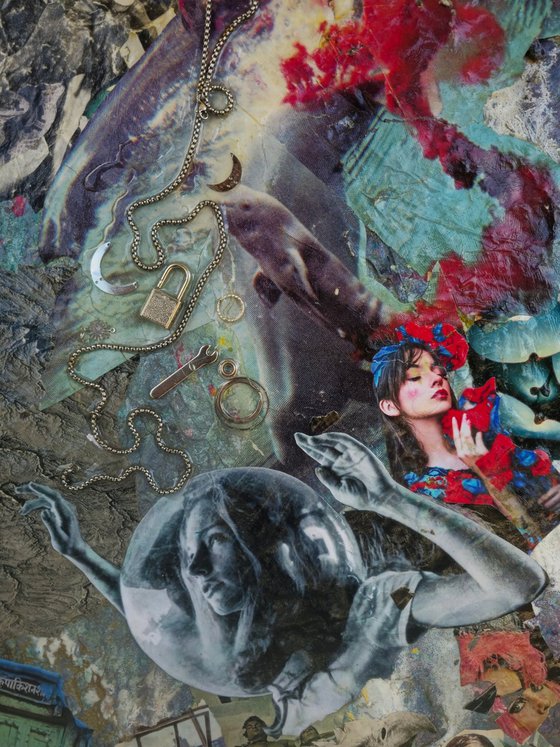
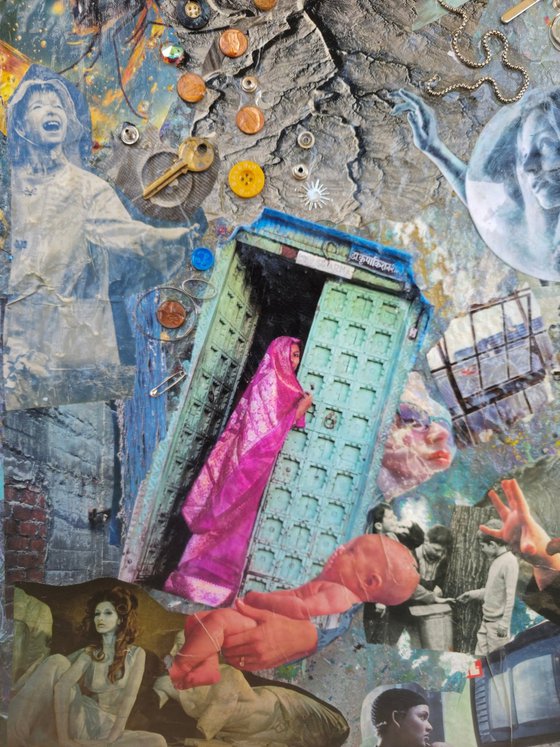
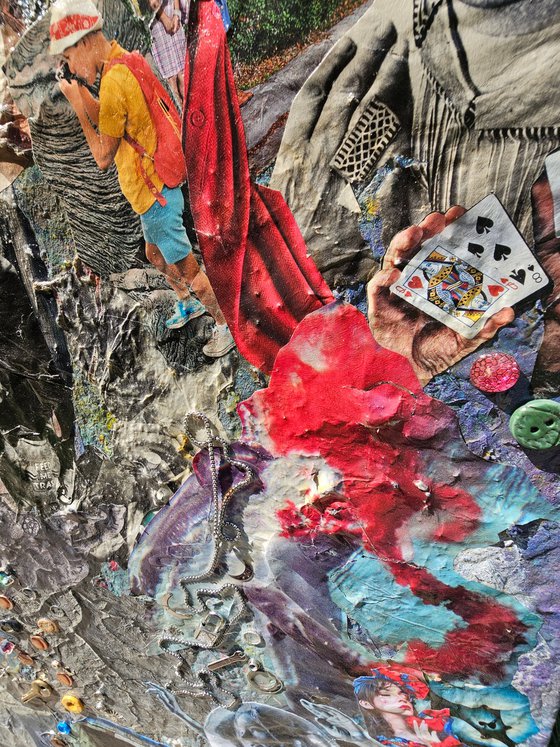
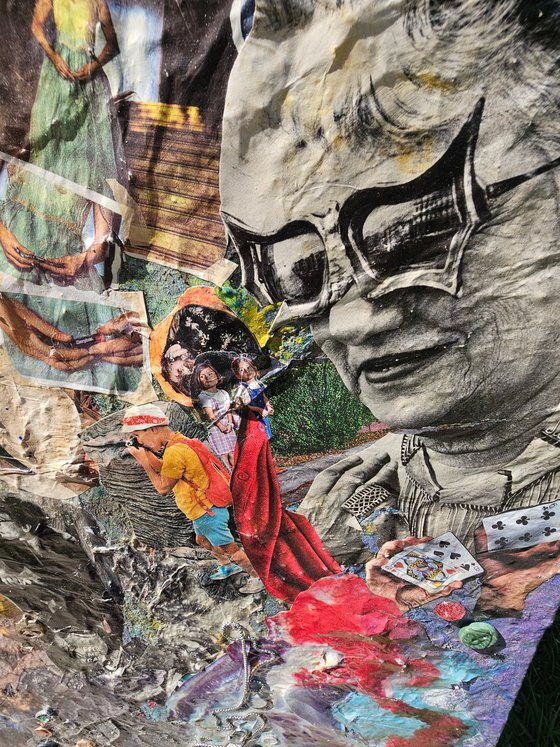
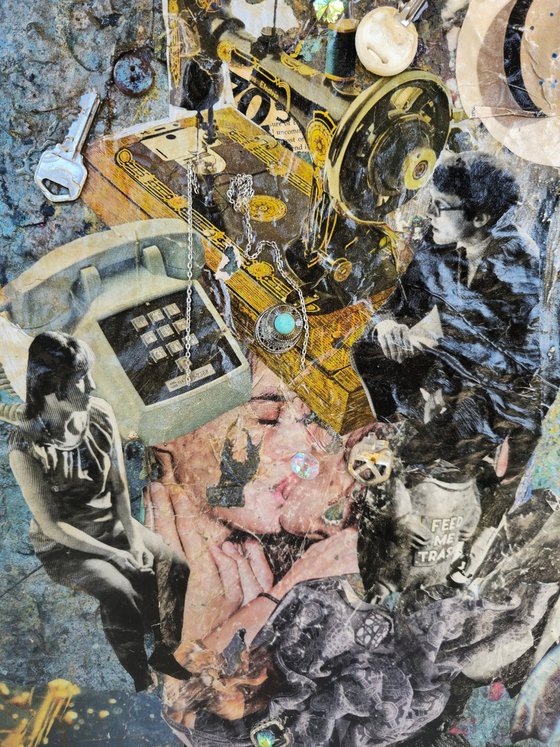
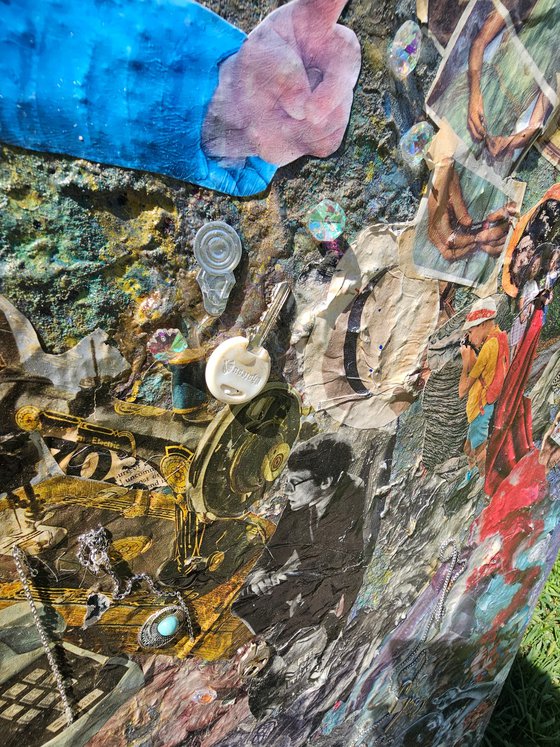
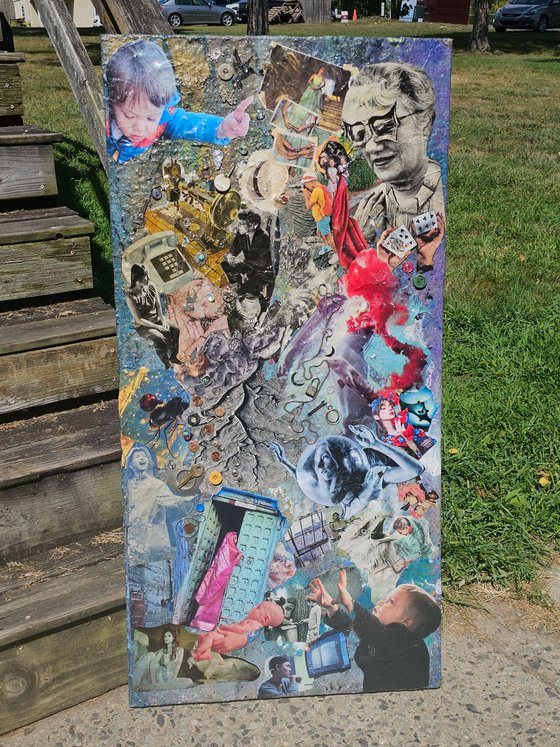
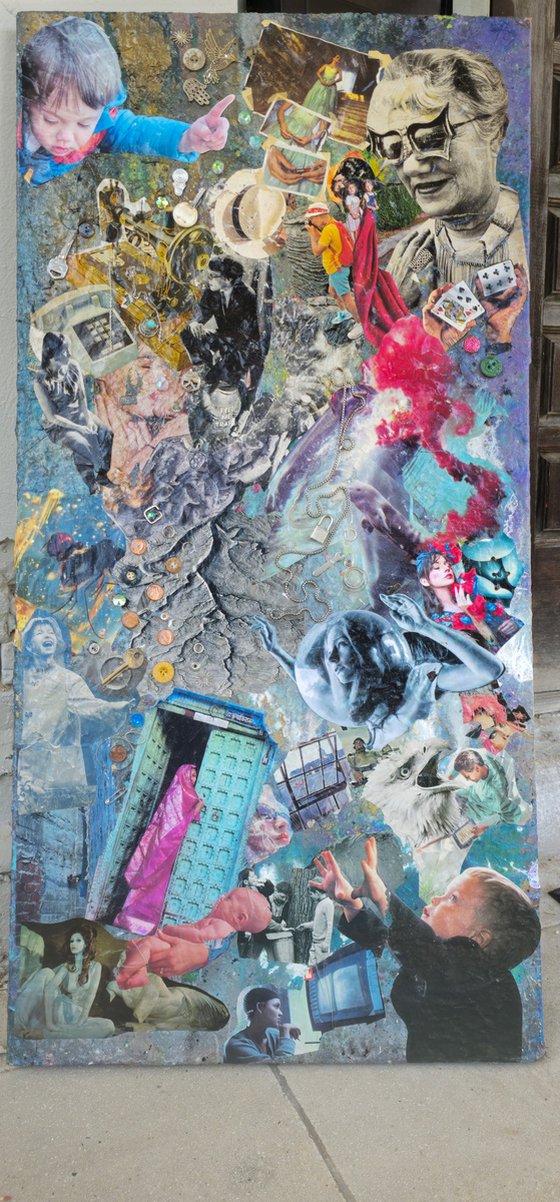
Figures from different ages, cultures, and moments overlap within a dense mixed-media landscape. A beluga whale gives birth beneath a long trail of blood. Children point, reach, dance, and observe. An elderly woman holds playing cards, while a woman in a ball gown stands on a staircase holding a battery. A sewing machine, telephone, computers, doors, keys, coins, tools, chains, crystals, and fragments of jewelry appear throughout the composition like artifacts recovered from several lives at once.
Some images suggest forces beyond our control: bloodline, birth, time, coincidence, and the hand we are dealt. Others represent the ways we attempt to shape our own direction through memory, therapy, communication, creativity, technology, and choice. The work asks whether destiny is something waiting for us—or something we construct afterward by connecting events and giving them meaning.
The most uncanny part of the painting revealed itself only after it was finished. I created it approximately one month before learning that I was unexpectedly pregnant with my second son. Looking back, nearly every part of the composition seemed connected to the pregnancy and the story that unfolded afterward: the whale giving birth, the newborn, the blood trail, the children, the mother figures, the images of inheritance, and the repeated gestures of pointing, reaching, holding, and watching.
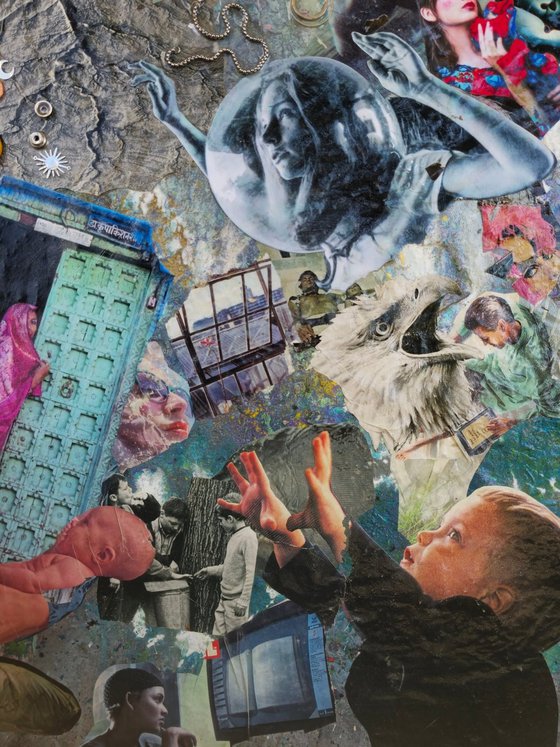
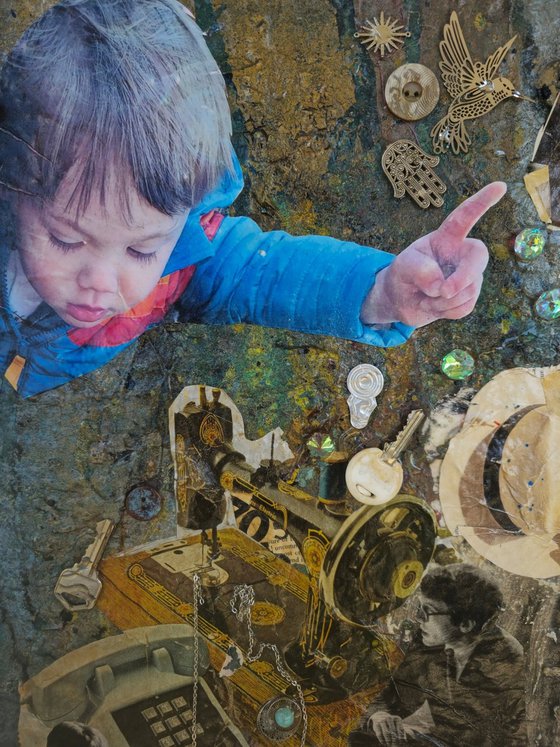
The little boy near the upper right is my older son, Orion. The boy near the lower right, reaching upward with both hands, came to feel like a symbol of Aries—the baby I did not yet know was coming. I had placed both children inside the same visual world before I knew that our family was about to change.
That discovery transformed the painting for me. What first appeared to be an abstract meditation on fate became something almost prophetic—not because it predicted the future clearly, but because my subconscious seemed to be assembling its symbols before my conscious mind understood their meaning.
HIDDEN IMAGERY & SYMBOLISM
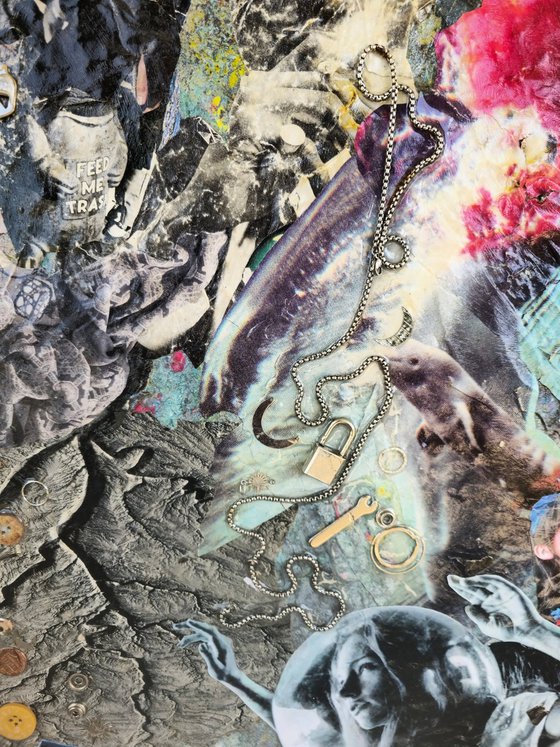
The beluga whale giving birth: Birth in its most instinctive and physical form. The trailing blood represents sacrifice, biological connection, and the irreversible passage between one life and another.
The two boys: Orion appears above, pointing toward the world beneath him. The second child reaches upward from below and later came to represent Aries. Together, they connect the life I already knew with the life moving toward me.
The newborn: Innocence, vulnerability, and an arrival that changes the meaning of everything surrounding it.
The playing cards: Chance, uncertainty, and the hand we are dealt. Their presence reflects the human impulse to search for patterns and meaning in events that may initially appear random.
The sewing machine: The construction and repair of identity. It suggests that we continuously stitch together our histories, relationships, memories, and decisions to create a coherent life story.
The therapist and patient: The process of examining the narratives we have built around ourselves. Therapy can reveal which parts of our identity feel true and which may be interpretations created to survive or make sense of the past.
The woman holding a battery: Stored energy, dormant potential, and the invisible charge carried from one stage of life into another.
The ancient doorway: A threshold between histories, identities, cultures, and possible realities. The woman standing within it appears to look from one world into another.
The woman with the empty fishbowl: A symbol of perception, containment, and the mind. The empty vessel may represent absence, possibility, or the uncertain space between reality and illusion.
The eagle and the man using a device: A collision between primal awareness and modern distraction. The eagle interrupts the man’s limited field of attention with a larger and more instinctive perspective.
The telephone, computer, and other devices: Changing forms of communication and the different ways people attempt to reach one another across distance, time, and emotional separation.
Keys, locks, chains, coins, crystals, tools, and jewelry: Everyday objects transformed into archaeological evidence. They suggest access, confinement, value, work, memory, inheritance, and the small physical fragments through which a life is remembered.
INTERPRETATION
The title holds two opposing ideas.
Synchrodestiny describes moments of meaningful alignment—events and connections that appear too perfectly placed to be meaningless. In this painting, birth, bloodline, childhood, family, memory, and repeated visual relationships seem to form a pattern that existed before I consciously recognized it.
Pseudo fate questions whether those patterns were truly predetermined or whether we create the appearance of destiny by looking backward and arranging our experiences into a meaningful story. We may call something fate only after it has happened because the narrative helps us understand it.
The painting does not choose between these possibilities. Instead, it exists in the tension between them. Perhaps destiny is inherited. Perhaps it is created. Perhaps coincidence becomes meaningful because we notice it. Perhaps the subconscious recognizes changes long before the conscious mind can name them.
Synchrodestiny & Pseudo Fate ultimately suggests that a life is shaped by both forces: what happens to us and what we make from it. We inherit bloodlines, circumstances, bodies, memories, and relationships—but we also choose how to connect those fragments and what story they will become.
"The future entered quietly, disguised as symbolism.
Perhaps fate is only the story we recognize after it has already found us."
Materials used:
Acrylic paint, photographic images printed with archival inks on fine art paper, paper collage, gesso, heavy gel medium, texture paste, spray ink, spray paint, color-shift paints, iridescent glaze, oil pastel, glitter, UV varnish, buttons, pennies, chains
Details:
- Collage on Canvas
- One of a kind artwork
- Size: 60.96 x 121.92 x 5.08cm (unframed) / 60.96 x 121.92cm (actual image size)
- Ready to hang
- Signed on the back
- Style: Surrealistic
- Subject: People and portraits
 Free returns
14 day money back guaranteeLearn more
Original artwork description
Synchrodestiny & Pseudo Fate is a map of connection—an exploration of the tension between the paths we are given and the paths we choose. It follows the beautiful, bloody, and bizarre threads that weave together a life: birth, memory, inheritance, chance, communication, identity, technology, and the stories we create to explain how we arrived where we are.
Figures from different ages, cultures, and moments overlap within a dense mixed-media landscape. A beluga whale gives birth beneath a long trail of blood. Children point, reach, dance, and observe. An elderly woman holds playing cards, while a woman in a ball gown stands on a staircase holding a battery. A sewing machine, telephone, computers, doors, keys, coins, tools, chains, crystals, and fragments of jewelry appear throughout the composition like artifacts recovered from several lives at once.
Some images suggest forces beyond our control: bloodline, birth, time, coincidence, and the hand we are dealt. Others represent the ways we attempt to shape our own direction through memory, therapy, communication, creativity, technology, and choice. The work asks whether destiny is something waiting for us—or something we construct afterward by connecting events and giving them meaning.
The most uncanny part of the painting revealed itself only after it was finished. I created it approximately one month before learning that I was unexpectedly pregnant with my second son. Looking back, nearly every part of the composition seemed connected to the pregnancy and the story that unfolded afterward: the whale giving birth, the newborn, the blood trail, the children, the mother figures, the images of inheritance, and the repeated gestures of pointing, reaching, holding, and watching.
The little boy near the upper right is my older son, Orion. The boy near the lower right, reaching upward with both hands, came to feel like a symbol of Aries—the baby I did not yet know was coming. I had placed both children inside the same visual world before I knew that our family was about to change.
That discovery transformed the painting for me. What first appeared to be an abstract meditation on fate became something almost prophetic—not because it predicted the future clearly, but because my subconscious seemed to be assembling its symbols before my conscious mind understood their meaning.
HIDDEN IMAGERY & SYMBOLISM
The beluga whale giving birth: Birth in its most instinctive and physical form. The trailing blood represents sacrifice, biological connection, and the irreversible passage between one life and another.
The two boys: Orion appears above, pointing toward the world beneath him. The second child reaches upward from below and later came to represent Aries. Together, they connect the life I already knew with the life moving toward me.
The newborn: Innocence, vulnerability, and an arrival that changes the meaning of everything surrounding it.
The playing cards: Chance, uncertainty, and the hand we are dealt. Their presence reflects the human impulse to search for patterns and meaning in events that may initially appear random.
The sewing machine: The construction and repair of identity. It suggests that we continuously stitch together our histories, relationships, memories, and decisions to create a coherent life story.
The therapist and patient: The process of examining the narratives we have built around ourselves. Therapy can reveal which parts of our identity feel true and which may be interpretations created to survive or make sense of the past.
The woman holding a battery: Stored energy, dormant potential, and the invisible charge carried from one stage of life into another.
The ancient doorway: A threshold between histories, identities, cultures, and possible realities. The woman standing within it appears to look from one world into another.
The woman with the empty fishbowl: A symbol of perception, containment, and the mind. The empty vessel may represent absence, possibility, or the uncertain space between reality and illusion.
The eagle and the man using a device: A collision between primal awareness and modern distraction. The eagle interrupts the man’s limited field of attention with a larger and more instinctive perspective.
The telephone, computer, and other devices: Changing forms of communication and the different ways people attempt to reach one another across distance, time, and emotional separation.
Keys, locks, chains, coins, crystals, tools, and jewelry: Everyday objects transformed into archaeological evidence. They suggest access, confinement, value, work, memory, inheritance, and the small physical fragments through which a life is remembered.
INTERPRETATION
The title holds two opposing ideas.
Synchrodestiny describes moments of meaningful alignment—events and connections that appear too perfectly placed to be meaningless. In this painting, birth, bloodline, childhood, family, memory, and repeated visual relationships seem to form a pattern that existed before I consciously recognized it.
Pseudo fate questions whether those patterns were truly predetermined or whether we create the appearance of destiny by looking backward and arranging our experiences into a meaningful story. We may call something fate only after it has happened because the narrative helps us understand it.
The painting does not choose between these possibilities. Instead, it exists in the tension between them. Perhaps destiny is inherited. Perhaps it is created. Perhaps coincidence becomes meaningful because we notice it. Perhaps the subconscious recognizes changes long before the conscious mind can name them.
Synchrodestiny & Pseudo Fate ultimately suggests that a life is shaped by both forces: what happens to us and what we make from it. We inherit bloodlines, circumstances, bodies, memories, and relationships—but we also choose how to connect those fragments and what story they will become.
"The future entered quietly, disguised as symbolism.
Perhaps fate is only the story we recognize after it has already found us."
Materials used:
Acrylic paint, photographic images printed with archival inks on fine art paper, paper collage, gesso, heavy gel medium, texture paste, spray ink, spray paint, color-shift paints, iridescent glaze, oil pastel, glitter, UV varnish, buttons, pennies, chains
Details:
- Collage on Canvas
- One of a kind artwork
- Size: 60.96 x 121.92 x 5.08cm (unframed) / 60.96 x 121.92cm (actual image size)
- Ready to hang
- Signed on the back
- Style: Surrealistic
- Subject: People and portraits