- Elya Yalonetski
- All Artworks
- Owl from the Lustgarden.
Owl from the Lustgarden. (2025) Original Clay Sculpture by Elya Yalonetski
14 x 19.5 x 12cm
£237.75Sold
Original artwork description
Hieronymus Bosch couldn't stop painting owls. They turn up everywhere in his work, perched in trees, tucked into hollows, nestled among his impossible creatures. If you counted them all across his paintings, I think he'd hold the title for the most owl-obsessed master of the Northern Renaissance. And I understand the obsession completely.
What draws me to Bosch's owls is how real they are. Around them, his world dissolves into fever dreams and moral chaos, but the owls themselves are painted with such care, such close observation, that they feel like they wandered in from our world to watch his unfold. That penetrating stare. They don't blink, and they don't look away.
The meaning of these owls has been argued over for centuries. In medieval and Renaissance symbolism, the owl carried a beautiful contradiction. Sacred to Athena, it stood for wisdom, knowledge, insight. In Christian iconography, it became a creature of darkness, deception, even heresy. Bosch leaned into that ambiguity. His owls might be neutral witnesses, or they might be silent accomplices to the folly unfolding around them. They might represent divine knowledge, or something far more unsettling.
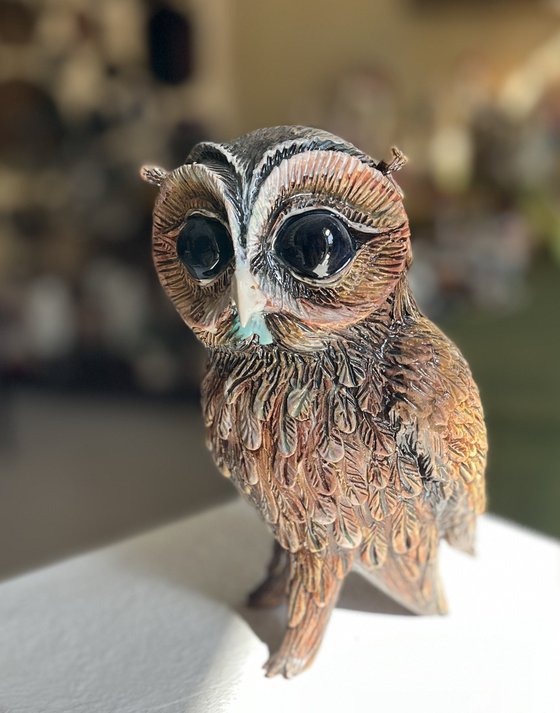
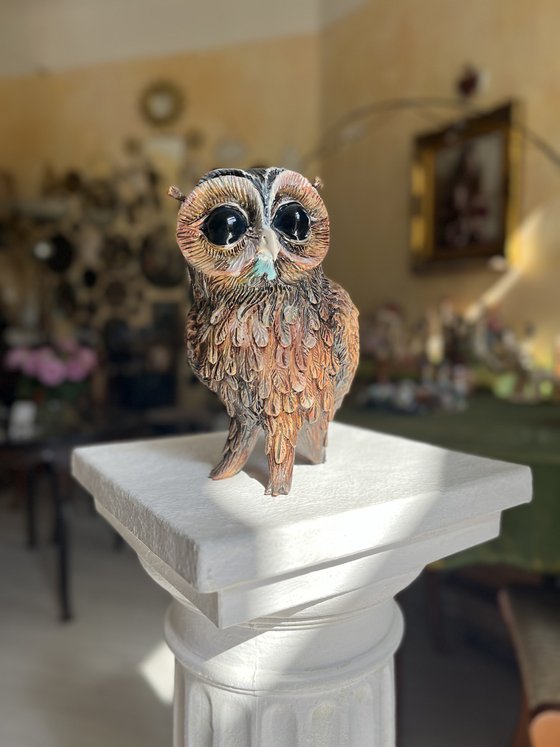
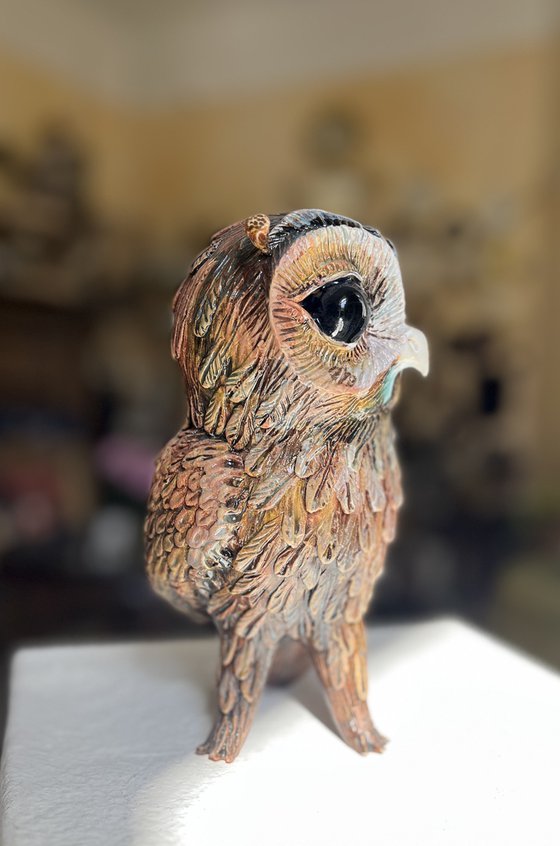
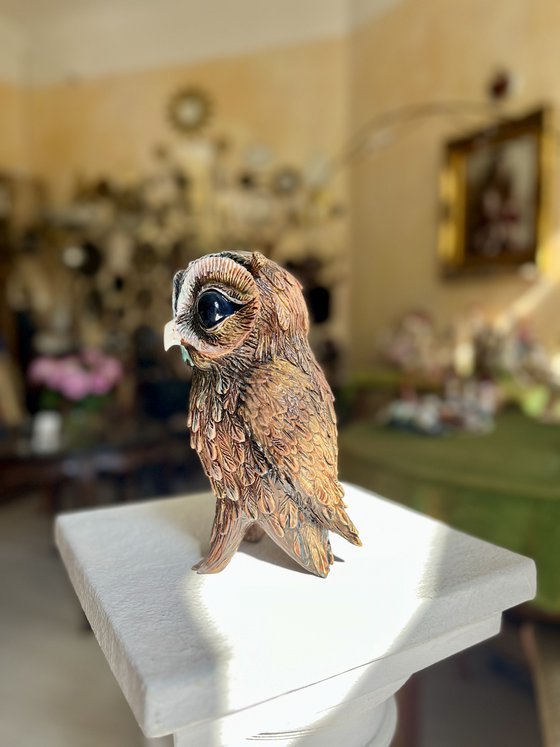
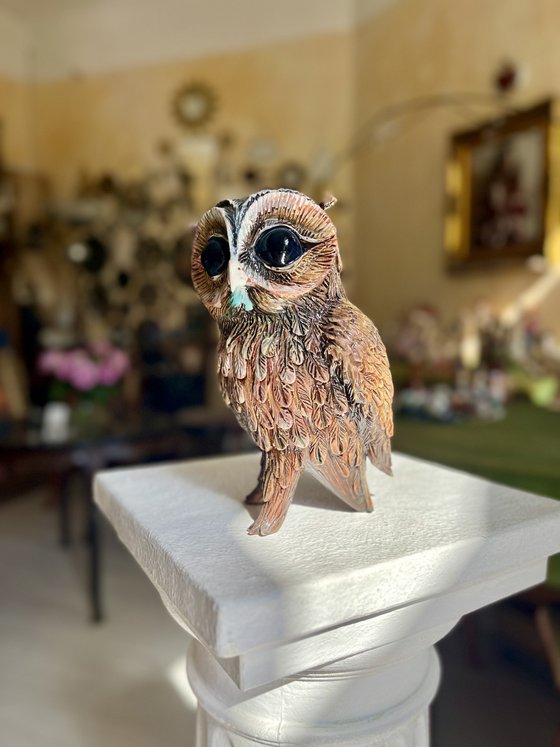
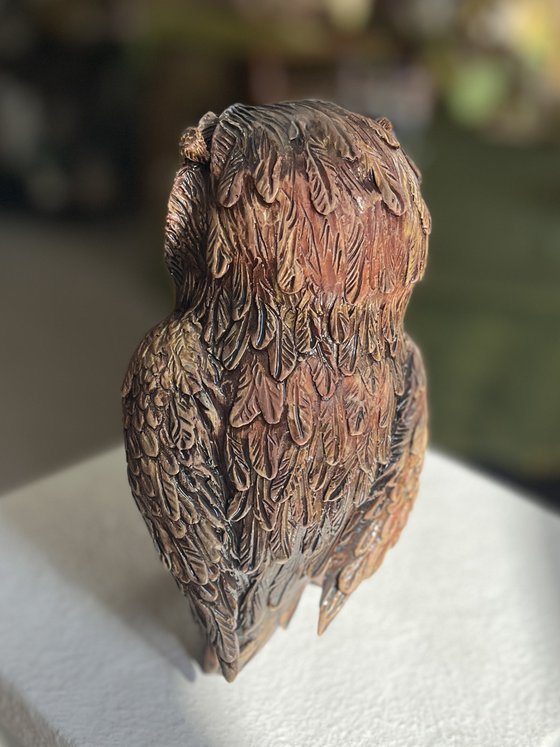
That's what I wanted to honor in this sculpture, but in my own language. I sculpted every feather by hand, layer over layer, each one carved and lifted so the body almost ripples when the light moves across it. The plumage runs through warm earth tones, copper, rust, soft ochre, with deeper shadows pooling between the feathers and quiet flashes of iridescence where the glaze catches. The face is its own small world: a delicate pale beak, a breath of turquoise just beneath it like a held secret, and those huge, glossy black eyes that seem to follow you around the room. Two little ear tufts tilt forward, slightly curious, slightly mischievous. He stands upright on his own carved feet, no perch, no pedestal of his own, just the bird and his gaze.
He is small enough to live on a shelf and large enough to change the room he's in. People tend to soften when they meet him. They lean in.
Bosch's owls rule his luminous nightmares and daydreams. This is my tribute to them, and to the long, patient art of looking back.
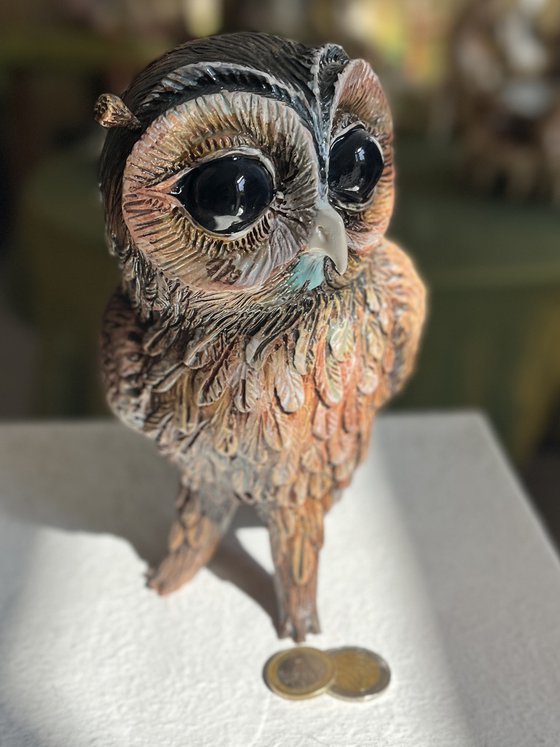
Coins (1 & 2 Euros) are for the size reference only.
Materials used:
Clay, Engobes, Glazes
Details:
- Clay sculpture on Canvas
- One of a kind artwork
- Size: 14 x 19.5 x 12cm
- Ready to hang
- Signed on the back
- Style: Surrealistic
- Subject: Animals and birds
 Free returns
14 day money back guaranteeLearn more
Original artwork description
Hieronymus Bosch couldn't stop painting owls. They turn up everywhere in his work, perched in trees, tucked into hollows, nestled among his impossible creatures. If you counted them all across his paintings, I think he'd hold the title for the most owl-obsessed master of the Northern Renaissance. And I understand the obsession completely.
What draws me to Bosch's owls is how real they are. Around them, his world dissolves into fever dreams and moral chaos, but the owls themselves are painted with such care, such close observation, that they feel like they wandered in from our world to watch his unfold. That penetrating stare. They don't blink, and they don't look away.
The meaning of these owls has been argued over for centuries. In medieval and Renaissance symbolism, the owl carried a beautiful contradiction. Sacred to Athena, it stood for wisdom, knowledge, insight. In Christian iconography, it became a creature of darkness, deception, even heresy. Bosch leaned into that ambiguity. His owls might be neutral witnesses, or they might be silent accomplices to the folly unfolding around them. They might represent divine knowledge, or something far more unsettling.
That's what I wanted to honor in this sculpture, but in my own language. I sculpted every feather by hand, layer over layer, each one carved and lifted so the body almost ripples when the light moves across it. The plumage runs through warm earth tones, copper, rust, soft ochre, with deeper shadows pooling between the feathers and quiet flashes of iridescence where the glaze catches. The face is its own small world: a delicate pale beak, a breath of turquoise just beneath it like a held secret, and those huge, glossy black eyes that seem to follow you around the room. Two little ear tufts tilt forward, slightly curious, slightly mischievous. He stands upright on his own carved feet, no perch, no pedestal of his own, just the bird and his gaze.
He is small enough to live on a shelf and large enough to change the room he's in. People tend to soften when they meet him. They lean in.
Bosch's owls rule his luminous nightmares and daydreams. This is my tribute to them, and to the long, patient art of looking back.
Coins (1 & 2 Euros) are for the size reference only.
Materials used:
Clay, Engobes, Glazes
Details:
- Clay sculpture on Canvas
- One of a kind artwork
- Size: 14 x 19.5 x 12cm
- Ready to hang
- Signed on the back
- Style: Surrealistic
- Subject: Animals and birds
Elya Yalonetski
Germany
About
Elya Yalonetski, an international Facebook star among ceramic artists creates a special selection for Artfinder. Elya is an award winning Berlin-based artist working with ceramics for the last 20... Read more