
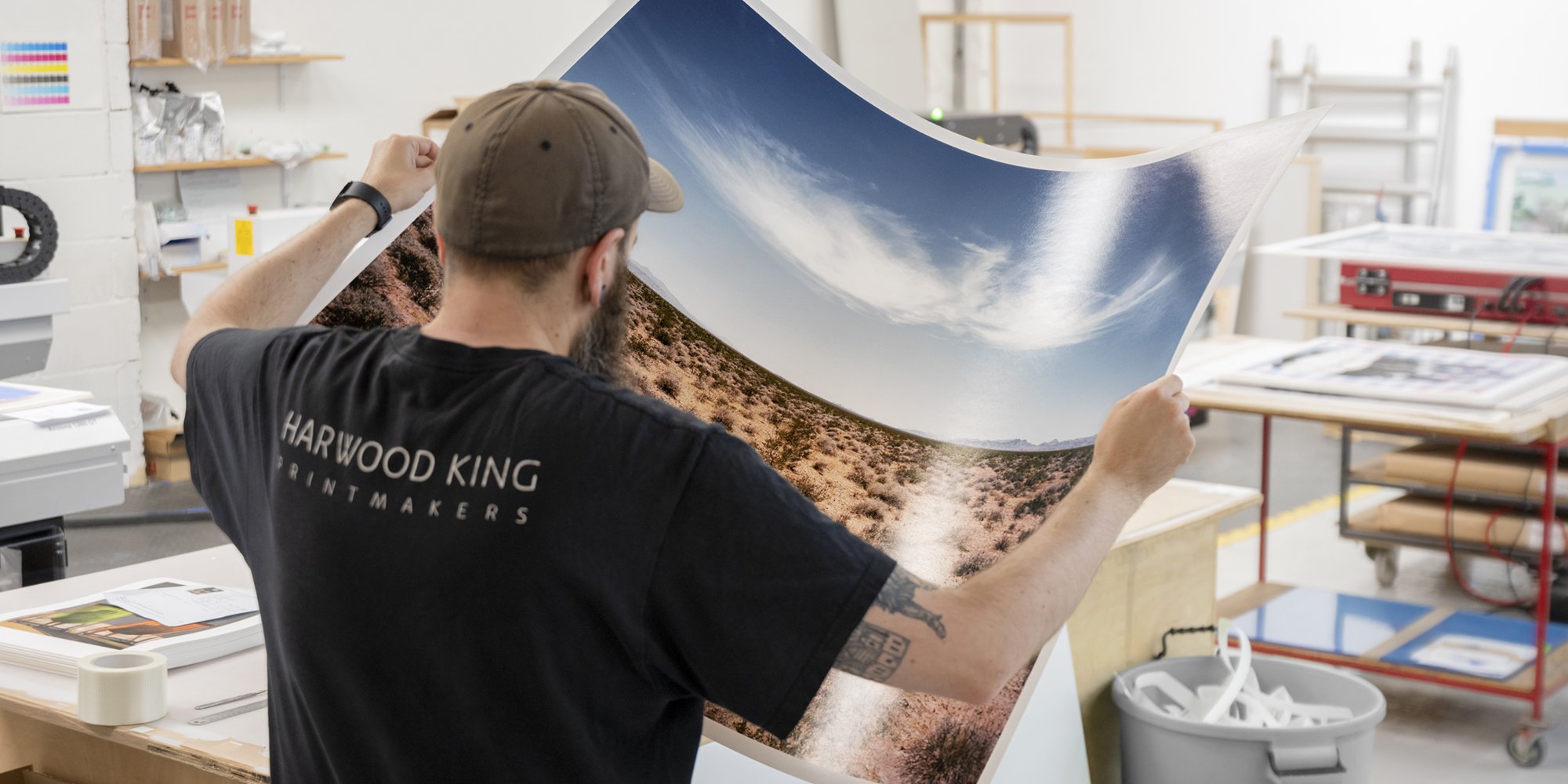
By Claire at Harwood King Printmakers

If you're selling on Artfinder, you already know how to connect with people who love original art. But there's a whole audience out there who might love your work and simply can't afford an original, or don't have the wall space for one. Prints let you reach those people. They let your most popular images live in far more homes, and done well, they can become a genuinely meaningful part of your income.
This guide walks through the whole process:
-
Getting your artwork digitised
-
Choosing how to print it
-
Editions and presentation
It’s your chance to benefit from what we've learned over many years working with artists at Harwood King Printmakers.
What are you actually making?
Before getting into the how, it's worth grounding ourselves in what we mean by "prints" it's a broader world than people sometimes realise.
Original prints vs. reproductions
Some prints are original artworks in their own right: linocuts, etchings, silkscreens, woodblocks, where the artist creates the plate or screen and the print is the artwork itself.
What we are going to be looking at are fine art prints: high-quality copies of an existing original. That includes giclée (digital fine art) prints, silkscreens made from a digital file, and lithographs. Done well, a reproduction print isn't a lesser thing; it's its own beautiful object in its own right.
Open editions vs. limited editions
Open edition prints are usually lower in price, often on more commercial materials, and not necessarily made to last decades. Limited editions are a different proposition: numbered, often signed, sometimes accompanied by a certificate of authenticity, and occasionally hand-finished by the artist. They carry genuine collectable value.
A limited edition of 50, signed and numbered on beautiful cotton rag paper, is something a collector will treasure. That's what this guide focuses on.
Getting your artwork digitised
The first step in making a print is getting your artwork into a digital file. The quality of this file determines how good your prints can be, as it's the foundation of everything. You want the highest resolution you can achieve, since that gives you the most flexibility later.
Phone photography
While phone cameras are now amazing, they are primarily set up for photographs you view on a screen, so great for social media and websites, not so good for printing. People with a good lighting set-up can get small prints for phone photos, but they are far from ideal for professional printmaking.
Scanning
You can scan smaller pieces on a home flatbed scanner, but the settings you use to capture the images are vital.
-
Scan at a high DPI. 300dpi is the minimum needed for printing but go as high as you can manage (the higher the DPI, the bigger the file size).
-
Save as TIFF, not JPEG — a JPEG discards information every time you save, whereas a TIFF keeps everything.
-
If you use a professional scanning service, ask for the RAW files.
Professional photography
This is what we'd recommend for most serious printmaking. A proper photography setup, such as the one we have with a wide format camera and a digital scan back capturing raw TIFF files, gives you the largest, most detailed file to work from, so you can print both larger and smaller than your original with confidence.
A word on colour
What you see on screen depends entirely on how well calibrated your monitor is; just because it looks the same or different on the screen does not mean it will necessarily come out the same in print. Screens are also backlit, whereas paper is not, and this can affect how you see the same colours.
We calibrate our screens every month to make sure what we see is as close as possible to what comes out from our printers, but we still need to print the file to get the final test on how well the colours will come out.
To colour match, we need the original artwork as well as the actual material and printer that will be used for the prints; a different printer and paper will affect the print colours even if the digital file is the same.
Be realistic about how much variation you're comfortable with. Some artists are fine with a slight shift; others need it exact. Have a conversation with your printer early on so you can have a clear idea of what you are getting.
Choosing your printing method
Giclée / digital printing. For most artists starting out, giclée is the natural first step, largely because you can print on demand rather than committing to a large upfront run.
The quality of giclée printing varies enormously:
Lower end: Commercial print shops, which might use wood-pulp paper and standard CMYK printers. This is more of a poster print than a fine art print.
Higher end: Specialist fine art printers like ourselves who use 100% cotton rag paper specially designed for giclee printing and large format printers with archival inks (sometimes up to 12 colours). They have experience in printing art and can offer you help and support in getting your prints right.
Some printers have online order interfaces which offer a convenient way to order. If you are ordering online and not going in to see the printers, it's best to get some test prints first to make sure you are happy with the papers and the colours before committing to a big order.
To make good quality prints that are more arts-based rather than commercial printing, it is worth doing your research when choosing a printer.
A word on paper
The paper really can make the print.
Somerset and Arches watercolour papers (traditional artists' papers coated for giclée inks) can be extraordinary for watercolour originals.
Smooth matte papers like a photo rag give a clean, minimal look and can give vibrant colours and deep blacks.
Baryta papers mimic a traditional darkroom print.
Don't feel constrained by "matching" medium to paper; a bold oil painting or photographic image can look magnificent on watercolour stock. It's worth experimenting.
Beyond paper. Giclée doesn't have to mean paper
Canvas
Our giclée printers can also print on canvas (which can be tray-framed or stretched, good for larger work and easier to ship).
Flatbed Printing
Digital flatbed printing can also offer an even wider range of materials, including specialist papers, wood, aluminium, and acrylic.
Mixed media prints
For artists who want to go further, combining giclée with silkscreen printing can add metallics, fluorescents, and varnish effects, things giclée alone can't do. The trade-off is a setup cost per screen, so this works best in batches. If you want to test the water first, hand-finishing a giclée edition (with pencil, inks, or even gold leaf or metallics) is a good way to offer something special for your customers before committing to the cost of a silkscreen run.
Editions, numbering and certificates
There's no single right answer on edition size. Smaller editions (10–50) tend to be more collectable and can command higher prices. Larger editions (95–150+) are more accessible and suit images with broad appeal.
With giclée, you don't have to print the whole run at once; you can print to order. But you must keep careful records of what's sold. If you've said an edition is 50, you can only ever sell 50.
If an edition sells out, you can revisit the image in a different size, material, or finish that's a new edition, not a continuation. Just be careful not to dilute something that's already sold well; collectors who bought into the original edition deserve to feel their purchase retains its value.
Signing and numbering by hand (e.g. 3/50) is standard practice and adds genuine value.
Things to consider
If you're printing in batches and want to sign each one, you'll need either to visit the printer or have prints sent to you before they go to the customer, which is worth planning for logistically.
If you have a signature on your original, you might want this digitally removed from the print file if you are going to sign by hand.
A certificate of authenticity (COA) gives buyers confidence and formally documents the edition. It's also a handy solution to the signing-logistics problem, since a signed certificate can travel with a print that's shipped directly. COA’s are not required, but theyare a lovely touch that collectors appreciate.
Sizing, borders and presentation
Sizing
Don't feel obliged to match standard paper sizes. If your original isn't those proportions, forcing it to fit means awkward cropping or wasted space. Many fine art printers, including us, print off the roll, so any size is possible.
Borders
A border is a genuinely important part of how a print feels, and is part of the aesthetic you are creating for your prints. If you're adding a signature, title, or edition number, you might want to allow a more generous bottom border for this to fit in. Borders generally should feel proportionate; a 5cm border can swamp a small image but looks right on a large one. If the print will be framed with a mount, a small handling border keeps fingerprints away from the image itself. If you are having your prints torn to the edge of the image, you can sign and number on the print if you want.
Torn edges
For that extra finish, we offer hand-torn edges, which give a beautiful hand-finished touch to a giclee print and can really complement the artwork. You can have a border or tear to the edge of the image; both give a hand-finished feel collectors like.
Embossing and stamps
A custom emboss or blind stamp with your initials, or a small logo or mark pressed into a corner, can look beautiful, especially on heavy watercolour paper. Entirely down to personal taste, but it's one of those details collectors notice.
To frame or not to frame
Framed prints sit at a higher price point and are ready to hang, but are heavier and pricier to ship. Unframed prints are cheaper and easier to post. Many artists send unframed prints with a framing recommendation, or partner with a trusted local framer.
Choosing which images to print
This is the question artists ask most often. The good news is you probably already have a sense of what's working:
-
Social media: Which posts get the most engagement, comments, or DMs?
-
Exhibition reactions: Which originals do people keep coming back to?
-
Customer conversations: What do people ask about most?
It's also worth thinking about scale. If your original work is large, a smaller print might open the door to buyers who couldn't fit the original in their home. If you work small, printing larger can give an image a completely different impact; sometimes something modest in person becomes something special at a different scale on beautiful paper.
Some artists offer multiple sizes for the same image, and while it is nice to offer customers choice, you don’t want to overwhelm them, and if you feel your image works well at a particular size, then it's fine to offer a print in just one size.
Bringing it together
There are a lot of decisions along the way: the paper, the size, the border, the edition length. But that's also what makes it exciting and allows you to put your artistic creativity into making a print that stands on its own as a work of art. Every one of those choices is an opportunity to shape how someone experiences your work, and to open it up to people who couldn't have collected it before.
If you'd like to talk through what any of this might look like for your own practice, we're always happy to hear from artists at any stage, from a first test print through to editions for established collectors.
You can find us at harwoodking.com or get in touch directly at sales@harwoodking.com.
