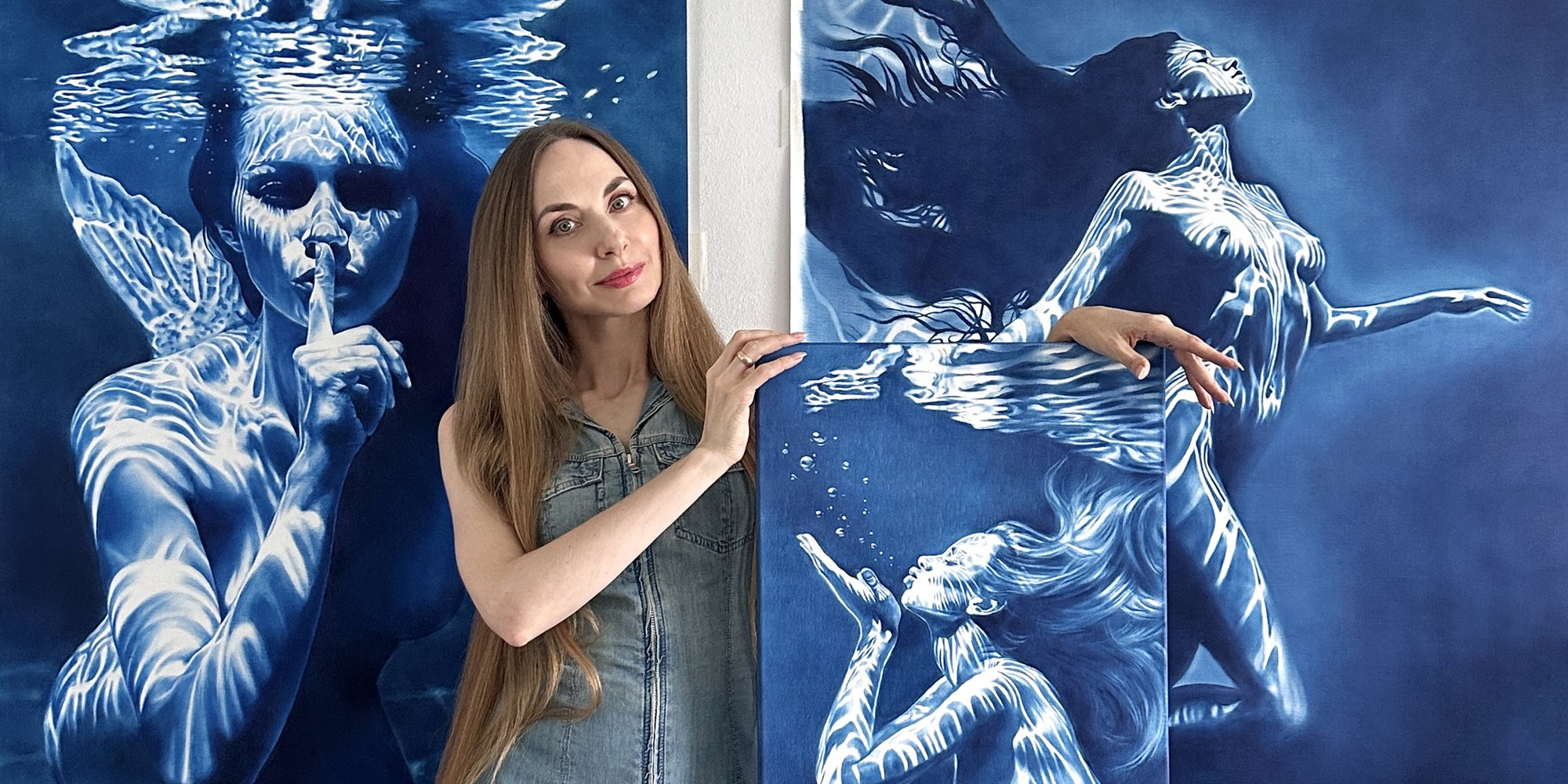
Our community of artists is the core foundation of Artfinder. With such a vast community based in all corners of the world, we wanted to help them share more about their artist journey, their artistic process and technique and what inspires them. Today, we chat with one of our amazing painters, Julia Shilo.
Tell us a bit about yourself and your work — where are you based, how did you get started, and what draws you to the kind of art you make now?
I have been drawing since childhood, and figurative painting and portraiture have always attracted me most. There is something almost magical about capturing a person’s likeness and preserving it on paper or canvas — not just their appearance, but something of their character and state of mind.
For a long time, however, art was not my profession. After being forced to relocate to Bulgaria in 2022, I began accepting commissions and gradually started devoting more and more of my time to painting. My first important sign that I was on the right path came with my selection for the London Biennale in 2025. My work sold on the opening day, and that became a defining moment for me. It was also the beginning of my search for a personal visual language and a special relationship with the colour blue.
The real turning point came later, when I was inspired by the minimalist aesthetics of light and shadow found in cyanotype imagery. I began creating monochromatic works featuring sirens and mermaids. Through these figures, I started exploring inner states, intuition, desire, freedom of choice, and that space between reality and the inner world where we are left alone with ourselves. Gradually, I began to notice which images and subjects particularly resonated with viewers and buyers. Their responses became part of my artistic exploration too. This is how my visual language gradually developed, and my audience even gave it a name — Blueism. It still feels both amusing and incredibly exciting to me: a name that was born not in the studio, but through a dialogue with the people who connected with my work.
What's a material, technique, or habit in your process that most people wouldn't guess just from looking at the finished piece?
Probably the biggest surprise for people is that my works are painted in oil. Through a process of trial and error, I came to oil and canvas as my primary materials, but I work with oil using a dry-brush technique. I apply the paint in very thin layers, creating a surface that looks quite different from what people usually expect from an oil painting. I am quite often asked, even by other artists, “What kind of paint is that?” Some people think I am working with ink or another medium altogether. I like that element of surprise. The material is traditional, but the way I use it allows the paint to become almost weightless — sometimes looking more like a print, drawing, or photographic image than an oil painting.
What's it been like selling your work through Artfinder — has it changed how you think about reaching collectors, or how you work day to day?
I have my work on several platforms, but with Artfinder it was probably love at first sight. I immediately liked the intuitive interface and how easy it is to add new work. It really encourages me to keep my profile active and regularly share new pieces. Being featured in curated collections and selections naturally increases the visibility of my work and can have a significant impact on sales. At those moments, the task of finding buyers becomes less of a concern because there is additional support from the platform. I can clearly see the difference in sales after a work has been included in a curated selection, and that is incredibly valuable to me. At the same time, many of my buyers discover my work through social media, and I can see this through their purchases. That is why the level of trust in the platform is especially important to me: someone may discover my work on Instagram and then purchase it through Artfinder, where the buying process feels clear and secure.
And there is another thing that makes me especially happy — I now have buyers who return and purchase my work again. Artfinder has also helped me make my working routine much more structured. I now have a rhythm to my week: I try to dedicate the beginning of the week to creating new work, while towards the end I focus on packaging and shipping. This structure helps me stay focused creatively while also keeping up with all the other responsibilities that come with being an artist.
What is a lie people tell about being a full-time artist, and what's the reality?
Probably the most obvious myth is that an artist is someone who lives in a world of inspiration, waits for the muse, and simply creates whenever the mood strikes. The reality is that it is a job. There are deadlines, planning, strategy, and a huge number of tasks that have nothing to do with inspiration.Sometimes you are standing in front of a canvas completely immersed in the creative process. Other times, you need to package paintings, photograph your work, upload it to platforms, answer messages, deal with paperwork, or organise shipping. All of that is part of being a professional artist too. For me, the most important things are consistency and discipline. You cannot wait for the perfect mood to begin your next painting. You have to keep working. And interestingly, that discipline itself eventually becomes a source of inspiration. When a new work is published and finds a buyer within the first few days, it is an incredibly powerful motivation. You realise that your work has genuinely found its way to someone, and it makes you want to keep going.
If someone bought one of your works tomorrow, what do you hope they'd notice about it after living with it for a year?
Yes, I believe beauty can save the world. At the same time, I think art is very much an emotional purchase. That is why it means so much to me when buyers write to say that it was not only the painting itself that moved them, but also the idea behind it and its deeper meaning. I would like them to still look at my work with the same sense of wonder a year later, while discovering something new in it each time. I hope it becomes more than simply a beautiful object in their home — that it continues to create an inner dialogue, bringing them back to questions about choice, the past, the influence of others, honesty with oneself, and who we truly want to be. If my work can make someone pause from time to time, ask themselves difficult questions, and allow themselves to hear honest answers, that is the most valuable thing it can achieve for me. Then I feel that my mission as an artist has been fulfilled — I have helped one more person come a little closer to their true self.
Cover image via Julia Shilo