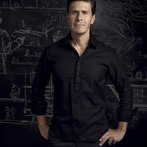
About jayme mestieri
Links
Education
2002 - 2005
masp museu de arte de sao paulo
1998 - 2002
senac photography
1993 - 1997
faculdade de arquitetura e urbanismo usp sao paulo
There are no upcoming events
Biography
We are living in a time where almost everything responds faster than we can think.
We tap a screen and something happens.
We swipe and something appears.
We ask and something answers.
The distance between intention and result has never been shorter.
But somewhere in that efficiency, something subtle disappeared: the friction of the hand. The hesitation. The mistake.
I am not against innovation. I live inside it. I use it every day.
But I also feel that the more friction we remove from life, the further we drift from the weight of reality.
When everything becomes immediate, what happens to experience?
The Craft That Is Fading
There was a time when knowing how to make something mattered.
Now knowing how to prompt something is enough.
Manual skill is slowly becoming optional. The hand is no longer necessary for many outcomes. Precision has been outsourced. Perfection is automated.
But craft was never about perfection.
Craft was about presence.
It was about leaving a trace that says: a human was here.
And maybe that is what I am trying to preserve in my drawings — the evidence of presence.
Layers Between Us and the Real
We don’t see the world directly anymore.
We see it through filters, algorithms, curated feeds.
Reality now arrives processed.
Sometimes we cannot tell what is real.
Sometimes we don’t even care to know.
The next step might not be confusion.
It might be indifference.
And that is more dangerous.
When the distinction between real and artificial becomes irrelevant, what happens to emotion? What happens to empathy?
I Am Not Criticizing the Future
This is not a nostalgic argument.
I build large urban projects. I work with technology, innovation, advanced systems. My architectural practice depends on it.
Architecture at urban scale demands coordination, precision, data, structure.
But inside my artistic production, I move in the opposite direction.
If architecture organizes complexity, drawing reduces it.
If architecture scales, drawing concentrates.
One expands.
The other condenses.
Both, however, are about human behavior.
Architecture as a Study of Behavior
Over the years, I understood something fundamental:
I do not design buildings.
I design behavior.
A plaza invites gathering.
A corridor accelerates movement.
A park slows the body down.
Architecture is a silent choreography of human conduct.
It shapes how thousands of people interact daily.
And when I draw, I am doing the same — but at a different scale.
Instead of directing crowds, I investigate expressions.
Instead of designing circulation, I explore emotion.
The Importance of the Error
When I finish a drawing and I see that I could have done it better, I do not correct it.
If there is a proportion slightly off, a line that hesitated, a shadow that escaped control — it stays.
That drawing is the first launch.
I am not looking for improvement.
I am looking for truth in the first gesture.
Perfection belongs to machines.
Imperfection belongs to us.
And I choose to stay close to that.
The Trace as Evidence
A drawing is not just an image.
It is a record of time.
You can see where the hand slowed down.
You can feel where the pressure increased.
You can notice where doubt existed.
A digital surface hides its process.
Paper reveals it.
And I want the process to remain visible.
Not as nostalgia — but as resistance.
Travel Notebooks and Human Habits
When I draw during travel, I am not documenting monuments.
I am observing behavior.
How someone waits.
How someone leans against a wall.
How a city breathes differently at night.
These small human gestures tell more truth than architecture sometimes.
The drawing becomes a way to slow down perception — to look again at what we are losing the ability to notice.
Emotion Before Image
I am not interested in drawing for the sake of drawing.
Technique matters, yes.
Structure matters.
But they are not the destination.
If the drawing carries emotion, it survives.
If it only carries technique, it fades.
The image is not the goal.
In a world mediated by layers, I try to narrow the channel.
Observer.
Paper.
Hand.
Nothing in between.
No algorithm adjusting.
No undo button.
No correction after the fact.
Just the first mark and the risk it carries.
Maybe that is my quiet response to automation.
Not a protest.
Just a choice.
To remain human — visibly.
i want to get connections via art finder, to bring these human relations throught my work