iHuman (2025) Original Ink Drawing by Maurizio Puglisi
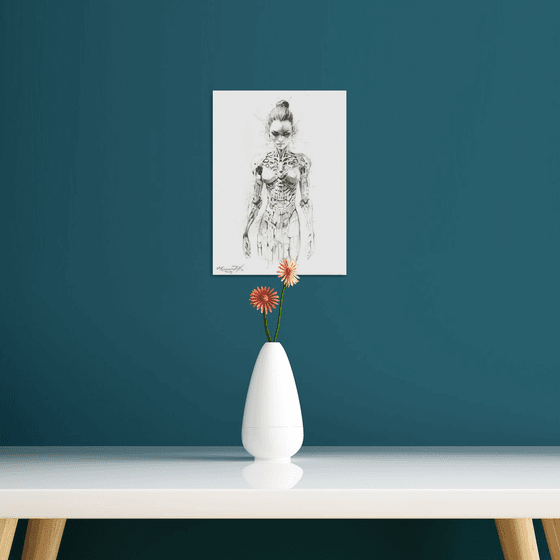
21 x 29 x 0.1cm (unframed)
$458.52
Original artwork description
inks,pencil on canson paper250 g/m
shipping in a cardboard box
“iHuman” The prefix “i” immediately evokes consumer technology products (iPhone, iPad, iMac).
It symbolizes the transformation of the human being into a digital, personalized, branded, and potentially interchangeable product.
It can also be read as a pun on “I, Human”—an affirmation of identity—or on “inhuman,” opening up an unresolved tension between humanity and post-humanity.
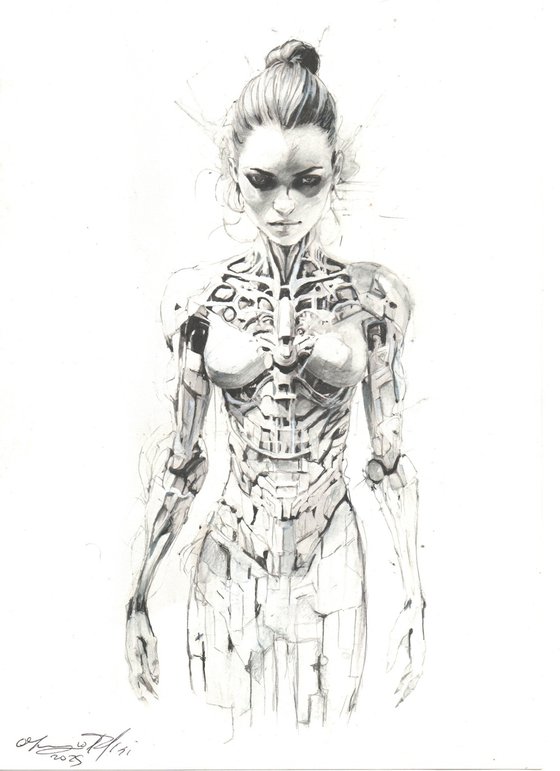
. The face/body contrast remains organic, expressive, with an intense gaze and hair pulled back in a classic chignon. It represents the last remnant of humanity: consciousness, individuality, emotion.
The body is an architecture of plates, joints, skeletal structures, and geometric modules. It is naked in the most radical sense: there is no longer any skin, only exposed mechanism.
This dualism is the symbolic heart of the work. The figure is not a robot imitating a human, but a human being whose body has been completely replaced or "revealed" as a machine. It evokes themes of transhumanism, cybernetics, and the question: what remains of us when the biological body is replaced?
The "disemboweled" body and vulnerability. The detailed rendering of the internal structures (similar to an anatomical drawing or a technical schematic) transforms the body into an object of analysis and exposure.
It symbolizes: the loss of intimacy and privacy in the digital age;
the fragility of human identity under the pressure of technology;
the beauty and horror of absolute transparency (everything is visible, nothing is hidden).
The frontal, almost classical pose recalls ancient statues and artistic nudes, but updates them with a mechanical touch, creating a short circuit between traditional aesthetic canons and cyberpunk imagery.
Gender and the technological body. The figure is clearly feminine in its silhouette and torso details, but the mechanical treatment renders it partially androgynous and objectified.
This recalls a recurring theme in sci-fi and cyberpunk art: the female body as an interface between desire, technology, and control. It can be read both as a critique of objectification and as a vision of a female identity empowered (or alienated) by the machine.
Aesthetics and Atmosphere: The black and white, the precise, almost technical line, the absence of color and background contribute to a sense of clinical coldness and formal purity.
The work is neither explicitly apocalyptic nor utopian: it remains ambiguous. It can evoke both a fascination with progress and a concern for the progressive loss of what defines humanity. In short, iHuman functions as a portrait of a threshold: the moment in which the human being is no longer fully biological nor yet merely machine. It is an image of the contemporary—and future—condition in which technology and identity merge to the point of becoming indistinguishable.
-The artwork listed are unique, original drawings and not prints, signed and dated by the artist.
Drawings is signed and dated by the artist as well as accompanied by a Certificate of Authenticity.
Multiple purchases of the same size will be shipped together, where possible, and any excess shipping costs will be refunded after purchas
Materials used:
ink,pencil
Details:
- Ink drawing on Paper
- One of a kind artwork
- Size: 21 x 29 x 0.1cm (unframed)
- Signed certificate of authenticity
- Style: Impressionistic
- Subject: Nudes and erotic
 Free returns
14 day money back guaranteeLearn more
Original artwork description
inks,pencil on canson paper250 g/m
shipping in a cardboard box
“iHuman” The prefix “i” immediately evokes consumer technology products (iPhone, iPad, iMac).
It symbolizes the transformation of the human being into a digital, personalized, branded, and potentially interchangeable product.
It can also be read as a pun on “I, Human”—an affirmation of identity—or on “inhuman,” opening up an unresolved tension between humanity and post-humanity.
. The face/body contrast remains organic, expressive, with an intense gaze and hair pulled back in a classic chignon. It represents the last remnant of humanity: consciousness, individuality, emotion.
The body is an architecture of plates, joints, skeletal structures, and geometric modules. It is naked in the most radical sense: there is no longer any skin, only exposed mechanism.
This dualism is the symbolic heart of the work. The figure is not a robot imitating a human, but a human being whose body has been completely replaced or "revealed" as a machine. It evokes themes of transhumanism, cybernetics, and the question: what remains of us when the biological body is replaced?
The "disemboweled" body and vulnerability. The detailed rendering of the internal structures (similar to an anatomical drawing or a technical schematic) transforms the body into an object of analysis and exposure.
It symbolizes: the loss of intimacy and privacy in the digital age;
the fragility of human identity under the pressure of technology;
the beauty and horror of absolute transparency (everything is visible, nothing is hidden).
The frontal, almost classical pose recalls ancient statues and artistic nudes, but updates them with a mechanical touch, creating a short circuit between traditional aesthetic canons and cyberpunk imagery.
Gender and the technological body. The figure is clearly feminine in its silhouette and torso details, but the mechanical treatment renders it partially androgynous and objectified.
This recalls a recurring theme in sci-fi and cyberpunk art: the female body as an interface between desire, technology, and control. It can be read both as a critique of objectification and as a vision of a female identity empowered (or alienated) by the machine.
Aesthetics and Atmosphere: The black and white, the precise, almost technical line, the absence of color and background contribute to a sense of clinical coldness and formal purity.
The work is neither explicitly apocalyptic nor utopian: it remains ambiguous. It can evoke both a fascination with progress and a concern for the progressive loss of what defines humanity. In short, iHuman functions as a portrait of a threshold: the moment in which the human being is no longer fully biological nor yet merely machine. It is an image of the contemporary—and future—condition in which technology and identity merge to the point of becoming indistinguishable.
-The artwork listed are unique, original drawings and not prints, signed and dated by the artist.
Drawings is signed and dated by the artist as well as accompanied by a Certificate of Authenticity.
Multiple purchases of the same size will be shipped together, where possible, and any excess shipping costs will be refunded after purchas
Materials used:
ink,pencil
Details:
- Ink drawing on Paper
- One of a kind artwork
- Size: 21 x 29 x 0.1cm (unframed)
- Signed certificate of authenticity
- Style: Impressionistic
- Subject: Nudes and erotic

Maurizio Puglisi
Italy
About
Maurizio Puglisi, I was born in 1994, I started a painting in 1994, attracted by the power of the oil technique over the years I have perfected my style lately... Read more