Artworks by Alfred Wallis
About Alfred Wallis
Biography
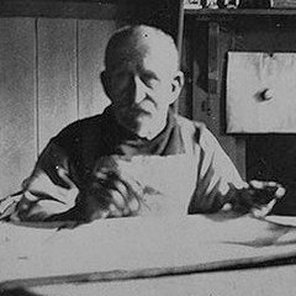
Alfred Wallis, Cornish fisherman and, from his late sixties on, self-taught artist, was born in Devonport on the 18th August, 1855. He attended school from the age of seven for at least two years, and at the age of nine – or such was his claim – he may have been employed as cabin boy to the fishermen working the waters off the Cornish coast. There is some doubt, however, that this claim is correct: he more likely worked as an apprentice basket maker after his brief schooling. But from the age of twenty there is clearer evidence for a sea-faring occupation since Wallis is listed as crew-member with the Belle Adventure, one of the many great sailing ships – schooners and brigantines – which carried global trade between 1820-1890 from UK ports to Europe and the United States. The Belle Adventure itself, fishing for cod, crossed the Atlantic bound for the Grand Banks off Newfoundland, and several of Wallis’s later pictures record this voyage (e.g. Voyage to Labrador, c.1936). These crossings were often dangerous. Wallis’s ship was itself caught in a storm and survived only by jettisoning the catch. After this Wallis exchanged deep sea for inshore fishing working on the smaller luggers setting sail in the mornings from Mounts Bay and returning, after a day’s fishing, before nightfall.
Wallis married Susan Ward – a widow twice his age with six children from a previous marriage. They had two children together, but neither survived. They moved from Devonport to St. Ives and here Wallis, leaving his sea-faring occupation, started a small shop selling old rope, nails and paint – marine wares and salvaged goods. He would collect supplies in a small cart calling out ‘old iron?’, and this became his nick-name. One local boy, Thomas Lander, recalls: ‘As boys we used to go on the beaches and collect small quantities of rags and bones. But they had to be clean…if he said ‘tuppence’ it was tuppence….he was a quiet man, an industrious man’ (1).
From the 1890s on, sailing schooners and brigantines were replaced by larger steam boats. This augured a decline of the traditional fishing fleets, and a decline, too, in the auxiliary activities associated with the fleets. The marine wares trade became unprofitable, and Wallis did odd jobs instead – moving furniture for the local antiques dealer, and working as a labourer to build houses to contain military personnel preparing for the 1914-18 war.
Susan Ward died in 1922, just after the war. The story, oft quoted, is that subsequent to his wife’s death Wallis started to paint, as he claimed, ‘for company’ – a strange statement but one that suggests that painting, if not a replacement for human contact, at least must have assuaged the loneliness he was feeling. Wallis was by nature an outsider, suspicious of human contact. This suspicion became ever stronger after his wife’s death, and led, towards the end of his life, to periods of full-blown paranoia. He painted ‘for company’, but also to recall a happier time: his pictures, largely of boats and harbours, are nostalgic for a time when the sailing fleets still operated and the fishing industry still flourished.
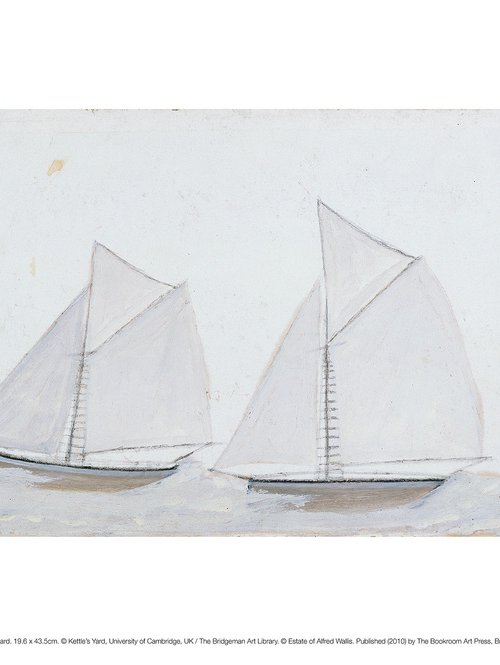
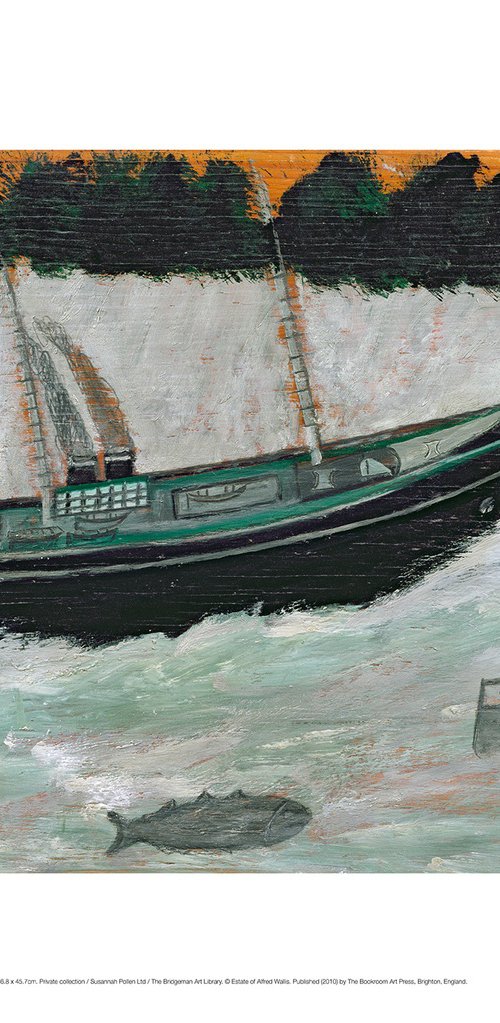
Wallis painted using household paints bought in small tins, and – appropriate for a former rag-and-bone merchant – he painted on discarded bits of card most often cadged from the local grocer’s shop. It was these paintings that Ben Nicholson stumbled upon. In August 1928 he and Christopher Wood ‘discovered’ Wallis. ‘On our way back from Porthmeor Beach’, writes Nicholson, ‘we passed an open door in Back Road West and through it saw some paintings of ships and houses on odd pieces of paper and cardboard nailed up all over the wall, with particularly large nails through the smallest ones. We knocked on the door and inside found Wallis, and the paintings we got from him then were the first he made’
Wallis married Susan Ward – a widow twice his age with six children from a previous marriage. They had two children together, but neither survived. They moved from Devonport to St. Ives and here Wallis, leaving his sea-faring occupation, started a small shop selling old rope, nails and paint – marine wares and salvaged goods. He would collect supplies in a small cart calling out ‘old iron?’, and this became his nick-name. One local boy, Thomas Lander, recalls: ‘As boys we used to go on the beaches and collect small quantities of rags and bones. But they had to be clean…if he said ‘tuppence’ it was tuppence….he was a quiet man, an industrious man’ (1).
From the 1890s on, sailing schooners and brigantines were replaced by larger steam boats. This augured a decline of the traditional fishing fleets, and a decline, too, in the auxiliary activities associated with the fleets. The marine wares trade became unprofitable, and Wallis did odd jobs instead – moving furniture for the local antiques dealer, and working as a labourer to build houses to contain military personnel preparing for the 1914-18 war.
Susan Ward died in 1922, just after the war. The story, oft quoted, is that subsequent to his wife’s death Wallis started to paint, as he claimed, ‘for company’ – a strange statement but one that suggests that painting, if not a replacement for human contact, at least must have assuaged the loneliness he was feeling. Wallis was by nature an outsider, suspicious of human contact. This suspicion became ever stronger after his wife’s death, and led, towards the end of his life, to periods of full-blown paranoia. He painted ‘for company’, but also to recall a happier time: his pictures, largely of boats and harbours, are nostalgic for a time when the sailing fleets still operated and the fishing industry still flourished.
Wallis painted using household paints bought in small tins, and – appropriate for a former rag-and-bone merchant – he painted on discarded bits of card most often cadged from the local grocer’s shop. It was these paintings that Ben Nicholson stumbled upon. In August 1928 he and Christopher Wood ‘discovered’ Wallis. ‘On our way back from Porthmeor Beach’, writes Nicholson, ‘we passed an open door in Back Road West and through it saw some paintings of ships and houses on odd pieces of paper and cardboard nailed up all over the wall, with particularly large nails through the smallest ones. We knocked on the door and inside found Wallis, and the paintings we got from him then were the first he made’
Biography
Alfred Wallis, Cornish fisherman and, from his late sixties on, self-taught artist, was born in Devonport on the 18th August, 1855. He attended school from the age of seven for at least two years, and at the age of nine – or such was his claim – he may have been employed as cabin boy to the fishermen working the waters off the Cornish coast. There is some doubt, however, that this claim is correct: he more likely worked as an apprentice basket maker after his brief schooling. But from the age of twenty there is clearer evidence for a sea-faring occupation since Wallis is listed as crew-member with the Belle Adventure, one of the many great sailing ships – schooners and brigantines – which carried global trade between 1820-1890 from UK ports to Europe and the United States. The Belle Adventure itself, fishing for cod, crossed the Atlantic bound for the Grand Banks off Newfoundland, and several of Wallis’s later pictures record this voyage (e.g. Voyage to Labrador, c.1936). These crossings were often dangerous. Wallis’s ship was itself caught in a storm and survived only by jettisoning the catch. After this Wallis exchanged deep sea for inshore fishing working on the smaller luggers setting sail in the mornings from Mounts Bay and returning, after a day’s fishing, before nightfall.
Wallis married Susan Ward – a widow twice his age with six children from a previous marriage. They had two children together, but neither survived. They moved from Devonport to St. Ives and here Wallis, leaving his sea-faring occupation, started a small shop selling old rope, nails and paint – marine wares and salvaged goods. He would collect supplies in a small cart calling out ‘old iron?’, and this became his nick-name. One local boy, Thomas Lander, recalls: ‘As boys we used to go on the beaches and collect small quantities of rags and bones. But they had to be clean…if he said ‘tuppence’ it was tuppence….he was a quiet man, an industrious man’ (1).
From the 1890s on, sailing schooners and brigantines were replaced by larger steam boats. This augured a decline of the traditional fishing fleets, and a decline, too, in the auxiliary activities associated with the fleets. The marine wares trade became unprofitable, and Wallis did odd jobs instead – moving furniture for the local antiques dealer, and working as a labourer to build houses to contain military personnel preparing for the 1914-18 war.
Susan Ward died in 1922, just after the war. The story, oft quoted, is that subsequent to his wife’s death Wallis started to paint, as he claimed, ‘for company’ – a strange statement but one that suggests that painting, if not a replacement for human contact, at least must have assuaged the loneliness he was feeling. Wallis was by nature an outsider, suspicious of human contact. This suspicion became ever stronger after his wife’s death, and led, towards the end of his life, to periods of full-blown paranoia. He painted ‘for company’, but also to recall a happier time: his pictures, largely of boats and harbours, are nostalgic for a time when the sailing fleets still operated and the fishing industry still flourished.
Wallis painted using household paints bought in small tins, and – appropriate for a former rag-and-bone merchant – he painted on discarded bits of card most often cadged from the local grocer’s shop. It was these paintings that Ben Nicholson stumbled upon. In August 1928 he and Christopher Wood ‘discovered’ Wallis. ‘On our way back from Porthmeor Beach’, writes Nicholson, ‘we passed an open door in Back Road West and through it saw some paintings of ships and houses on odd pieces of paper and cardboard nailed up all over the wall, with particularly large nails through the smallest ones. We knocked on the door and inside found Wallis, and the paintings we got from him then were the first he made’
Wallis married Susan Ward – a widow twice his age with six children from a previous marriage. They had two children together, but neither survived. They moved from Devonport to St. Ives and here Wallis, leaving his sea-faring occupation, started a small shop selling old rope, nails and paint – marine wares and salvaged goods. He would collect supplies in a small cart calling out ‘old iron?’, and this became his nick-name. One local boy, Thomas Lander, recalls: ‘As boys we used to go on the beaches and collect small quantities of rags and bones. But they had to be clean…if he said ‘tuppence’ it was tuppence….he was a quiet man, an industrious man’ (1).
From the 1890s on, sailing schooners and brigantines were replaced by larger steam boats. This augured a decline of the traditional fishing fleets, and a decline, too, in the auxiliary activities associated with the fleets. The marine wares trade became unprofitable, and Wallis did odd jobs instead – moving furniture for the local antiques dealer, and working as a labourer to build houses to contain military personnel preparing for the 1914-18 war.
Susan Ward died in 1922, just after the war. The story, oft quoted, is that subsequent to his wife’s death Wallis started to paint, as he claimed, ‘for company’ – a strange statement but one that suggests that painting, if not a replacement for human contact, at least must have assuaged the loneliness he was feeling. Wallis was by nature an outsider, suspicious of human contact. This suspicion became ever stronger after his wife’s death, and led, towards the end of his life, to periods of full-blown paranoia. He painted ‘for company’, but also to recall a happier time: his pictures, largely of boats and harbours, are nostalgic for a time when the sailing fleets still operated and the fishing industry still flourished.
Wallis painted using household paints bought in small tins, and – appropriate for a former rag-and-bone merchant – he painted on discarded bits of card most often cadged from the local grocer’s shop. It was these paintings that Ben Nicholson stumbled upon. In August 1928 he and Christopher Wood ‘discovered’ Wallis. ‘On our way back from Porthmeor Beach’, writes Nicholson, ‘we passed an open door in Back Road West and through it saw some paintings of ships and houses on odd pieces of paper and cardboard nailed up all over the wall, with particularly large nails through the smallest ones. We knocked on the door and inside found Wallis, and the paintings we got from him then were the first he made’