Thomas Ruff treats photography itself as his real subject, using each new series to test what a photograph can actually show.
A leading figure in the Düsseldorf School, he trained under Bernd and Hilla Becher alongside photographers Andreas Gursky and Thomas Struth. His Portraits series, begun in 1981, blew up expressionless images of friends and colleagues to a towering scale.
His Stars series drew on more than 1,000 astronomical negatives bought from an observatory in Chile.
Ruff has continued to move between analogue and digital processes, always questioning whether a photograph can be trusted to tell the truth.
A leading figure in the Düsseldorf School, he trained under Bernd and Hilla Becher alongside photographers Andreas Gursky and Thomas Struth. His Portraits series, begun in 1981, blew up expressionless images of friends and colleagues to a towering scale.
His Stars series drew on more than 1,000 astronomical negatives bought from an observatory in Chile.
Ruff has continued to move between analogue and digital processes, always questioning whether a photograph can be trusted to tell the truth.
Summary
Thomas Ruff treats photography itself as his real subject, using each new series to test what a photograph can actually show.
A leading figure in the Düsseldorf School, he trained under Bernd and Hilla Becher alongside photographers Andreas Gursky and Thomas Struth. His Portraits series, begun in 1981, blew up expressionless images of friends and colleagues to a towering scale.
His Stars series drew on more than 1,000 astronomical negatives bought from an observatory in Chile.
Ruff has continued to move between analogue and digital processes, always questioning whether a photograph can be trusted to tell the truth.
A leading figure in the Düsseldorf School, he trained under Bernd and Hilla Becher alongside photographers Andreas Gursky and Thomas Struth. His Portraits series, begun in 1981, blew up expressionless images of friends and colleagues to a towering scale.
His Stars series drew on more than 1,000 astronomical negatives bought from an observatory in Chile.
Ruff has continued to move between analogue and digital processes, always questioning whether a photograph can be trusted to tell the truth.
Artworks by Thomas Ruff
About Thomas Ruff
Biography
About Thomas Ruff
Thomas Ruff was born in 1958 in Germany's Black Forest. He studied at the Kunstakademie Düsseldorf from 1977 to 1985, under the photographers Bernd and Hilla Becher, alongside Andreas Gursky, Candida Höfer and Thomas Struth.
Faces at a monumental scale
Ruff's Portraits series, made between 1981 and 1991, shows friends and colleagues with a flat, neutral expression, printed at a scale that makes every pore and blemish visible. His photograph, Portrait (T. Bernstein), was mounted directly onto Plexiglas at two metres tall, to heighten the strange intimacy of studying a stranger's face at close range.
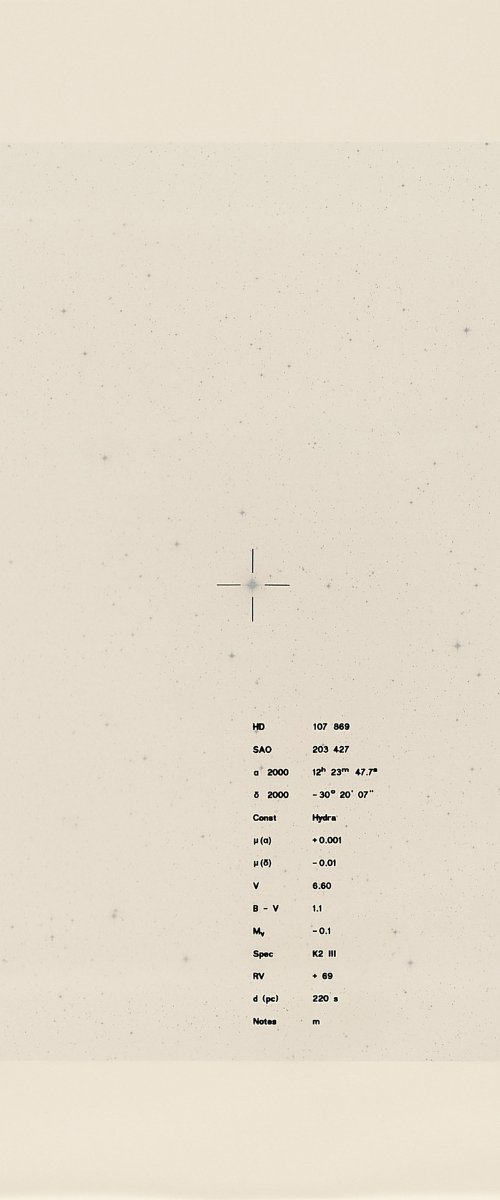
In 1989, Ruff began his Stars series, buying more than 1,000 negatives of the night sky from the European Southern Observatory in Chile. He enlarged and reoriented them into a new body of work made without ever using a camera himself.
Prints across every process
Ruff's photographs are produced as large-format prints. He has worked with analogue negatives, digital manipulation, found press images and, more recently, computer-generated forms, always tying the printing method to the questions raised by each series.
His work has been exhibited at the Whitechapel Gallery, the National Portrait Gallery in London and Haus der Kunst in Munich. He continues to work from a shared studio in Düsseldorf.
Wolfgang Tillmans
Biography
About Thomas Ruff
Thomas Ruff was born in 1958 in Germany's Black Forest. He studied at the Kunstakademie Düsseldorf from 1977 to 1985, under the photographers Bernd and Hilla Becher, alongside Andreas Gursky, Candida Höfer and Thomas Struth.
Faces at a monumental scale
Ruff's Portraits series, made between 1981 and 1991, shows friends and colleagues with a flat, neutral expression, printed at a scale that makes every pore and blemish visible. His photograph, Portrait (T. Bernstein), was mounted directly onto Plexiglas at two metres tall, to heighten the strange intimacy of studying a stranger's face at close range.
In 1989, Ruff began his Stars series, buying more than 1,000 negatives of the night sky from the European Southern Observatory in Chile. He enlarged and reoriented them into a new body of work made without ever using a camera himself.
Prints across every process
Ruff's photographs are produced as large-format prints. He has worked with analogue negatives, digital manipulation, found press images and, more recently, computer-generated forms, always tying the printing method to the questions raised by each series.
His work has been exhibited at the Whitechapel Gallery, the National Portrait Gallery in London and Haus der Kunst in Munich. He continues to work from a shared studio in Düsseldorf.
Wolfgang Tillmans